Origami/Techniques/Yoshizawa-Randlett system
Many origami books begin with a description of basic origami techniques which are used to construct the models. The folds are normally described using the Yoshizawa-Randlett diagramming system. There are two main types of origami symbol, lines and arrows.[1] The arrows show how the paper is bent or moved. Lines show various types of edges:
- A thick line for the edge of the paper
- A dashed line for a valley fold
- A dashed and dotted line for mountain folds (there may be one or two dots per dash depending on the author)
- A thin line for a previous fold
- A dotted line for a previous fold that's hidden, or sometimes a fold that's not yet made.
Paper representation
-
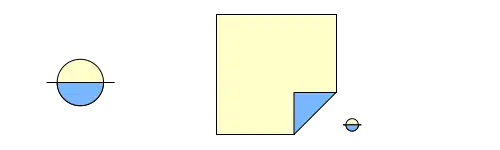 Side color
 -
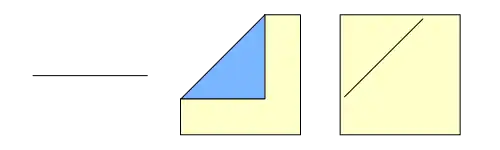 Crease
 -
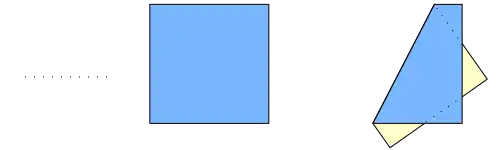 Invisible line
Operations
-
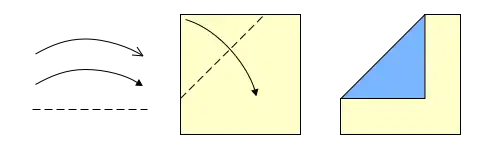 Valley fold
 -
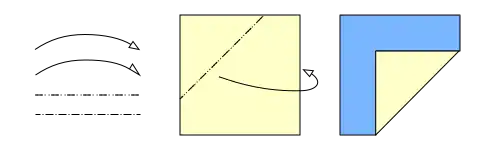 Mountain fold
 -
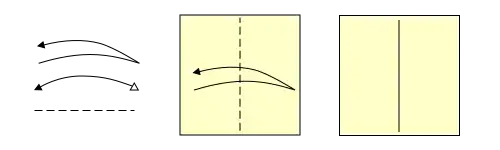 Fold and unfold valley
 -
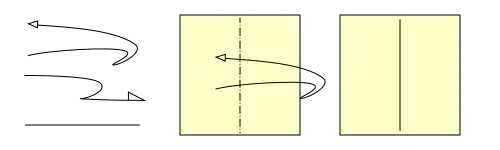 Fold and unfold mountain
 -
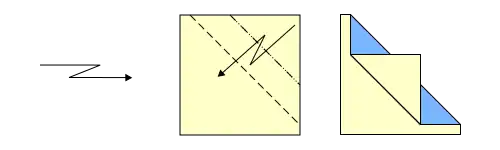 Pleat fold
 -
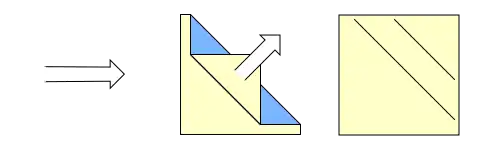 Pull
Pull -
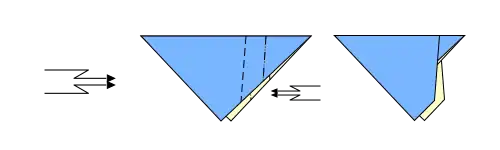 Inside crimp fold
 -
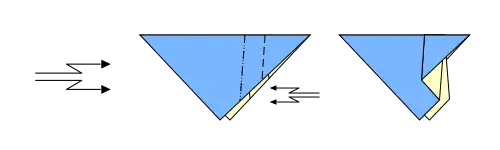 Outside crimp fold
 -
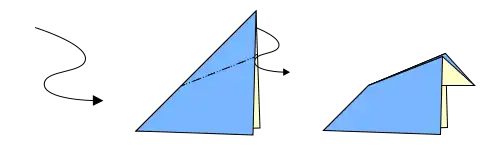 Inside reverse fold
 -
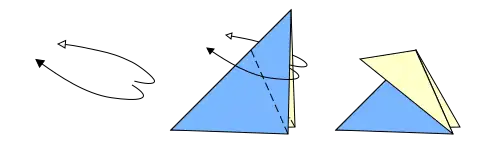 Outside reverse fold
 -
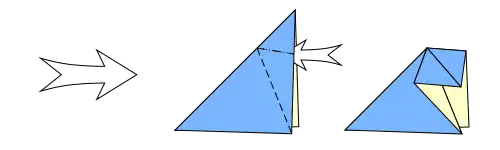 Open
Open -
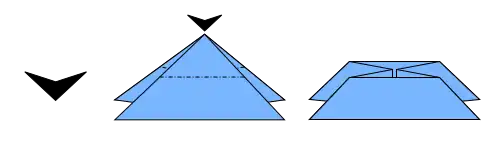 Sink
Sink -
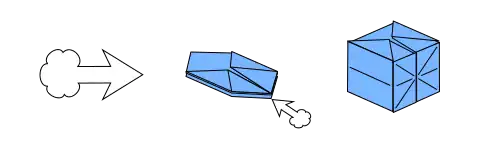 Inflate
 -
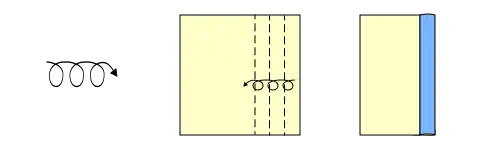 Roll
Roll -
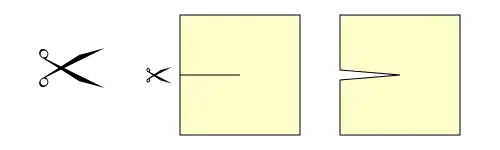 Cut
Cut -
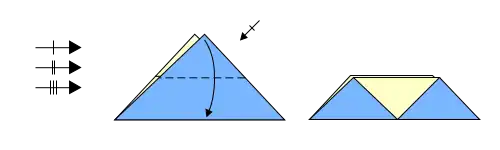 Repeat action
View
-
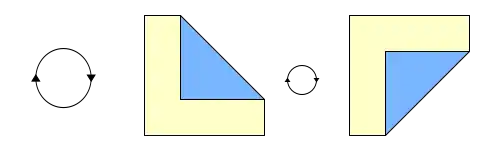 Rotate
 -
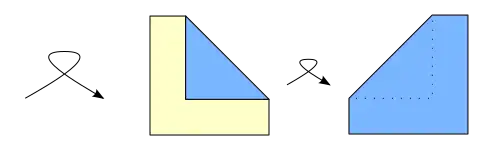 Turn over
 -
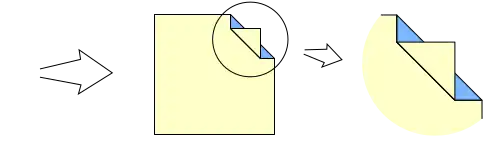 Zoom in
 -
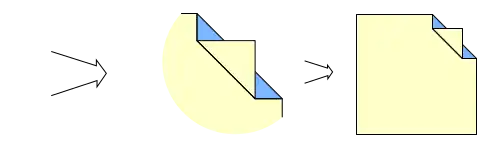 Zoom out
There are some symbols that have been used by some authors but are not accepted into the Yoshizawa-Randlett system. Robert Lang has introduced a “view from here” symbol that looks like an eye which has proven to be very useful, especially with his signature three-dimensional models.
-
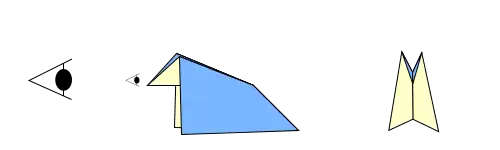 View from here
Several different methods have been introduced to point out to the folder to pay attention to a certain spot; these range from a letter or number to a circle, dot, or other geometric symbol.