Quarter-Tone Harmony/Chords
If chords can be altered by semitone in conventional theory, then there can also exist chords that are altered quartertonally. Such chords can still have use in conventional progressions.
Of course, this is not to mention quartertonal chords that are useful outside of conventional contexts.
Triadic Alterations
Where alterations of a semitone are made to conventional chords, alterations by one or three quarter tones can also be made instead.
The common use of the term "altered chord" refers to a minor or major triad with the alteration in the fifth; this gives us five new chords via quartertonal alteration:

Note that the minor triad with the fifth altered by three quarter tones (C - E♭ - G ) is not present, since the interval between E♭ and G (or rather, E♭ and A
 ) is a semi-augmented fourth, and is too large to be considered a third.
It it also possible to alter the root of conventional chords, either up or down by a quarter tone, giving us eight new chords:

This gives us thirteen total forms:

Note that chord 8 is the same as chord 10 transposed a semitone higher, and chord 9 is the same as chord 11 transposed a semitone higher.
Case Study: Neapolitan Chords
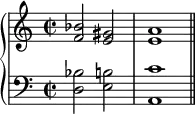
A good use of quartertonally-altered chords exists in the Neapolitan sixth chord (the first inversion of ♭II).
Consider the purpose of a Neapolitan sixth chord. In A minor, a typical iio-V-i progression would look like this:
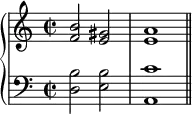
(B diminished, E major, A minor)
Replacing the iio chord with a Neapolitan sixth chord simply involves altering the B by a semitone to B♭:
We can, however, alter the B only by a quarter tone into B, which looks like this:
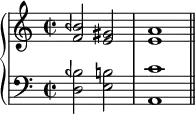
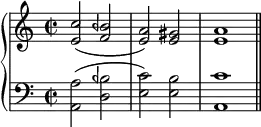
Interestingly, this B lies exactly between A and C, the root and third of the i chord (A minor), so we can arrange i chords on either side of this altered chord to emphasize this motion:
The Neutral Chord
An interesting case of triadic quartertonal modulation is the neutral chord, which can be identified as a major triad with the third lowered by a quarter tone or as a minor triad with the third raised by a quarter tone.

Further still, it can be identified as a major chord with the root and fifth raised, or as a minor chord with the root and fifth lowered.
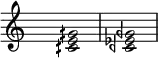
Whereas both the major and minor triads consist of one major third and one minor third, the neutral chord consists only of two stacked neutral thirds.
This not only introduces many harmonic possibilities, but it also implies the existence of higher-order neutral chords (seventh chords, ninth chords, etc.) produced by stacking more neutral thirds, which themselves contain interlocking chains of perfect fifths:
