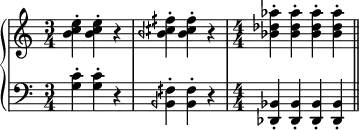
Quarter-Tone Harmony/Modulations
With twelve new notes comes twenty-four new keys, twelve major and twelve minor. Key signatures can be made to accomodate these new keys, but they will not be used for the sake of brevity.
Importantly, the keys made by the new notes don't share any notes with any conventional key. This means that if we want to modulate from a conventional key to a new key (or vice versa), then, in the words of Wyschnegradsky:
…a progression of modulation passages by means of transitory chords will not bring us any closer to the key to which we want to modulate. To do such a modulation, the progresion must move suddenly from the chord of a semitone scale to a chord of the quarter-tone scale (or vice versa).
Simple Modulations
Modulations from a conventional key to a new key are smoothest when all voices move by a single quarter tone, rather than three or five:
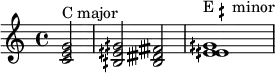
All notes in the C major chord individually move up or down in single quartertones: the C to B , the E to E, and the G to G. This produces an E minor triad in second inversion, which is closed properly with a cadential progression to establish the key of E minor.
Such modulations can be called simple quartertonal modulations, or simply simple modulations.
Here are some promising examples of simple modulations by Wyschnegradsky in four parts, filling in the gaps using conventional theory:
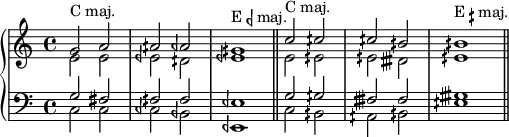
In many cases, to great effect, the bass note may jump more than a quarter tone so as to put the chords on either side of the modulation in root position. For instance, in both of these examples, the bass note moves by nine quarter tones (a supermajor third) in either direction, which establishes the destination key much faster:

Possible Modulations
For any set of notes in the conventional system (although this still applies if there are notes outside of it), a simple quartertonal modulation occurs when every note moves either up or down a quarter tone. Each note can only go in one of two directions; therefore, for a set of notes, there are possible destinations for a simple quartertonal modulation:


- Dyads can modulate to four other dyads because .
- Triads can modulate to eight other triads because .
- Four-note chords (sixth chords, seventh chords, etc.) can modulate to sixteen other triads because .


Consider a C major triad. It is a triad, and therefore it has eight possible destinations. Here they are with some respelling:

- C major triad
- C major triad with a ♭5, or F
 half-diminished seventh chord on C (without A)
 - C minor triad
- C diminished triad
- E minor triad on B
- C
 suspended triad
 - C augmented triad
- C major triad
Here's the same analysis for a C minor triad:

- C minor triad
- C diminished triad
- C suspended second triad
- D dominant seventh chord on C (without A)
- C augmented triad
- C major triad
- G major triad on B
- C minor triad
Generalization
Only considering chords without quartertonal intervals, let us use a temporary notation for triads that will make analyzing triadic simple modulations much easier.
A triad , is a triad where the interval between the first and second notes is semitones large and the interval between the second and third notes is semitones large. For instance, the minor triad is notated 3,4, the major triad is notated as 4,3. This will become very useful for naming triads that have no defined name in conventional theory, but please note that this notation only accounts for the chord type and does not care for the chord's root.


We can then re-interpret simple quartertonal modulations as transformations on these numbers. Now consider all possible simple modulations on a triad ,:
- Up, up, up: No intervals change, so the transformation can be notated as 0,0.
- Up, up, down: Only interval changes; it is compressed by one semitone, so the transformation can be notated as 0,-1.
- Up, down, up: Interval is compressed by a semitone whereas interval is stretched by a semitone, so the transformation can be notated as -1,+1.
- Up, down, down: Only interval changes; it is compressed by one semitone, so the transformation can be notated as -1,0.
- Down, up, up: Only interval changes; it is stretched by one semitone, so the transformation can be notated as +1,0.
- Down, up, down: Interval is stretched by a semitone whereas interval is compressed by a semitone, so the transformation can be notated as +1,-1.
- Down, down, up: Only interval changes; it is stretched by one semitone, so the transformation can be notated as 0,+1.
- Down, down, down: No intervals change, so the transformation can be notated as 0,0.
With this, we can see what transformations are possible and how many possible modulations will achieve them. Two modulations do not change the chord type whereas the six other modulations compress or stretch at least one interval by a semitone in varying combinations.
Pivots
It's also possible to modulate by altering a note or notes in a typical chord in a progression by a quarter tone. These altered tones then act as "pivots," shifting the rest of the progression by a quarter tone. These modulations are not nearly as smooth as simple modulations, but are far more flexible, since they can be tactfully inserted into any typical progression.
This example by Wyschnegradsky starts in D major, and then features a Neapolitan chord with its root E♭ shifted up by a quarter tone to E, forcing the rest of the progression up a quarter tone to D major.
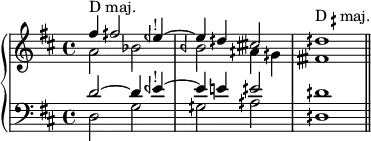
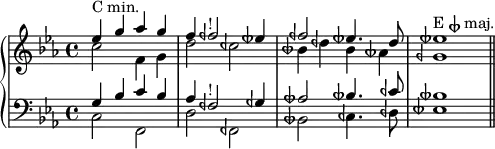
Combined with conventional modulations, quartertonal modulations can end up in quite exotic destinations, as in this custom example. This example starts in C minor, going to the iio chord, D diminished. The third of that chord, F, is flattened to F, at which point it suddenly transforms into the root of a different chord. This chord (F minor without the third) acts as the ii of E major, and it is closed off as such with a ii-V-I progression.
Chromatic Passages
Where the free use of quartertonal chords and harmonies (those outside of the conventional system) is acceptable, chromatic progressions where independent lines move steadily by quarter tones make for good modulations between tonalities:
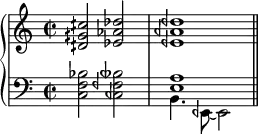
This presents excellent opportunity to use the quartertonal contrary motion property (see Concepts#Contrary Motion):