Problem 1
|
Let  be i.i.d. random variables with moment generating function be i.i.d. random variables with moment generating function ![{\displaystyle M(t)=E[\exp(tX_{1})]}](../4fd20edbefdfa5dcf02fe4770254e59772771c76.svg) which is finite for all which is finite for all  . Let . Let  . .
(a) Prove that
![{\displaystyle P[X_{1}>a]\leq exp[-h(a)]}](../4ab97bd1cb8a3bdad78edaeebd04774181befc99.svg) where where
![{\displaystyle h(a)=\sup _{t\geq 0}[at-\psi (t)]}](../2fc0957e736fdf3f37f1734347eca3bc8f59d319.svg) and and 
(b) Prove that
![{\displaystyle P[{\tilde {X}}_{n}\geq a]\leq \exp[-nh(a)]}](../8a9be333edd9d5b1247055e866342d5d21f9cb31.svg) . .
(c) Assume ![{\displaystyle E[X_{1}]=0}](../b559f6bfca3f6ec901504b5a925be71f6ec5ab38.svg) . Use the result of (b) to establish that . Use the result of (b) to establish that  almost surely. almost surely.
|
Solution
(a)
![{\displaystyle {\begin{aligned}P[X_{1}>a]=&\int _{X_{1}>a}1\,dF=\int _{X_{1}>a}{\frac {\exp(ta)}{\exp(ta)}}\,dF\\=&e^{-at}\int _{X_{1}>a}e^{at}\,dF\leq e^{-at}\int _{X_{1}>a}e^{X_{1}t}\,dF\\\leq &e^{-at}\int _{\Omega }e^{X_{1}t}\,dF=e^{-at}E[\exp(tX_{1})]\end{aligned}}}](../4a45d27554424ae95b3b6d271d8d7067d3e8075d.svg)
Thus far, we have not imposed any conditions on . So the above inequality will hold for all , hence for the supremum as well, which gives us the desired result.
(b)
![{\displaystyle {\begin{aligned}P[{\tilde {X}}_{n}>a]=&\int _{{\tilde {X}}_{n}>a}1\,dF=\int _{{\tilde {X}}_{n}>a}{\frac {\exp(nta)}{\exp(nta)}}\,dF\\=&e^{-nat}\int _{\sum _{i=1}^{n}X_{i}>an}e^{nat}\,dF\leq e^{-nat}\int _{\sum _{i=1}^{n}X_{i}>an}e^{\sum _{i=1}^{n}X_{i}t}\,dF\\\leq &e^{-nat}\int _{\Omega }e^{\sum _{i=1}^{n}X_{i}t}\,dF=e^{-nat}(\int _{\Omega }e^{X_{i}t}\,dF)^{n}\end{aligned}}}](../5f6673721e7ff6a75c8014069030daf6599b4d21.svg) where the last equality follows from the fact that the
where the last equality follows from the fact that the  are independent and identically distributed.
(c)
Problem 2
Solution
Problem 3
|
Let  be independent homogeneous Poisson processes with rates be independent homogeneous Poisson processes with rates  , respectively. Let , respectively. Let  be the time of the first jump for the process be the time of the first jump for the process 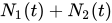 and let and let  be the random index of the component process that made the first jump. Find the joint distribution of be the random index of the component process that made the first jump. Find the joint distribution of  . In particular, establish that . In particular, establish that  are independent and that is exponentially distributed. are independent and that is exponentially distributed.
|
Solution
Show is exponentially distributed
Let  be the first time that a Poisson process
  jumps.

is a Poisson Process with parameter 
Proof: There are three conditions to check:
(i)  almost surely
(ii) For  is
is  independent of
  ? This is true since both
  are Poisson Processes and are both independent of each other.
(iii) For is distributed Poisson with parameter  ?
This is true since the sum of independent Poisson processes are also poison. (see second bullet)
?
This is true since the sum of independent Poisson processes are also poison. (see second bullet)
Joint distribution of (J,Z)


Problem 4
Solution
Problem 5
Solution
Define 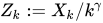 . Then
 ![{\displaystyle E[Z_{k}]=0}](../b37e6f3fdad585cd559814ff9c64966b8d1a98eb.svg) and
and ![{\displaystyle V[Z_{k}]={\frac {\sigma ^{2}}{k^{2\gamma }}}}](../87bd11acb36973f9c58035329b3cd1c85f6aeeda.svg) . We check the three components of Kolmogorov's three-series theorem to conclude that
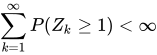
. We check the three components of Kolmogorov's three-series theorem to conclude that  converges almost surely.
![{\displaystyle \sum _{k=1}^{\infty }E[Z_{k}1_{|Z_{k}|\leq 1}]<\infty }](../20bff55ee5446a811478ed016ea27b153bf98188.svg)
![{\displaystyle \sum _{k=1}^{\infty }V[Z_{k}1_{|Z_{k}|\leq 1}]<\infty }](../a7d401b5f580d0b5d7b6d02054431ce9f237d7fa.svg)
Problem 6
|
Consider the following process  taking values in taking values in  . Assume . Assume  is an i.i.d. sequence of positive integer valued random variables and let is an i.i.d. sequence of positive integer valued random variables and let  be independent of the be independent of the  . Then . Then

|
Solution


![{\displaystyle E[(X-E(X|{\mathcal {G}}_{2}))^{2}]\leq E[(X-E(X|{\mathcal {G}}_{1}))^{2}].}](../21647b4feb219e5859f287cb7aa88e27a196eac4.svg)


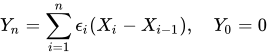

![{\displaystyle E[X_{i}]=0}](../f4c9e03e40d46499fafe6c167817d5fd76abbcc2.svg)
![{\displaystyle V[X_{i}]=\sigma ^{2}<\infty }](../45ff904b256655850c9801ec0742968a58ea00f6.svg)

