Holy Face of Lucca

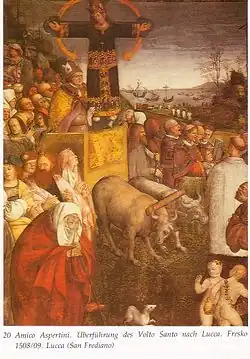
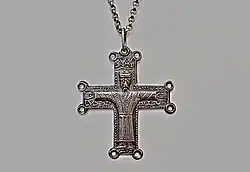
The Holy Face of Lucca (in Italian: Volto Santo di Lucca) is an eight-foot-tall ancient wooden carving of Jesus crucified in the cathedral of San Martino, Lucca, Italy. Medieval legends state that it was sculpted by Nicodemus who assisted St. Joseph of Arimathea in placing Christ in his tomb after the crucifixion. The same legends placed its miraculous arrival in Lucca to AD 782.
Radiocarbon dating of both wood and canvas places it between 770–880 AD, which corresponds to the Legend of Leobino according to which the Holy Face arrived in Lucca from Palestine in 782 (another copy says 742).
The Holy Face is located in the free-standing octagonal Carrara marble chapel (the tempietto or "little temple"), which was built in 1484 by Matteo Civitali, the sculptor-architect of Lucca, to contain it. The tempietto stands in the left-hand aisle of the cathedral of San Martino in Lucca.
Quotes
- By the Holy Face of Lucca.
- customary oath of king William II of England, as reported by Eadmer and William of Malmesbury
- That the simulacrum of Christ Crucified known as the Holy Face (which Dante also wanted to touch in his Poem) is very ancient is beyond doubt; all its characteristics, which we will discuss below, are those of an image of great antiquity and, in the opinion of many, of a Byzantine image. Although explicit records show that it did not appear in Lucca Cathedral until the 12th century, and coins bearing its image cannot be traced back beyond the 13th century, according to numismatists, however, from these documents it can be argued that it existed long before, and there are many reasonable inferences that demonstrate that its transfer to Lucca dates back to the end of the 8th century.
- Che il simulacro di Cristo Crocifisso detto il Santo Volto (di cui anche Dante volle toccar nel Poema) sia molto antico, non è da porsi in dubbio; tutti i suoi caratteri, di cui diremo in appresso, son quelli d'un'imagine di grande antichità, e per quanto a molti sembra, di una imagine bizantina. E sebbene per memorie esplicite non apparisca nella Cattedrale lucchese che nel secolo XII, e le monete in che vedesi la sua effigie non debbansi riportare, per asserto dei numismatici, al di là del secolo XIII, da tali documenti però se ne può argomentare una lunga preesistenza, e son molte le ragionevoli induzioni che si recarono a dimostrare che il suo trasporto in Lucca risale al finir del secolo VIII.
- Enrico Ridolfi (1828-1909), L'arte in Lucca studiata nella sua cattedrale, pp. 135-136.
- Che il simulacro di Cristo Crocifisso detto il Santo Volto (di cui anche Dante volle toccar nel Poema) sia molto antico, non è da porsi in dubbio; tutti i suoi caratteri, di cui diremo in appresso, son quelli d'un'imagine di grande antichità, e per quanto a molti sembra, di una imagine bizantina. E sebbene per memorie esplicite non apparisca nella Cattedrale lucchese che nel secolo XII, e le monete in che vedesi la sua effigie non debbansi riportare, per asserto dei numismatici, al di là del secolo XIII, da tali documenti però se ne può argomentare una lunga preesistenza, e son molte le ragionevoli induzioni che si recarono a dimostrare che il suo trasporto in Lucca risale al finir del secolo VIII.
See also
External links