Israeli–Palestinian conflict
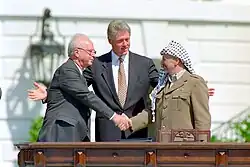

The Israeli–Palestinian conflict is an ongoing military and political conflict about land and self-determination within the territory of the former Mandatory Palestine. Key aspects of the conflict include the Israeli occupation of the West Bank and Gaza Strip, the status of Jerusalem, Israeli settlements, borders, security, water rights, the permit regime, Palestinian freedom of movement, and the Palestinian right of return.
Quotes
- No one ever thought that 140,000,000 Americans would become the hands of the Jews ... Arabs! Rise as one and fight for your sacred rights. Kill the Jews wherever you find them. This pleases God, history, and religion. This saves your honor. God is with you.
- Haj Amin al-Husseini, the Mufti of Jerusalem, and head of the Palestinian Arab Higher Committee, Quoted in Joseph B. Schechtman, The Mufti and the Fuhrer (1965) p. 150
- The truth is that if Israel were to put down its arms there would be no more Israel. If the Arabs were to put down their arms there would be no more war.
- Benjamin Netanyahu, Israeli prime minister. Speech at the Knesset (the Israeli Parliament) at the end of the 2006 Israel-Lebanon conflict. (August 14 2006). [1]
- This will be a war of extermination and a momentous massacre which will be spoken of like the Mongolian massacres and the Crusades."
- Abdul Rahman Hassan Azzam Pasha, Secretary General of the Arab League, in anticipation of victory over the new Jewish state in 1948 by the five invading Arab armies. This quote is described by Isi Leibler (1972) and mentioned in letters to the New York Times in 15 October 1951, and 28 August 1958.
- I declare a holy war, my Muslim brothers! Murder the Jews! Murder them all!
- Haj Amin al-Husseini, the Mufti of Jerusalem, and head of the Palestinian Arab Higher Committee, Quoted in Joseph B. Schechtman, The Mufti and the Fuhrer
- "Our forces are now entirely ready not only to repulse the aggression, but to initiate the act of liberation itself, and to explode the Zionist presence in the Arab homeland. The Syrian army, with its finger on the trigger, is united....I, as a military man, believe that the time has come to enter into a battle of annihilation."
- After the withdrawal of the UNEF, the Voice of the Arabs radio station proclaimed (May 18 1967): "As of today, there no longer exists an international emergency force to protect Israel. We shall exercise patience no more. We shall not complain any more to the UN about Israel. The sole method we shall apply against Israel is total war, which will result in the extermination of Zionist existence."
- After the withdrawal of the UNEF during the Six Day War waiting period, the Voice of the Arabs radio station (May 18 1967), Quoted in Isi Leibler, The Case For Israel, p. 60.
- "We will not enter Palestine with its soil covered in sand. We will enter it with its soil saturated in blood."
- Pressident Nasser March 18, 1965, Quoted in Howard Sachar, A History of Israel: From the Rise of Zionism to Our Time, p. 616.
- There will be no Jewish survivors in the holy war for liberating Palestine
- Ahmad Shukeiri Leader of the PLO during the Six Day War waiting period, Quoted in The Times June 8 1967 newspaper
- We owe a responsibility not only to those who are in Israel but also to those generations that are no more, to those millions who have died within our lifetime, to Jews all over the world, and to generations of Jews to come. We hate war. We do not rejoice in victories. We rejoice when a new kind of cotton is grown, and when strawberries bloom in Israel.
- Israeli prime minister Golda Meir, As quoted in As Good as Golda : The Warmth and Wisdom of Israel's Prime Minister (1970) edited by Israel Shenker and Mary Shenker, p. 28
- We are working with our allies to prevent conflict in the Middle East. The peace treaty between Egypt and Israel is a notable achievement which represents a strategic asset for America and which also enhances prospects for regional and world peace. We are now engaged in further negotiations to provide full autonomy for the people of the West Bank and Gaza, to resolve the Palestinian issue in all its aspects, and to preserve the peace and security of Israel.
- Jimmy Carter, James Earl Carter, Jr.'s Third State of the Union Address
- I know the difference between the world as we wish it to be and the world as it is. The world as it is, is a divided Palestinian people, a place that allows rockets to be launched from apartment buildings, a place for a mosques are weapon storage sites, a place where school children are taught hate -- that's the world as it is.
- Lindsey Graham, Speech to the American Israel Public Affairs Committee, delivered 22 March 2010
- We are destined to live together, on the same soil in the same land. We, the soldiers who have returned from battle stained with blood, we who have seen our relatives and friends killed before our eyes, we who have attended their funerals and cannot look into the eyes of their parents, we who have come from a land where parents bury their children, we who have fought against you, the Palestinians. We say to you today in a loud and clear voice: Enough of blood and tears. Enough.
We have no desire for revenge. We harbor no hatred towards you. We, like you, are people who want to build a home, to plant a tree, to love, live side by side with you in dignity, in empathy, as human beings, as free men. We are today giving peace a chance and again saying to you in a clear voice: Enough.
- The state of Israel will promote the development of the country for the benefit of all its inhabitants; will be based on precepts of liberty, justice and peace taught by the Hebrew prophets; will uphold the full social and political equality of all its citizens without distinction of race, creed or sex; will guarantee full freedom of conscience, worship, education and culture; will safeguard the sanctity and inviolability of shrines and holy places of all religions; and will dedicate itself to the principles of the Charter of the United Nations.
- First Israeli Prime Minister David Ben-Gurion, Israel's Proclamation of Independence, read on (14 May 1948)
- There are monsters among us. Every day I read about an American “plan” to either invade some place new or to otherwise inflict pain to convince a “non-compliant” foreign government how to behave. [...] Just as often, one learns about a new atrocity by Israelis inflicted on the defenseless Arabs just because they have the power to do so. Last Friday in Gaza the Israeli army shot and killed four unarmed demonstrators and injured 300 more while the Jewish state’s police invaded a Palestinian orphanage school in occupied Jerusalem and shut it down because the students were celebrating a “Yes to peace, no to war” poetry festival. Peace is not in the Israeli authorized curriculum.
- The history of the Israeli-Palestinian conflict is the history of two societies in extreme distress: anyone who speaks only of the anguish of the Israelis is not telling the whole truth, nor is anyone who speaks only of the misery of the Palestinians...More than anything, we must understand that this was not a battle of strength against strength, but of weakness against weakness; throughout the whole Arab-Israeli conflict, each side has felt itself to be far weaker than its opponent, and acted accordingly. We must understand that there was no "Jewish justice," as Golda Meir said in one of her less sterling moments, nor was there "Arab justice," a claim that also has proponents; rather, there were two deep traumas, on which a completely new life, a different world, new hope must be built.
- Shulamith Hareven "No One Asked the Medics" in The Vocabulary of Peace: Life, Culture, and Politics in the Middle East (1995)
- Here we stand before you, men who fate and history have sent on a mission of peace to end once and for all 100 years of bloodshed. Our dream is also your dream -- King Hussein, President Mubarak, Chairman Arafat, all the others, and, above [all], assisting us, President Bill Clinton -- a President who is working in the service of peace. We all love the same children, weep the same tears, hate the same enmity, and pray for reconciliation. Peace has no borders.... My brother Jews speak through the media to you [of] thousands of years of exile. And the dream of generations have returned us to our historic home in the land of Israel -- the land of the Prophets. Etched on every vineyard, every field, every olive tree, every flower is the deep imprint of the Jewish history; of the Book of the books that we have bequeathed to the entire world; of the values of morality and of justice. Every place in the land of the Prophets, every name is an integral part of our heritage of thousands of years of the divine promise to us and to our descendants. Here, is where we were born. Here, is where we created a nation. Here, we forged a haven for the persecuted and built a model of a democratic country. But we are not alone here on this soil, in this land. And so we are sharing this good earth today with the Palestinian people in order to choose life. Starting today, an agreement on paper will be translated into reality on the ground. We are not retreating. We are not leaving. We are building -- and we are doing so for the sake of peace. Our neighbors, the Palestinian people, we who have seen you in your difficulties, we saw you for generations; we who have killed and have been killed are walking beside you now toward a common future, and we want you as a good neighbors.
- I find that no other question so much reminds me of F. Scott Fitzgerald and his aphorism about the necessity of living with flat-out contradiction. Do I sometimes wish that Theodor Herzl and Chaim Weizmann had never persuaded either the Jews or the gentiles to create a quasi-utopian farmer-and-worker state at the eastern end of the Mediterranean? Yes. Do I wish that the Israeli air force could find and destroy all the arsenals of Hezbollah and Hamas and Islamic Jihad? Yes. Do I think it ridiculous that Viennese and Russian and German scholars and doctors should have vibrated to the mad rhythms of ancient so-called prophecies rather than helping to secularize and reform their own societies? Definitely. Do I feel horror and disgust at the thought that a whole new generation of Arab Palestinians is being born into the dispossession and/or occupation already suffered by their grandparents and even great-grandparents? Absolutely, I do.
- Christopher Hitchens, "Can Israel survive for another 60 years?," 12 May 2008, Slate.com
- I came here tonight to talk about the agreement and security that are broad consensus within Israeli society. This is what guides our policy. This policy must take into account the international situation. We have to recognize international agreements but also principles important to the State of Israel. I spoke tonight about the first principle - recognition. Palestinians must truly recognize Israel as the state of the Jewish people. The second principle is demilitarization. Any area in Palestinian hands has to be demilitarization, with solid security measures. Without this condition, there is a real fear that there will be an armed Palestinian state which will become a terrorist base against Israel, as happened in Gaza. We do not want missiles on Petah Tikva, or Grads on the Ben-Gurion international airport. We want peace.
- My friends, while Israel will be ever vigilant in its defense, we will never give up on our quest for peace. I guess we’ll give it up when we achieve it. Israel wants peace. Israel needs peace. We’ve achieved historic peace agreements with Egypt and Jordan that have held up for decades.
- Israeli Prime Minister Benjamin Netanyahu, Speech before a joint session of the United States Congress, May 24, 2011
- In the midst of wanton aggression we call upon the Arab inhabitants of the state of Israel' to return to the ways of peace and play their part in the development of the state, with full and equal citizenship and due representation in all its bodies and institutions, provisional or permanent.
- First Israeli Prime Minister David Ben-Gurion, Israel's Proclamation of Independence, read on (14 May 1948)
- I urge the Israeli authorities to abide by the laws governing armed conflict, including the proportionate use of force. I call on them to exercise maximum restraint in the conduct of military operations. I likewise urge Hamas and other militant groups to stop the indiscriminate launching of rockets and mortars from highly populated civilian neighbourhoods into civilian population centres in Israel, also in clear violation of international humanitarian law. Densely populated civilian areas must not be used for military purposes.
- Antonio Guterres, Secretary-General’s Remarks to the General Assembly Meeting on the Situation in the Middle East and Palestine, United Nations Secretary-General, Statements, (May 20, 2021)
- We do not believe in might; we believe in right, only in right. And that is why our aspiration, from the depths of our hearts, from time immemorial until this very day, is peace.
- Israeli Prime Minister Menachem Begin, Speech to the Knesset with Anwar Sadat, Egypt's president
- The Arabs had lost Palestine, it was a catastrophe, a nakba, as it became known. Several hundred thousand Palestinians had to flee, within the country or into neighboring countries. Palestinians felt they were being made to atone for Europe’s sin of the Holocaust by sacrificing their own land. They took the keys to their houses with them and never gave up on the idea of returning home one day. But in 1967, during six days of war, the Arabs lost more land: Gaza, the West Bank, East Jerusalem, including the walled old city that is home to Al-Aqsa mosque, as well as Egypt’s Sinai and Syria’s Golan Heights. Jerusalem was under Jewish rule again for the first time in two millennia. Across the Arab and Muslim world, there was disbelief, shock, and tears. Arabs had put their faith in nationalism and in Egypt’s president, Gamal Abdel Nasser. Just a few years prior, in 1956, Nasser had emerged victorious from a war for control over Egypt’s Suez Canal, staring down not only the French and the British but also Israel. The charismatic nationalist had become a hero for millions across the Arab world. How could he have lost this time? Perhaps, some people thought, God had forsaken Muslims; perhaps a return to religion was the answer.
- Kim Ghattas, Black Wave: Saudi Arabia, Iran, and the Forty-Year Rivalry That Unraveled Culture, Religion, and Collective Memory in the Middle East (2020)
- The peace agreements with Egypt and Jordan are vital. But they’re not enough. We must also find a way to forge a lasting peace with the Palestinians. Two years ago, I publicly committed to a solution of two states for two peoples: A Palestinian state alongside the Jewish state.
- Israeli prime minister Benjamin Netanyahu, Speech before a joint session of the United States Congress, May 24, 2011
- Not there's no Holocaust, let say they exaggerated the Holocaust. We don't say many people...but they say there's Holocaust but they are exaggerating, so there's such perception of this event of this title, the Holocaust, in our region...It's not the matter how many were killed, six million or one million, or half...killing is killing, I mean how many Soviets were killed? eight million, so why didn't we talk about them? the problem is not how many were killed. How do they do use it? what do the Palestinians have to do to the Holocaust to pay the price? This is one question we asked...We know that there was massacre against Jewish and against others...what's going on in Palestine we see it the same way, but you don't see it the same way...
- Bashar al-Assad, Interview with Charlie Rose, (2006)
- We offer peace and amity to all neighboring states and their peoples, and invite them to co-operate with the independent Jewish nation for the common good of all. The state of Israel is ready to contribute its full share to the peaceful progress and reconstitution of the Middle East.
- First Israeli Prime Minister David Ben-Gurion, Israel's Proclamation of Independence, read on (14 May 1948)
- So now here is the question. You have to ask it. If the benefits of peace with the Palestinians are so clear, why has peace eluded us? Because all six Israeli Prime Ministers since the signing of Oslo accords agreed to establish a Palestinian state. Myself included. So why has peace not been achieved? Because so far, the Palestinians have been unwilling to accept a Palestinian state, if it meant accepting a Jewish state alongside it.
- Israeli Prime Minister Benjamin Netanyahu, Speech before a joint session of the United States Congress, May 24, 2011
- If you want to see the picture, you have to see whole picture, if you talked about violence, let's talk about 4000 Palestinians killed during the last five years while from Israeli side a few hundreds killed, So if you want to talk about the violence and you called this violence "terrorism" Israel kills more, more Palestinian than Palestinian kills on Israel, Second, You have to see both sides. You talk about Hamas, what they did in Israel but don't talk about Israel and what they did in Palestinian Territories.
- Bashar al-Assad, Interview with Charlie Rose, (2006)
- Jews strove throughout the centuries to go back to the land of their fathers and regain statehood. In recent decades, they returned in their masses. They reclaimed a wilderness, revived their language, built cities and villages, and established a vigorous and ever-growing community, with its own economic end cultural life. They sought peace, yet were ever prepared to defend themselves. They brought blessings of progress to all inhabitants of the country.
- First Israeli Prime Minister David Ben-Gurion, Israel's Proclamation of Independence, read on (14 May 1948)
- Israelis and Palestinians live on the same piece of land namely; Palestine that is located between the River Jordan and the Mediterranean. This is a disputed land. In 1948 the majority of the population, three quarters of the population were Palestinians. Less than a quarter of the population were Israelis. They managed to expel the Palestinians from their homes and unilaterally declared a state called Israel. This is inadmissible under international law. No one can legally declare a state on a disputed territory.
- And so reborn Israel always strove for peace, yearned for it, made endless endeavors to achieve it. My colleagues and I have gone in the footsteps of our predecessors since the very first day we were called by our people to care for their future. We went any place, we looked for any avenue, we made any effort to bring about negotiations between Israel and its neighbors, negotiations without which peace remains an abstract desire.
- Israeli Prime Minister Menachem Begin, Noble Peace Prize Speech
- Make no mistake, this is a science: with every violent victory of the Zionist occupation army over the Palestinian resistance, the Zionists take one step closer to their own annihilation. The Palestinians, by following the example which the West has proudly placed before the world, of the much-celebrated terrorism against German occupation in World War II on the part of the French Resistance, and the "partisans" of eastern Europe, have brought untold grief and misery to their people.
- Michael Hoffman, Judaism Discovered: A Study of the Anti-Biblical Religion of Racism, Self-Worship, Superstition and Deceit (2008)
- Peace is the beauty of life. It is sunshine. It is the smile of a child, the love of a mother, the joy of a father, the togetherness of a family. It is the advancement of man, the victory of a just cause, the triumph of truth. Peace is all of these and more and more.
- Israeli Prime Minister Menachem Begin, Noble Peace Prize Speech
- We salute the Palestinian people of heroic mujahideen as well as every hero and heroine amongst the champions of self-sacrifice who confront the Zionist aggression with their lives and thus foil the wrong ideas of the American administrations which have acted in alliance with their artificial Zionist creation in the crimes they perpetrate and the shame they reap.
- Saddam Hussein, speech commemorating 82nd anniversary of the Iraqi Armed Forces, 6 January 2003
- I believe there is no time to waste; we need to move toward peace with a sense of urgency and with a sense of purpose. I want to make this clear: My goal is not to have endless negotiations. My goal is not negotiations for the sake of negotiations. My goal is to achieve a permanent peace treaty between Israel and the Palestinians.
- Israeli Prime Minister Benjamin Netanyahu, Speech to the Jewish Federations of North America, as quoted in "Netanyahu Calls for More Peace Talks" CBS News (November 9, 2009)
- The ICC’s chief prosecutor, Fatou Bensouda, said last month that there was a “reasonable basis” to open a war crimes probe into Israeli military actions in the Gaza Strip as well as Israeli settlement construction in the West Bank...she recently told The Times of Israel that accusing her of anti-Semitism was “particularly regrettable” and “without merit... I, along with my Office, execute our mandate under the Rome Statute with utmost independence, objectivity, fairness and professional integrity. We will continue to meet our responsibilities as required by the Rome Statute without fear or favor,” she said
- Like all Israelis, I yearn for peace. I see the utmost importance in taking all possible steps that will lead to a solution of the conflict with the Palestinians
- Israeli Prime Minister Ariel Sharon, in an interview with the BBC.
- Right and wrong are the same in Palestine as anywhere else. What is peculiar about the Palestine conflict is that the world has listened to the party that has committed the offence and has turned a deaf ear to the victims.
- Arnold J. Toynbee. Forward to The Transformation of Palestine. Northwestern University Press, USA, 1971.