Vector and its opposite vector
If there is a vector  then its opposite vector is
  . The opposite vector has the same magnitude as vector's magnitude but with opposite in direction . Opposite vector of vector B is
Sum and difference of 2 vectors


Dot product of two vectors
Definitioɲ
The scalar product or inner product or dot product of two vectors is defined as

where
ː is the angle between the two vectors (see Figure 2(b)).
If  and
and  are perpendicular to each other,
  and
and  . Therefore,
  .
.
The dot product therefore has the geometric interpretation as the length of the projection of onto the unit vector  when the two vectors are placed so that they start from the same point.
The scalar product leads to a scalar quantity and can also be written in component form (with respect to a given basis) as

If the vector is  dimensional, the dot product is written as
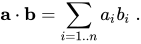
Using the Einstein summation convention, we can also write the scalar product as

Dot product identities
 (commutative law).
 (distributive law).
Cross product of two vectors
Definition
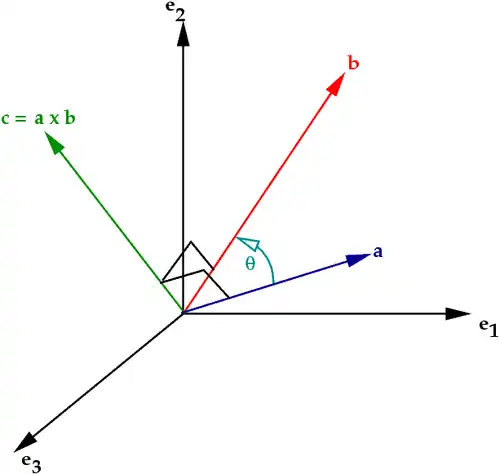
The vector product (or cross product) of two vectors and is another vector  defined as

where
ː is the angle between and , and  is a unit vector perpendicular to the plane containing and in the right-handed sense (see Figure 3 for a geometric interpretation)
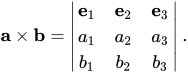
In terms of the orthonormal basis  , the cross product can be written in the form of a determinant
In index notation, the cross product can be written as

where  is the Levi-Civita symbol (also called the permutation symbol, alternating tensor). This latter expression is easy to remember if you recognize that xyz, yzx, and zxy are "positive" and the others are negative: xzy, yxz, zyx.
If  , then



Indentities







The rest of this resource has been moved to Vector calculus.