Introduction
In the following lesson, we first make an identification of the complex numbers  with the two-dimensional
  -vector space
  , then we consider the classical real partial derivatives and the Jacobian matrix, and investigate the relationship between complex differentiability and partial derivatives of component functions of a map from to . After that, the Cauchy-Riemann differential equations are proven based on these preliminary considerations.
Identification of Complex Numbers with
Let  .
Since the mapping
.
Since the mapping  is bijective, the inverse mapping :
  maps
vectors from one-to-one back to a complex number.
maps
vectors from one-to-one back to a complex number.
Real and Imaginary Part Functions
Now, if we decompose a function  with
with  into its real and imaginary parts with real functions
  ,
,  where
where  and
and  , then the total derivative of the function
  has the following Jacobian matrix as its representation: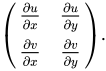
Task
For the complex-valued function
 , give the mappings
  with
with  explicitly.
Evaluation of the Jacobian Matrix at a Point
The evaluation of the Jacobian matrix at a point 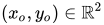 gives the total derivative at the point
  :
:
Cauchy-Riemann Differential Equations
A function  is complex differentiable at
  if and only if it is real differentiable and the Cauchy-Riemann differential equations hold for with , where : :
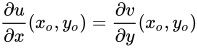 :
: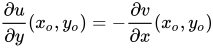 are satisfied.
Relationship Between the Partial Derivatives
In the following explanations, the definition of differentiability in to properties of the partial derivatives in the Jacobian matrix.
Part 1
If the following limit exists for  at
at  with
with  open: :
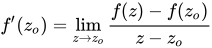 , then for any sequences
  in the domain with
  , we also have: :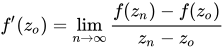
Part 2
Now consider only the sequences for the two following limit processes with  : :
: : , :
, : ,
,
Part 3: Limit Process for Real Part
By inserting the component functions for the real and imaginary parts , we get with : : ::
:: ::
::
Part 4: Limit Process for Imaginary Part
Applying this to the second equation, we get with : : ::
:: ::
:: ,
,

In the first summand, the fraction is extended by  , and in the second summand , the is canceled so that the denominator becomes real-valued and
  corresponds.
Part 5: Comparison of Real and Imaginary Parts
By equating the terms from (3) and (4) and comparing the real and imaginary parts, we obtain the Cauchy-Riemann differential equations.
- Real part:
- Imaginary part:
Part 6: Partial Derivative in the Direction of the Real Part
The partial derivatives in of the Cauchy-Riemann differential equations can also be expressed in with  ,
,  ,
,  , and .
 ,
, ,
, .
.
Part 7: Partial Derivative in the Direction of the Imaginary Part
The partial derivatives in of the Cauchy-Riemann differential equations can also be expressed in with , , , and .
 ,
, ,
, .
.
Part 8: Cauchy-Riemann DGL with Functions in
The partial derivatives of the Cauchy-Riemann differential equations can also be expressed in with 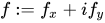 ,
,  ,
,  :
Real part:
:
Real part: 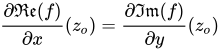 Imaginary part: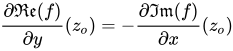
Theorem - Cauchy-Riemann DGL
Let  be an open subset. The function
  is complex differentiable at a point
  . Then, the partial derivatives of
  and
and  exist at
  , and the following Cauchy-Riemann differential equations hold:

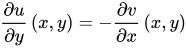
In this case, the derivative of  at the point
  can be represented in two ways using the component functions and :
 The proof of the Cauchy-Riemann differential equations uses a comparison of the real and imaginary parts to derive the above equations.
Proof
The proof considers two directional derivatives:
- (DG1) the derivative in the direction of the real part and
- (DG2) the derivative in the direction of the imaginary part.
Since these coincide for complex differentiability, the Cauchy-Riemann differential equations are obtained by setting them equal and comparing the real and imaginary parts.
Step 1 - Derivative in the Direction of the Real Part
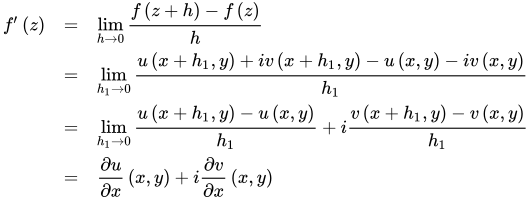
In the first step, let  converge to 0 in the direction of the real part. To achieve this, choose
  with
with  . The decomposition of the function into its real part
  and imaginary part
  then yields (DG1).
Step 2 - Calculation of the Derivative - Real Part
Step 3 - Derivative in the Direction of the Imaginary Part
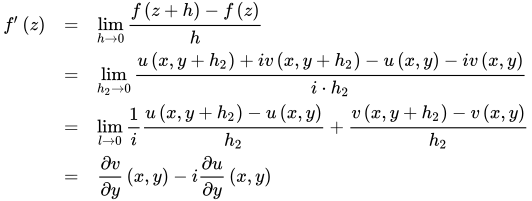
Similarly, the partial derivative for the imaginary part can be considered with  and
and  . This yields equation (DG2).
Step 4 - Calculation of the Derivative - Imaginary Part
Step 5 - Equating the Derivatives
By equating the two derivatives, one can compare the real and imaginary parts of the two derivatives (DG1) and (DG2):

Step 6 - Comparison of Real and Imaginary Parts
Two complex numbers are equal if and only if their real and imaginary parts are equal. This results in the Cauchy-Riemann differential equations. The two representation formulas follow from the above equation and the Cauchy-Riemann equations.
See also
Page Information
You can display this page as
Wiki2Reveal slides
Wiki2Reveal
TheWiki2Reveal slides were created for the Complex Analysis'
and the Link for the Wiki2Reveal Slides was created with the link generator.
Translation and Version Control
This page was translated based on the following Wikiversity source page and uses the concept of Translation and Version Control for a transparent language fork in a Wikiversity:
https://de.wikiversity.org/wiki/Cauchy-Riemann-Differentialgleichungen