Theorem
Let  be an open subset. Let the function
  be differentiable at a point
  . Then all partial derivatives of
  and
and  exist at
  and the following Cauchy-Riemann equations hold:

In this case, the derivative of  at
at  can be represented by the formula

Proof
The proof can be decomposed into 3 main steps:
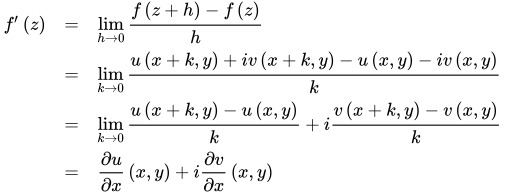
- calculate the partial derivative for the real part,
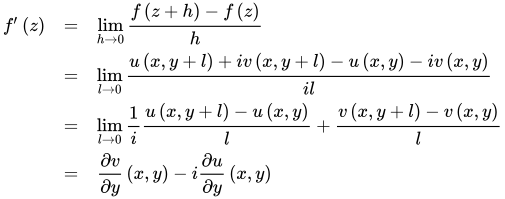
- calculate the partial derivative for the imaginary part,
- due to property of being complex differentiable both derivatives yield the same complex value. This leads to Cauchy-Riemann equations.
Proof - Step 1
Let  . Then
Proof - Step 2
Let  . Then
Proof - Step 3
Both partial derivatives must provide a same complex value due to the fact that is complex differentiable:

Proof - Step 4
Equating the real and imaginary parts, we get the Cauchy-Riemann equations. The representation formula follows from the above line and the Cauchy-Riemann equations.
See also
Page Information
You can display this page as Wiki2Reveal slides
Wiki2Reveal
The Wiki2Reveal slides were created for the Complex Analysis' and the Link for the Wiki2Reveal Slides was created with the link generator.