Cognitive Drive Architecture/Course Summary and Synthesis
11.1. Purpose of the Course
This course introduced Cognitive Drive Architecture (CDA) as a structural, domain-independent framework for modeling effort and engagement in cognitive systems. Grounded in Lagunian Dynamics, CDA shifts the understanding of Drive from vague motivational traits to formally defined internal variables interacting within a system equation. Its central goal is to explain how effort arises, when it breaks down, and how it can be realigned, not by boosting motivation, but by structurally configuring the system that supports it.
11.2. Key Concepts Recap
| Core Element | Summary |
|---|---|
| Lagunian Dynamics | Foundational theory modeling cognitive effort as the output of real-time variable interaction |
| Drive Equation | |
| Ignition Domain | Variables: Primode (ignition gate), CAP (volitional amplifier) |
| Tension Domain | Variables: Flexion (task adaptability), Anchory (focus stability), Grain (friction) |
| Flux Domain | Variable: Slip (systemic entropy/variability) |
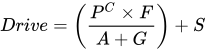
These variables are designed to be observable, testable, and alterable, allowing real-time diagnosis and adjustment of engagement conditions.
11.3. Failure Modes and Configuration Patterns
CDA offers a non-pathologizing model of effort breakdown, reinterpreting struggles as system misconfigurations:
| Failure Mode | Primary Misconfiguration | Typical Outcome |
|---|---|---|
| Start Failure | Primode = 0 | No initiation despite desire |
| Motivated Stall | CAP ↑, Flexion ↓ | Urgency without movement |
| Drift Collapse | Anchory ↓, Grain ↑ | Focus dissolves mid-task |
| Resistance Spiral | Flexion ↓ + repeated failures | Cyclical disengagement |
| Entropy Drag | Slip ↑↑ | High variability; inconsistent output |
Understanding these patterns enables compassionate, structural intervention rather than reliance on discipline or motivation.
11.4. Applications by Domain
CDA has practical uses across disciplines:
| Domain | Example Use |
|---|---|
| Education | Scaffold Flexion and Primode to reduce disengagement |
| Therapy | Address behavioral avoidance via Grain/Anchory modeling |
| Interface Design | Lower Grain by simplifying flow; boost Anchory with layout stability |
| Coaching | Track system variability; stabilize routines to reduce Slip |
Even low-tech implementations (Module 9) can yield significant insights using simple logs, cues, or environmental scaffolds.
11.5. Research Opportunities
CDA is designed to be empirically testable, not just theoretically elegant:
- Operationalize core variables via physiological or behavioral measures
- Test Drive Equation predictions in controlled contexts
- Integrate CDA with motivational, executive function, and attentional models
- Validate Slip as a structured, non-random source of variability
This positions CDA as both a practical tool and a scientific hypothesis ready for falsification and refinement.
11.6. Learning Objectives Revisited
By completing this course, learners should now be able to:
- Understand and interpret the Drive Equation
- Recognize failure modes as structural, not personal
- Apply CDA across contexts (education, therapy, design, coaching)
- Use low-tech strategies to self-monitor and scaffold Drive
- Design or interpret empirical studies testing CDA’s predictions
- Rethink effort and inconsistency through a system configuration lens
11.7. Continuing Exploration
Suggested next steps for learners:
- Track a week of tasks using a Drive Log
- Identify a personal “Start Failure” and test a Primode scaffold
- Redesign one task to increase Flexion or reduce Grain
- Share CDA with a colleague or client to map a breakdown nonjudgmentally
- Draft a mini-case study on how Slip impacts your own productivity
11.8. Course Closing Statement
Cognitive Drive Architecture reimagines effort not as a trait, not as discipline, and not as motivation, but as a system configuration problem. It gives us a new lens to interpret engagement, failure, and volatility without shame, blame, or mystification.
Whether you’re a student, educator, therapist, designer, or researcher, CDA offers a way to understand action, or inaction, with precision and humanity.
The next version of this model will be shaped not just by data, but by the lived experiences of those who apply it. Your logs, reflections, failures, and insights are part of that evolution.