Introduction
The Cauchy integral theorem is one of the central results of Complex Analysis. It exists in various versions, and in this article, we aim to present a basic one for convex regions and a relatively general one for nullhomologous cycles.
For Convex Regions
Statement
Let  be a convex region, and let
  be a closed
rectifiable curve
Trace of Curve in
be a closed
rectifiable curve
Trace of Curve in  . Then, for every holomorphic function
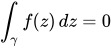
  , the following holds:
Proof 1: Antiderivatives of f
First, we observe that  has a antiderivative in . Fix a point
  . For any point
  , let
, let ![{\displaystyle [z_{0},z]}](../708c2843c4b0a4e214ec36e8dc3200fa284356da.svg) denote the straight-line segment connecting
denote the straight-line segment connecting  and
and  as path.
Proof 2: Definition of the Antiderivative
Define  by:
by:
![{\displaystyle F(z):=\int _{[z_{0},z]}f(\zeta ),d\zeta }](../95b1b2e45a5ad1b34800d9823281ea6bb5ac47aa.svg) .
.
Due to the convexity of , the triangle  with vertices
  lies entirely within for
  .
.
Proof 3: Application of Goursat’s Lemma
By Goursat's Lemma for the boundary  of a triangle
  with vertices
  , we have:
![{\displaystyle {\begin{array}{rl}0&=\int _{\partial \Delta }f(z)\,dz\\&=\int _{[z_{0},z]}f(\zeta )\,d\zeta -\int _{[z_{0},w]}f(\zeta )\,d\zeta +\int _{[z,w]}f(\zeta )\,d\zeta \\&=F(z)-F(w)+\int _{[z,w]}f(\zeta )\,d\zeta \end{array}}}](../731f234fc9fc27bfc602b41ecb9844b503544b41.svg)
Proof 4: Conclusion Using Goursat's Lemma
This leads to:
![{\displaystyle {\begin{array}{rl}F(z)-F(w)&=\int _{[w,z]}f(\zeta )\,d\zeta \\&=\int _{0}^{1}f{\bigl (}w+t(z-w){\bigr )}\cdot (z-w)\,dt\\&=\underbrace {\int _{0}^{1}f{\bigl (}w+t(z-w){\bigr )}\,dt} _{A(z):=}\cdot (z-w)\end{array}}}](../6b4b7ffc3b49845241a239960a805ce0303c35f1.svg)
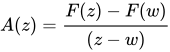
Thus, we have:
Proof 5: Limit Process
Since  is continuous in
  , taking the limit as
  gives:

Proof 5: Differentiability of 
Therefore,  is continuous, and is differentiable in
  , with:

Since was arbitrary, we conclude  , proving that has a antiderivative.
Proof 6: Path Integration
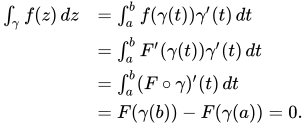
Now, let ![{\displaystyle \gamma \colon [a,b]\to G}](../601c8522053a766d00a46f49a8541fb058509f02.svg) be a piecewise continuously differentiable, closed curve. Then:
be a piecewise continuously differentiable, closed curve. Then:
Proof 7:
Let be an arbitrary integration path in , and let  . As shown here, we choose a polygonal path
 ![{\displaystyle {\hat {\gamma }}\colon [a,b]\to \mathbb {C} }](../477f60a2cdbed9ad66b384d0f9053a15a1f39860.svg) such that
such that  ,
,  , and
, and
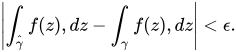
Since polygonal paths are piecewise continuously differentiable, the above result implies 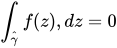 . Consequently,
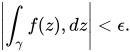
As was arbitrary, the claim follows.
For Cycles in Arbitrary Open Sets
In arbitrary open sets, one must ensure that cycles do not enclose singularities or poles in the complement of the domain. Enclosing such singularities may contribute a non-zero value to the integral (e.g., the function  and
and  in a domain
  . Even though is holomorphic in , the integral is not zero but
  (see nullhomologous cycle).
Statement
Let be open, and let  be a nullhomologous cycle in . Then, for every holomorphic function , the following holds:
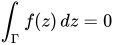
Proof
Let  , and define
  by
by

Then,  is holomorphic, and by the global integral formula, we have:

See Also
Page Information
You can display this page as Wiki2Reveal slides
Wiki2Reveal
The Wiki2Reveal slides were created for the Complex Analysis' and the Link for the Wiki2Reveal Slides was created with the link generator.
Translation and Version Control
This page was translated based on the following von Cauchy Wikiversity source page and uses the concept of Translation and Version Control for a transparent language fork in a Wikiversity: