The Identity Theorem is a statement about holomorphic functions, asserting that they are uniquely determined under relatively weak conditions.
Statement
Let  be a domain. For two holomorphic functions
  , the following are equivalent:
(1)  (i.e.,
  for all
  )
)
(2) There exists a  such that
  for all
  .
.
(3) The set { }has a limit point in
  .
.
Proof
By considering  , we may assume without loss of generality that
  . Equivalently, the proof is reduced to showing the following three statements:
- (N1)
 (i.e.,
  for all )
- (N2) There exists a such that
 for all .
- (N3) The zero set
 has a limit point in .
Proof Type
The equivalence is proven using a cyclic implication:

Proof (N1 to N2)
(N1)  (N2) is obvious, as all derivatives of the zero function
  are zero.
Proof (N2 to N3)
Assume (N2). Consider the power series expansion 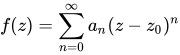 in
in  with
with  .
Here,
.
Here, 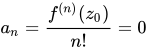 for all .
Thus,
for all .
Thus,  , and (N3) follows.
Proof (N3 to N1) – Contradiction Proof
The step (N3) (N1) is proven by contradiction. Assume the zero set has a limit point and is not the zero function.
Proof 1 - (N3 to N1) - Power Series Expansion at Limit Point
Assume (N3), i.e., the set  of zeros of has a limit point .
Thus, there exists a sequence
of zeros of has a limit point .
Thus, there exists a sequence  with
with  and
and  as well as
  for all . Let be the power series expansion of around
  .
.
Proof 2 - (N3 to N1) - Power Series Expansion
Suppose there exists with  . Due to the well-ordering property of
  , there would also be a smallest such
  . Then

Proof 3 - (N3 to N1) - Power Series Evaluation
For each  , we have

Proof 4 - (N3 to N1) - Limit Process
Since  and
and  , we get

As  for all
  as
as  . This contradicts . Therefore,
  for all , and hence for all , i.e., (N2) holds.
Proof 5 - (N3 to N1) - V is Closed
If (N2) holds, set  .
.
 is closed in as the intersection of closed sets, because the
  are continuous, and preimages of closed sets (here
  ) are closed.
Proof 6 - (N3 to N1) - V is Open
is also open in , as for every  , the power series expansion of around
  vanishes. Thus, is locally zero around . Since
  , is non-empty, and hence
  due to the connectedness of .
Proof 7 - From (N1)-(N3) to (1)-(3)
The statement of the Identity Theorem (1)-(3) follows for arbitrary  and
and  , by applying (N1)-(N3) to
  .
.
See Also
Page Information
This learning resource can be presented as a
Wiki2Reveal slides
Wiki2Reveal
The Wiki2Reveal slides were created for the Complex Analysis'
and the Link for the Wiki2Reveal Slides was created with the link generator.
Translation and Version Control
This page was translated based on the following Wikiversity source page and uses the concept of Translation and Version Control for a transparent language fork in a Wikiversity: