Definition
Let  be a domain and
  . If
. If 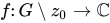 is a holomorphic function, then
  is called an isolated singularity of
  .
.
Classification
Depending on the behavior of in the neighborhood of , one distinguishes three different types of isolated singularities of .
Removable Singularities
If can be holomorphically extended to the entire domain  , then we say that is a removable singularity. According to the Riemann Removability Theorem, this is the case if is bounded in a neighborhood of .
Poles
If is not a removable singularity, but there exists an  such that
  has a removable singularity at , then we say that has a pole at . The smallest such
  is called the order of the pole.
Essential Singularities
If is neither removable nor a pole, then is called an essential singularity of .
Examples
- Since
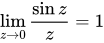 , the function
 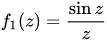 has a removable singularity at
  .
.
- The function
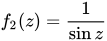 does not have a removable singularity at, since
 is unbounded at
  , but has a first-order pole at , because
  and
and 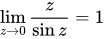 , which has a removable singularity at 0 .
- The function
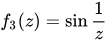 has an essential singularity at , since for every , the function
 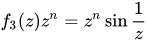 is unbounded in any neighborhood of . To see this, consider
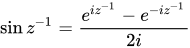 .For
.For  with
with  is also
  ,which diverges as
  .
.
Laurent Expansions
The type of isolated singularity can also be inferred from the Laurent Expansion of around . Let
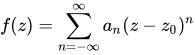
be the Laurent Series of around . We define
 .
.
Then, has the following singularities:
 , i.e., all negative coefficients vanish, the main part of the series is zero, and the singularity is removable.
 , i.e., only finitely many negative coefficients are nonzero, there is a pole of order
  .
.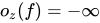 , i.e., infinitely many negative coefficients are nonzero, the singularity is essential.
Examples
Let us consider our three examples again:
- It is
 , so
, so  , a removable singularity.
- It is
 so
so  , a pole of first order.
- It is
 , so
, so  , an essential singularity.
Page information
Translation and Version Control
This page was translated based on the following Wikiversity source page and uses the concept of Translation and Version Control for a transparent language fork in a Wikiversity:
https://de.wikiversity.org/wiki/Kurs:Funktionentheorie/isolierte_Singularität