The residue theorem states, how to calculate the integral of a holomorphic function using its Residuals .
Statement
Let  be a holomorphic function in a region
  except for a discrete set of isolated singularities
  , and let
  be a null-homologous Chain in that does not intersect any point of
  . Then, the following holds:

Proof
The sum in the statement of the residue theorem is finite because can enclose only finitely many points of the discrete set of singularities.
Step 1 - Reduction to a finite number of summands
Let  be the points in for which
  . The singularities in that are not enclosed are denoted by
  .
.
Step 2 - Nullhomologous cycle
is assumed to be null-homologous in . By the definition of  ,is also null-homologous in
  .
.
Step 3 - Principal parts of the Laurent series
For the singularities  with
with  and
and  , let
, let
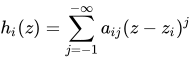
be the main part of the Laurent Expansion of around  . The function
  is holomorphic on
  .
.
Step 4 - Subtraction of principal parts
Subtracting all the principal parts corresponding to from the given function , we obtain
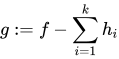
a function on that now has only removable singularities.
Step 5 - Holomorphic extension to
If the singularities are Isolated singularity on ,  can be extended holomorphically to all
  .
.
Step 6 - Application of Cauchy's integral theorem
By the Cauchy Integral Theorem for , we have
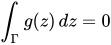
so, by the definition of ,
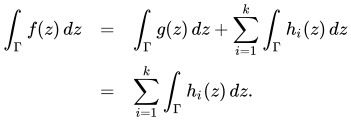
Step 7 - Calculation of integrals of the principal parts
The computation of the integral over reduces to computing the integrals of the principal parts for . Using the linearity of the integral, we have:
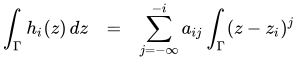
the terms  For
For  , have antiderivatives, so
 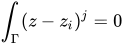 .
.
Step 8 - Calculation of integrals of the principal parts
Finally, the computation of the integrals of the principal parts yields, using the definition of the Winding number:
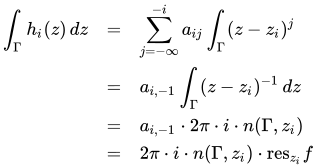
after.
Step 9 - Calculation of the integrals of the residues
Thus, the statement follows as:
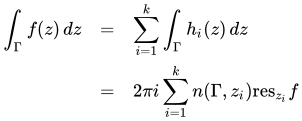
Questions about the residue theorem
- Let
 be a meromorphic function (i.e., holomorphic except for a discrete set of singularities in ). Why does the cycle enclose only finitely many poles?
Applications
The Zeros and poles counting integral counts the zeros and poles of a meromorphic function.
See also
Page Information
You can display this page as Wiki2Reveal slides
Wiki2Reveal
The Wiki2Reveal slides were created for the Complex Analysis' and the Link for the Wiki2Reveal Slides was created with the link generator.
Translation and Version Control
This page was translated based on the following Wikiversity source page and uses the concept of Translation and Version Control for a transparent language fork in a Wikiversity:
https://de.wikiversity.org/wiki/Kurs:Funktionentheorie/Residuensatz