The integral counting zeros and poles counts, as the name suggests, the zeros and poles of a meromorphic function along with their multiplicities. More precisely:
Zero of order n
Let  be open,
  a holomorphic function, and
  . The function
  has
has  a zero of order
  at if there exists a holomorphic function
  , such that:
 .
.
Pole of order n
Let be open,  a holomorphic function, and . The function has a pole of order at if there exists a holomorphic function , such that:
 .
.
Tasks
Let be open, a holomorphic function, and . Furthermore, let have a zero of order at .
Task 1: Zero of order n
Using the definition of the order of a zero, compute the expression for  :
:

Task 2: Zero of order n
Explain why for the term  , a neighborhood
  exists where
  has no singularities.
Task 3: Zero of order n
Explain why does not necessarily need to be defined on the entire set .
Task 4: Zero of order n
What can you conclude for the following integrals:
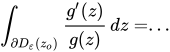
and

Task 5: Pole of order n
Apply the calculations and explanations to poles of order and compute the integrals:
and
Statement
Let be open, and  . Let
. Let  be the set of zeros and
  the set of poles of . Let
  be a Chain that encircles each zero and each pole of exactly once in the positive orientation Winding number , i.e.,
  for each
  . For , we set:

then
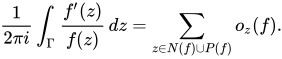
Proof
For each  , there exists a neighborhood
  and a holomorphic function
 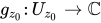 such that
  ,
,  , and
, and

holds.
Proof 1: Holomorphicity and Application of Residue Theorem
The integrand is holomorphic everywhere in  , except possibly at
 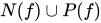 . By the Residue Theorem, it suffices to compute the residues of at the points of .
Proof 2: Residue for Zeros/Poles
Let . Differentiating  , we obtain:

Thus, for  near
near  :
:
 with
with
Proof 3: Application of Residue Theorem
The second term is holomorphic, so is a simple pole of  , and
, and
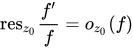
The claim follows by the Residue Theorem.
Page Information
You can display this page as Wiki2Reveal slides
Wiki2Reveal
The Wiki2Reveal slides were created for the Complex Analysis' and the Link for the Wiki2Reveal Slides was created with the link generator.
Translation and Version Control
This page was translated based on the following Wikiversity source page and uses the concept of Translation and Version Control for a transparent language fork in a Wikiversity:
https://de.wikiversity.org/wiki/Kurs:Funktionentheorie/Null-_und_Polstellen_zählendes_Integral