A convolution between two signals,  and
and  , is an operation defined as follows:

The process of convolution is very useful in the time domain analysis of systems, because we can fully describe a system by its impulse response. Let's consider the following system which operates on an input as  , having characterized its impulse response by
  :
:

![{\displaystyle y(t)=O[x(t)]}](./1bcbde6e2c8f6d1e70e8f56a8c69313b007db6fc.svg)

Put into other words, the output of a system in an instant  can be written as a linear combination of past and future instants of the input and its impulse response:
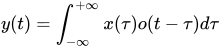
Discrete Convolution
In discrete time there is no continuous time but finite samples ![{\displaystyle x[n]}](./864cbbefbdcb55af4d9390911de1bf70167c4a3d.svg) .
.
So the integral can be rewritten as a sum:
![{\displaystyle (x*y)[m]=\sum _{n=-\infty }^{\infty }x[m-n]*y[n]}](./fa4e1a1fc29f530f66fabe0c320568805865d308.svg)
To understand the convolution of finite length signals better, let's look at an example with the signals ![{\displaystyle x=[1,2,3]}](./bd8ff4b392747a4cec746755bb92e34627d7610e.svg) and
and ![{\displaystyle y=[6,9]}](./39f49564b3d4d7667f108734bfd7d870b113a6c4.svg) .
.
[ 1] * [6 9] = ?

[ 6 12 18  0]    // [1 2 3] * 6
[ 0  9 18 27]    // [1 2 3] * 9
-------------
[ 6 21 36 27]    // sum of the above
Note that the length of the output signal has the length  where
where  is the length of
  and
and  the length of
  .
.