Proof
We do induction over
 ,
the base case is clear, so let
,
the base case is clear, so let
 .
The set of permutations
.
The set of permutations
 can be split up, by sorting along
  , and considering the bijective mappings
-

as a permutation  on
on 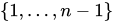 , by both sets in an order-preserving way with . This yields a bijection
 ,
where
,
where  denotes the set of permutations on
  which send
  to
to  . Between the signs, there is the relation
-

since we need  transpositions to put the -th place to the first place. Altogether, there is a natural bijection
-

Hence, we get
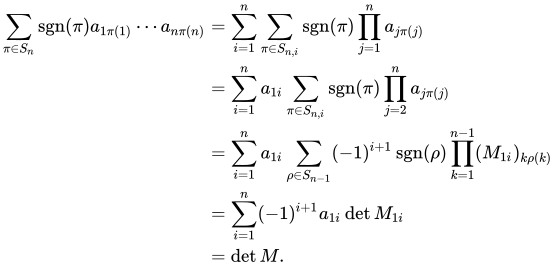
Here,  is the submatrix in which the first row and the -th column is omitted.
For the penultimate equation, we use the induction hypothesis, and the last equation rests on
Laplace expansion with respect to the first row.
is the submatrix in which the first row and the -th column is omitted.
For the penultimate equation, we use the induction hypothesis, and the last equation rests on
Laplace expansion with respect to the first row.