Overview
The w:four-momentum  is defined as the product of mass and w:four-velocity
  or alternatively can be obtained by integrating the four-momentum density
  with respect to volume V (the four-momentum density corresponds to components
  of the stress energy tensor combining energy density W and momentum density
  ). In addition, replacing rest mass with rest mass density
  in terms of rest volume
  produces the mass four-current
  in analogy to the electric four-current:
![{\displaystyle {\begin{matrix}{\begin{matrix}P^{\mu }&\underbrace {=mU^{\mu }=m\gamma \left(c,\mathbf {v} \right)=\left({\frac {E}{c}},\mathbf {p} \right)} &=\underbrace {{\frac {1}{c}}\int \int \int T^{\alpha 0}dV} \\&(a)&(b)\\P^{\mu }/V&\underbrace {={\frac {1}{c}}T^{\alpha 0}=\left({\frac {W}{c}},\mathbf {g} \right)} \\&(c)\\J^{\mu }&\underbrace {=\mu _{0}U^{\mu }=\mu \left(c,\mathbf {v} \right)} \quad \left[\partial \cdot J^{\mu }=0\right]\\&(d)\end{matrix}}\\\left[\gamma ={\frac {\mu }{\mu _{0}}}={\frac {V_{0}}{V}}={\frac {1}{\sqrt {1-{\frac {v^{2}}{c^{2}}}}}},\ m=\mu V=\mu _{0}V_{0}\right]\end{matrix}}}](../275b23004a5ae00feed32bcfffc4f67791bd2444.svg)
Without explicitly defining the four-momentum vector, the Lorentz transformation of all components of (a) was given by #Planck (1907), while the Lorentz transformation of all components of (c) were given by #Laue (1911-13). The first explicit definition of (a) was given by #Minkowski (1908), followed by #Lewis and Wilson (1912), #Einstein (1912-14), #Cunningham (1914), #Weyl (1918-19). Four-momentum density (c) played a role in the papers of #Einstein (1912-14) and #Lewis and Wilson (1912). The material four-current (d) was given by #Laue (1913) and #Weyl (1918-19).
Historical notation
Planck (1907)
After w:Albert Einstein gave the energy transformation into the rest frame in 1905 and the general energy transformation in May 1907, w:Max Planck in June 1907 defined the transformation of both momentum  and energy E as follows[R 1]

or simplifying in terms of enthalpy R=E+pV:[R 2]

and the transformations into the rest frame[R 3]
![{\displaystyle {\begin{matrix}E={\frac {c}{\sqrt {c^{2}-v^{2}}}}E_{0}^{\prime }+{\frac {q^{2}}{\sqrt {c^{2}-v^{2}}}}Vp_{0}^{\prime },\quad R={\frac {c}{\sqrt {c^{2}-v^{2}}}}R_{0}^{\prime },\quad G={\frac {q}{c^{2}}}R={\frac {q}{c{\sqrt {c^{2}-v^{2}}}}}R_{0}^{\prime }\\\left[{\mathfrak {G}}_{x}=G{\frac {\dot {x}}{q}},\ {\mathfrak {G}}_{x}=G{\frac {\dot {y}}{q}},\ {\mathfrak {G}}_{z}=G{\frac {\dot {z}}{q}}\right]\end{matrix}}}](../17f4b5cd88242980181b0cc0556dc7dd85935ea6.svg)
Even though Planck wasn't using four-vectors, his formulas correspond to the Lorentz transformation of four-vector ![{\displaystyle \left[c{\mathfrak {G}}_{x},c{\mathfrak {G}}_{y},c{\mathfrak {G}}_{z},R=E+pV\right]}](../713eb1923d6ad82487e14d0ac9da6ba83a44def6.svg) , becoming the ordinary four-momentum
, becoming the ordinary four-momentum ![{\displaystyle \left[c{\mathfrak {G}}_{x},c{\mathfrak {G}}_{y},c{\mathfrak {G}}_{z},E\right]}](../6a3adbe73ca34e0aaaa25297bddd26debe9ad49a.svg) by setting the pressure p=0.
by setting the pressure p=0.
Minkowski (1907-09)
In 1907 (published 1908) w:Hermann Minkowski defined the following continuity equation with  as rest mass density and w as four-velocity:[R 4]
![{\displaystyle {\begin{matrix}{\text{lor }}\nu {\overline {w}}={\frac {\partial \nu w_{1}}{\partial x_{1}}}+{\frac {\partial \nu w_{2}}{\partial x_{2}}}+{\frac {\partial \nu w_{3}}{\partial x_{3}}}+{\frac {\partial \nu w_{4}}{\partial x_{4}}}=0\\\left[{\text{lor }}=\left|{\frac {\partial }{\partial x_{1}}},\ {\frac {\partial }{\partial x_{2}}},\ {\frac {\partial }{\partial x_{3}}},\ {\frac {\partial }{\partial x_{4}}}\right|\right]\end{matrix}}}](../841d77b84a2dd0f4d55b0bdfc39a8467fd775ca1.svg)
which implies the mass four-current equivalent to (d).
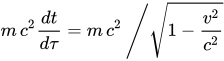
The first mention of four-momentum (a) was given by Minkowski in his lecture “space and time” from 1908 (published 1909), calling it "momentum-vector" (“Impulsvektor”) as the product of mass m with the motion-vector (i.e. four-velocity) at a point P[R 5]. He further noted that if the time component of four-momentum is multiplied by  it becomes the kinetic energy:
Laue (1911-13)
w:Max von Laue (1911) in his influential first textbook on relativity, gave the Lorentz transformation of the components of the symmetric “world tensor” T (i.e. stress energy tensor), with the l=ict components being energy flux  , momentum density
  , energy density W, and pointed out that the divergence of those l-components represents the energy conservation theorem (with A as power of the force density):[R 6]
![{\displaystyle {\begin{matrix}\left(T_{lx},T_{ly},T_{lz},T_{ll}\right)\Rightarrow \left({\frac {i}{c}}{\mathfrak {S}}_{x},\ {\frac {i}{c}}{\mathfrak {S}}_{y},\ {\frac {i}{c}}{\mathfrak {S}}_{z},\ -W\right)\\A+div{\mathfrak {S}}+{\frac {\partial W}{\partial t}}=0\\\hline {\begin{aligned}{\mathfrak {S}}_{x}&={\frac {\left(1+\beta ^{2}\right){\mathfrak {S}}_{x}^{\prime }+v\left(\mathbf {p} _{xx}^{\prime }+W^{\prime }\right)}{1-\beta ^{2}}}\\&={\frac {qc^{2}}{c^{2}-q^{2}}}\left(\mathbf {p} _{xx}^{0}+W^{0}\right)\end{aligned}},\ {\begin{aligned}{\mathfrak {S}}_{y}&={\frac {{\mathfrak {S}}_{y}^{\prime }+v\mathbf {p} _{xy}^{\prime }}{\sqrt {1-\beta ^{2}}}}\\&={\frac {qc}{c^{2}-q^{2}}}\mathbf {p} _{xy}^{0}\end{aligned}},\ {\begin{aligned}{\mathfrak {S}}_{z}&={\frac {{\mathfrak {S}}_{z}^{\prime }+v\mathbf {p} _{xz}^{\prime }}{\sqrt {1-\beta ^{2}}}}\\&={\frac {qc}{c^{2}-q^{2}}}\mathbf {p} _{xz}^{0}\end{aligned}},\ {\begin{aligned}W&={\frac {W'+\beta ^{2}\mathbf {p} _{xx}^{\prime }+2{\frac {v}{c^{2}}}{\mathfrak {S}}_{x}^{\prime }}{1-\beta ^{2}}}\\&={\frac {c^{2}W^{0}+q^{2}\mathbf {p} _{xx}^{0}}{c^{2}-q^{2}}}\end{aligned}}\\\left[{\mathfrak {g}}={\frac {\mathfrak {S}}{c^{2}}}\right]\end{matrix}}}](../5223e64b4463538f6c069062c65ce2ce17873fd8.svg)
which components correspond to four-momentum density (c) in case of vanishing pressure p, even though Laue didn't directly denoted it as a four-vector.
In the second edition (1912, published 1913), Laue discussed hydrodynamics in special relativity, defining the four-current of a material volume element in terms of rest mass density  and four-velocity Y, and its continuity equation:[R 7]
![{\displaystyle {\begin{matrix}M=k^{0}Y\\M_{x}={\frac {k{\mathfrak {q}}_{x}}{c}},\ M_{y}={\frac {k{\mathfrak {q}}_{y}}{c}},\ M_{z}={\frac {k{\mathfrak {q}}_{z}}{c}},\ M_{l}=ik\\Div\,M=k^{0}Div\,Y+\left(Y,\Gamma \varrho \alpha \delta \,k^{0}\right)=0\\\left[k^{0}=k{\frac {\sqrt {c^{2}-q^{2}}}{c}},\ Div={\text{four-divergence}},\ \Gamma \varrho \alpha \delta ={\text{four-gradient}},\ l=ict\right]\end{matrix}}}](../104578ea16df94fad08a356f840269dbf00272d7.svg)
equivalent to material four-current (d).
Lewis and Wilson (1912)
w:Edwin Bidwell Wilson and w:Gilbert Newton Lewis (1912) devised an alternative 4D vector calculus based on w:Dyadics which, however, never gained widespread support. They explicitly defined “extended momentum” (i.e. four-momentum)  and used it to derive the “extended force” (i.e. four force) together with
  as four-acceleration:[R 8]
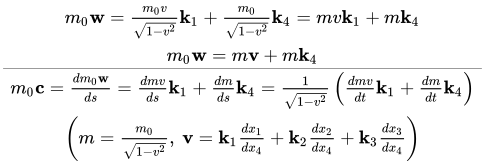
equivalent to (a). Using rest mass density , they also defined the extended vector[R 9]
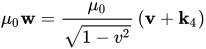
equivalent to the material four-current (d). Then they defined the four-momentum of radiant energy representing total momentum and energy per volume  by integrating electromagnetic energy density
  and the Poynting vector
  :[R 10]
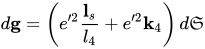
equivalent to (b). They added, however, that the corresponding energy density vector  is not a four-vector because it is not independent of the chose axis.
Einstein (1912-14)
In an unpublished manuscript on special relativity (written around 1912/14), w:Albert Einstein showed how to derive the components of the momentum-energy four-vector from the components  (four-momentum density) of the stress-energy tensor (overline indicates integration over volume,
  is four-velocity):[R 11]
![{\displaystyle {\begin{matrix}{\overline {T}}_{14}=ic{\overline {\mathfrak {g}}}_{1}=ic\int {\mathfrak {g}}_{x}dxdydz\\{\overline {T}}_{44}=-{\overline {\eta }}=-\int \eta \,dxdydz\\\left({\overline {\mathfrak {g}}}_{1},{\overline {\mathfrak {g}}}_{1},{\overline {\mathfrak {g}}}_{1},{\frac {i}{c}}{\overline {\eta }}\right)\Rightarrow {\frac {{\overline {\eta }}_{0}}{c}}\left(G_{\mu }\right)\\\hline {\overline {\mathfrak {g}}}={\frac {m{\mathfrak {q}}_{x}}{\sqrt {1-{\frac {q^{2}}{c^{2}}}}}},\ {\overline {\eta }}={\frac {mc^{2}}{\sqrt {1-{\frac {q^{2}}{c^{2}}}}}}\\\left[{\frac {{\bar {\eta }}_{0}}{c^{2}}}=m\right]\end{matrix}}}](../1fb78a5bd58ed228b574bb24d3e77c13d5f2d21e.svg)
equivalent to (a,b,c).
In the context of his Entwurf theory (a precursor of general relativity), Einstein (1913) formulated the following equations for momentum J and energy E using the metric tensor  , from which he concluded that momentum and energy of a material point form a “covariant vector” (i.e. covariant four-momentum), and also showed that the corresponding volume densities are equal to certain components of the stress-energy tensor
  (i.e. w:dust solution):[R 12]
![{\displaystyle {\begin{matrix}J_{x}=m{\frac {\partial H}{\partial {\dot {x}}}}=m{\frac {\dot {x}}{\sqrt {c^{2}-q^{2}}}},\ {\text{etc.}}\\E={\frac {\partial H}{\partial {\dot {x}}}}{\dot {x}}+{\frac {\partial H}{\partial {\dot {y}}}}{\dot {y}}+{\frac {\partial H}{\partial {\dot {z}}}}{\dot {z}}-H=m{\frac {c^{2}}{\sqrt {c^{2}-q^{2}}}}\\\hline J_{x}=-m{\frac {g_{11}{\dot {x_{1}}}+g_{12}{\dot {x_{2}}}+g_{13}{\dot {x_{3}}}+g_{14}}{\frac {ds}{dt}}}=-m{\frac {g_{11}dx_{1}+g_{12}dx_{2}+g_{13}dx_{3}+g_{14}dx_{4}}{ds}},\\-E=-\left({\dot {x}}{\frac {\partial H}{\partial {\dot {x}}}}+\cdot +\cdot \right)+H=-m\left(g_{41}{\frac {dx_{1}}{ds}}+g_{42}{\frac {dx_{2}}{ds}}+g_{43}{\frac {dx_{3}}{ds}}+g_{44}{\frac {dx_{4}}{ds}}\right)\\\hline {\frac {J_{x}}{V}}=-\varrho _{0}{\sqrt {-g}}\cdot \sum _{\nu }g_{1\nu }{\frac {dx_{\nu }}{ds}}\cdot {\frac {dx_{4}}{ds}}\\-{\frac {E}{V}}=-\varrho _{0}{\sqrt {-g}}\cdot \sum _{\nu }g_{4\nu }{\frac {dx_{\nu }}{ds}}\cdot {\frac {dx_{4}}{ds}}\\\left[\Theta _{\mu \nu }=\varrho _{0}{\frac {dx_{\mu }}{ds}}\cdot {\frac {dx_{\nu }}{ds}},\ \varrho _{0}={\frac {m}{V_{0}}}\right]\end{matrix}}}](../cf266984ceb9d7aa32b592d9898eec2ca4af68a0.svg)
equivalent to (a,b,c) in the case of being the Minkowski tensor.
In 1914 Einstein summarized his previous arguments using the covariant four-vector  (i.e. covariant four-momentum) and explicitly showed that in the case of being the Minkowski tensor it becomes the ordinary four-momentum of special relativity. He also argued in a footnote why (in terms of his theory of gravitation) this covariant four-momentum is preferable over the contravariant four-momentum
  :[R 13]
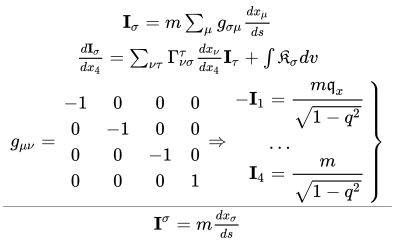
equivalent to (a).
Cunningham (1914)
Like Wilson and Lewis, w:Ebenezer Cunningham used the expression “extended momentum” (i.e. four-momentum), and derived the four-force from it:[R 14]
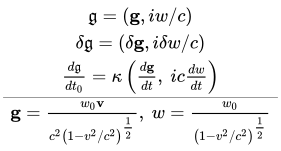
equivalent to (a, b).
Weyl (1918-19)
In the first edition of his book “space time matter”, w:Hermann Weyl (1918) defined the “material current” in terms of rest mass density and four-velocity, together with its continuity equation:[R 15]
![{\displaystyle {\begin{matrix}\mu _{0}u^{i}\\\sum _{i}{\frac {\partial \left(\mu _{0}u^{i}\right)}{\partial x_{i}}}=0\\\left[{\frac {dv}{dV}}=\mu ,\ {\frac {dm}{dV_{0}}}=\mu _{0},\ \mu _{0}=\mu {\sqrt {1-v^{2}}},\ dV=dV_{0}{\sqrt {1-v^{2}}}\right]\end{matrix}}}](../fcd570b4f341276701db16d7bd0157e9ed23390b.svg)
equivalent to (d).
In 1919, in the framework of general relativity, he expressed the pseudotensor density of total energy as  , with the integral
  (i.e. four-momentum) of
  (i.e. four-momentum density) in space
  = const. representing energy (i=0) and momentum (i=1,2,3). For an arbitrary coordinate system he defined is as the product of mass and four-velocity[R 16]

equivalent to (a,b,c).
In the third edition of his book (1919), the description of the material current remained the same as in the first edition,[R 17] but this time he also included a description of four-momentum in terms of four-momentum density :[R 18]
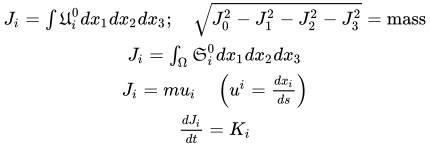
equivalent to (a,b,c).
References
- ↑ Planck (1907), eq. 28,29,33
- ↑ Planck (1907), eq. 28,31,34
- ↑ Planck (1907), eq. 43,45,46
- ↑ Minkowski (1907), p. 102
- ↑ Minkowski (1908), p. 85
- ↑ Laue (1911), p. 82ff, 184f
- ↑ Laue (1913), p. 230
- ↑ Lewis/Wilson (1911), p. 420, 444
- ↑ Lewis/Wilson (1911), p. 467
- ↑ Lewis/Wilson (1911), p. 478f
- ↑ Einstein (1912/14), p. 96f
- ↑ Einstein/Grossmann (1913), p. 227, 229, 232
- ↑ Einstein (1914), p. 1060, 1082
- ↑ Cunningham (1914), p. 162f
- ↑ Weyl (1918), p. 148
- ↑ Weyl (1918), p. 125-128
- ↑ Weyl (1919), p. 158
- ↑ Weyl (1919), p. 233-234, 257-259
- Cunningham, E. (1914), The principle of relativity, Cambridge: University Press
- Einstein, A. (1912–14), "Einstein's manuscript on the special theory of relativity", The collected papers of Albert Einstein, vol. 4, pp. 3–108
{{citation}}: CS1 maint: date format (link)
- Einstein, A. & Grossmann, M. (1913), "Entwurf einer verallgemeinerten Relativitätstheorie und eine Theorie der Gravitation", Zeitschrift für Mathematik und Physik, 62: 225–261
{{citation}}: CS1 maint: multiple names: authors list (link)
- Einstein, A. (1914), "Die Formale Grundlage der allgemeinen Relativitätstheorie", Berliner Sitzungsberichte, 1914 (2): 1030–1085
- Laue, M. v. (1911), Das Relativitätsprinzip, Braunschweig: Vieweg
- Laue, M. v. (December 1912), Das Relativitätsprinzip (2. Edition), Braunschweig: Vieweg (published 1913)
- Lewis, G. N. & Wilson, E. B. (1912), "The Space-time Manifold of Relativity. The Non-Euclidean Geometry of Mechanics and Electromagnetics", Proceedings of the American Academy of Arts and Sciences, 48: 387–507
{{citation}}: CS1 maint: multiple names: authors list (link)
- Minkowski, H. (1908) [1907], "Die Grundgleichungen für die elektromagnetischen Vorgänge in bewegten Körpern", Nachrichten von der Gesellschaft der Wissenschaften zu Göttingen, Mathematisch-Physikalische Klasse: 53–111
 See also the transcription Die Grundgleichungen für die elektromagnetischen Vorgänge in bewegten Körpern on German Wikisource
- See also the transcription The Fundamental Equations for Electromagnetic Processes in Moving Bodies on English Wikisource
- Minkowski, H. (1909) [1908], "Raum und Zeit", Physikalische Zeitschrift, 10: 75–88
- See also the transcription Raum und Zeit on German Wikisource
- See also the transcription Space and Time on English Wikisource
- Planck, M. (1907), "Zur Dynamik bewegter Systeme", Berliner Sitzungsberichte, Erster Halbband, 29: 542–570
Reprinted in: Planck, M. (1908) [1907], "Zur Dynamik bewegter Systeme", Annalen der Physik, 331 (6): 1–34
- See also the transcription Zur Dynamik bewegter Systeme on German Wikisource
- See also the transcription On the Dynamics of Moving Systems on English Wikisource
- Weyl, H. (March 1918), Raum-Zeit-Relativität, Berlin: Springer
- Weyl, H. (1919), "Eine neue Erweiterung der Relativitätstheorie", Annalen der Physik, 364 (10): 101–133
- Weyl, H. (1919), Raum-Zeit-Relativität (3. Auflage), Berlin: Springer