Overview
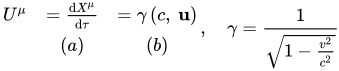
The w:four-velocity is defined as the rate of change in the w:four-position of a particle with respect to the particle's w:proper time  , while the derivative of four-velocity with respect to proper time is four-acceleration), and the product of four-velocity and mass is four-momentum. It can be represented as a function of three-velocity
  :
:
 .
.
Historical notation
Killing (1884/5)
w:Wilhelm Killing discussed Newtonian mechanics in non-Euclidean spaces by expressing coordinates (p,x,y,z), velocity v=(p',x',y',z'), acceleration (p”,x”,y”,z”) in terms of four components, obtaining the following relations:[M 1]
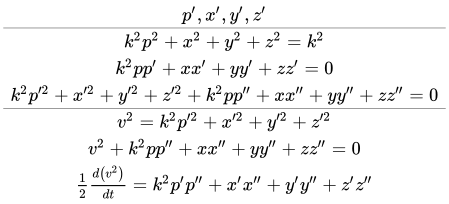
If the Gaussian curvature  (with k as radius of curvature) is negative the velocity becomes related to the hyperboloid model of hyperbolic space, which at first sight becomes similar to the relativistic four-velocity in Minkowski space by setting
  with c as speed of light. However, Killing obtained his results by differentiation with respect to Newtonian time t, not relativistic proper time, so his expressions aren't relativistic four-vectors in the first place, in particular they don't involve a limiting speed. Also the dot product of acceleration and velocity differs from the relativistic result.
Poincaré (1905/6)
w:Henri Poincaré explicitly defined the four-velocity as:[R 1]
 with
with 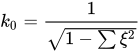
which is equivalent to (b) because
![{\displaystyle \left[\xi ,\eta ,\zeta \right]={\frac {\mathbf {u} }{c}},\ \Sigma \xi ^{2}={\frac {\mathbf {u} \cdot \mathbf {u} }{c^{2}}}}](../e6cbc3715f598610578cd779166bc5620d858107.svg)
Minkowski (1907/8)
w:Hermann Minkowski employed matrix representation of four-vectors and six-vectors (i.e. antisymmetric second rank tensors) and their product from the outset. He defined the “velocity vector” (Geschwindigkeitsvektor or Raum-Zeit-Vektor Geschwindigkeit):[R 2]

which is equivalent to (b), which he used to form further four-vectors using electromagnetic quantities etc.:
![{\displaystyle {\begin{aligned}wF&=-\Phi &&{\text{electric rest force}}\\wF^{*}&=-i\mu \Psi =\mu wf^{\ast }&&{\text{magnetic rest force}}\\\Omega &=iw[\Phi \Psi ]^{\ast }&&{\text{rest ray}}\\-w{\overline {s}}&=\varrho '&&{\text{rest density}}\\s+(w{\overline {s}})w&=-\sigma wF&&{\text{rest current}}\\\nu {\frac {dw_{h}}{d\tau }}&=K+(w{\overline {K}})w&&{\text{ponderomotive force density}}\end{aligned}}}](../54cd7c40e7311540c3a68b89e2c07cf4c3878fa7.svg)
In 1908, he denoted the derivative of the position vector[R 3]

corresponding to (a). He went on to define the derivative of four-velocity with respect to proper time as "acceleration vector" (i.e. four-acceleration), and the product of four-velocity and mass as “momentum vector” (i.e. four-momentum).
Bateman (1909/10)
The first discussion of four-velocity in an English language paper (even though in the broader context of w:spherical wave transformations), was given by w:Harry Bateman in a paper read 1909 and published 1910:[R 4]

equivalent to (b), from which he derived four-acceleration and four-jerk:

Ignatowski (1910)
w:Wladimir Ignatowski defined the “vector of first kind”:[R 5]
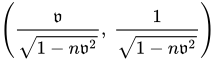
equivalent to (b).
Laue (1911)
In the first textbook on relativity, w:Max von Laue explicitly used the term “four-velocity” (Vierergeschwindigkeit) for Y:[R 6]

which is equivalent to (b), which he used to formulate the four-potential  of an arbitrarily moving point charge de, as well as the four-convection and four-conduction using four-current P:[R 7]
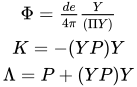 ,
,
and the vector products with electromagnetic tensor  and displacement tensor
  and their duals:[R 8]
![{\displaystyle {\begin{aligned}[][Y{\mathfrak {B}}]&=\varepsilon [Y{\mathfrak {M}}]\\{}[Y{\mathfrak {M}}^{\ast }]&=\mu [Y{\mathfrak {B}}^{\ast }]\end{aligned}}}](../15864d332e145c52ed3c859fc7cb72fb452f73e9.svg)
In the second edition (1913), Laue used four-velocty Y in order to define the four-acceleration  , four force K in terms of four-acceleration, and material four-current M (i.e. four-momentum density) using rest mass density
  :[R 9]
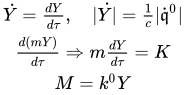 ,
,
De Sitter (1911)
w:Willem De Sitter defined the four-velocity in terms of both velocity  and w:Proper velocity
  as:[R 10]
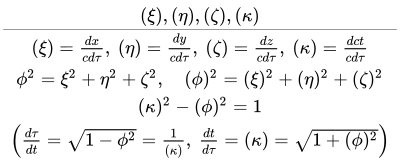
equivalent to (b).
Wilson/Lewis (1912)
w:Gilbert Newton Lewis and w:Edwin Bidwell Wilson devised an alternative 4D vector calculus based on w:Dyadics which, however, never gained widespread support. They defined the “extended velocity” as a “1-vector”:[R 11]

equivalent to (a,b).
Kottler (1912)
w:Friedrich Kottler defined four-velocity as:[R 12]
![{\displaystyle {\begin{aligned}V^{(1)}&={\frac {{\mathfrak {v}}_{z}}{ic}}{\frac {1}{\sqrt {1-{\mathfrak {v}}^{2}/c^{2}}}},&V^{(2)}&={\frac {{\mathfrak {v}}_{y}}{ic}}{\frac {1}{\sqrt {1-{\mathfrak {v}}^{2}/c^{2}}}},\\V^{(3)}&={\frac {{\mathfrak {v}}_{x}}{ic}}{\frac {1}{\sqrt {1-{\mathfrak {v}}^{2}/c^{2}}}},&V^{(4)}&={\frac {1}{\sqrt {1-{\mathfrak {v}}^{2}/c^{2}}}},\end{aligned}}\quad \left[\sum _{\alpha =1}^{4}\left(V^{(\alpha )}\right)^{2}=1\right]}](../375193a69e258fe6aaf65d915a2f39b88f7f1f35.svg)
equivalent to (a,b) from which he derived four-acceleration and four-jerk, and demonstrated its relation to the tangent c_{1}^{(\alpha)} in terms of Frenet-Serret formulas, its derivative with respect to proper time, and its relation to four-acceleration and curvature  :[R 13]

and derived four-acceleration and four-jerk:[R 14]
![{\displaystyle {\begin{aligned}-c^{2}{\frac {dV}{ds}}&={\frac {d^{2}x}{d\tau ^{2}}}=({\dot {\mathfrak {v}}},0){\frac {1}{1-{\mathfrak {v}}^{2}/c^{2}}}+({\mathfrak {v}},ic){\frac {{\mathfrak {v}}{\mathfrak {\dot {v}}}/c^{2}}{\left(1-{\mathfrak {v}}^{2}/c^{2}\right)^{2}}}=\\&=({\dot {\mathfrak {v}}}_{\bot },0){\frac {1}{1-{\mathfrak {v}}^{2}/c^{2}}}+({\mathfrak {{\dot {\mathfrak {v}}}_{\Vert }}},0){\frac {1}{\left(1-{\mathfrak {v}}^{2}/c^{2}\right)^{2}}}+\left(0,{\frac {i}{c}}{\frac {{\mathfrak {{\dot {\mathfrak {v}}}_{\Vert }}}{\mathfrak {v}}}{\left(1-{\mathfrak {v}}^{2}/c^{2}\right)^{2}}}\right),\\-ic^{3}{\frac {d^{2}V}{ds^{2}}}=&{\frac {d^{3}x}{d\tau ^{3}}}=({\ddot {\mathfrak {v}}},0){\frac {1}{\left({\sqrt {1-{\mathfrak {v}}^{2}/c^{2}}}\right)^{3}}}+({\ddot {\mathfrak {v}}},0){\frac {3{\frac {{\mathfrak {v}}{\mathfrak {\dot {v}}}}{c^{2}}}}{\left({\sqrt {1-{\mathfrak {v}}^{2}/c^{2}}}\right)^{5}}}+({\mathfrak {v}},ic)\left\{{\frac {{\mathfrak {\dot {v}}}^{2}/c^{2}+{\frac {{\mathfrak {v}}{\mathfrak {\ddot {v}}}}{c^{2}}}}{\left({\sqrt {1-{\mathfrak {v}}^{2}/c^{2}}}\right)^{5}}}+{\frac {4\left({\frac {{\mathfrak {v}}{\mathfrak {\dot {v}}}}{c^{2}}}\right)^{2}}{\left({\sqrt {1-{\mathfrak {v}}^{2}/c^{2}}}\right)^{7}}}\right\}\\&\left[{\dot {\mathfrak {v}}}={\mathfrak {{\dot {\mathfrak {v}}}_{\Vert }}}+{\dot {\mathfrak {v}}}_{\bot }\right]\end{aligned}}}](../61e59c4f4209f8df8bbeb605613c6593deaf3e95.svg)
Einstein (1912-14)
In an unpublished manuscript on special relativity, written between 1912-1914, w:Albert Einstein defined four-velocity as:[R 15]
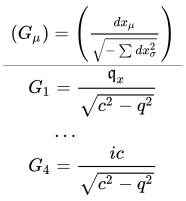
equivalent to (b) and used it to define four-momentum by multiplication with rest energy:[R 16]

Silberstein (1914)
While w:Ludwik Silberstein used Biquaternions already in 1911, his first mention of the “velocity-quaternion” was given in 1914. He also defined its conjugate, its Lorentz transformation, the relation of four-acceleration Z, and its relation to the equation of motion as follows:[R 17]
![{\displaystyle {\begin{matrix}Y={\frac {dq}{d\tau }}=\gamma _{p}[\iota c+\mathbf {p} ]\\YY_{c}=-c^{2}\\Y'=QYQ\\Z={\frac {dY}{d\tau }}\\ZY_{c}+YZ_{c}=0\\{\frac {dmY}{d\tau }}=X\end{matrix}}}](../5d32835c7e14d2f250847a6e2b280000b4184ea4.svg)
equivalent to (a,b).
References
- Mathematical
- Relativity
- ↑ Poincaré (1905/06), p. 173
- ↑ Minkowski (1907/8), p. 64–65,73
- ↑ Minkowski (1908), p. 84
- ↑ Bateman (1909/10), p. 253f
- ↑ Ignatowski (1910), p. 23
- ↑ Laue (1911), p. 63
- ↑ Laue (1911), p. 102, 119
- ↑ Laue (1911), p. 124
- ↑ Laue (1913), p. 69–70, 80, 230
- ↑ De Sitter (1911), p. 392
- ↑ Lewis/Wilson (1912), p. 443f
- ↑ Kottler (1912), p. 1663
- ↑ Kottler (1912), p. 1707
- ↑ Kottler (1912), p. 1663
- ↑ Einstein (1912), p. 84
- ↑ Einstein (1912), p. 97
- ↑ Silberstein (1914), p. 183
 See also the transcription The Transformation of the Electrodynamical Equations on English Wikisource
- deSitter, W. (1911), "On the bearing of the Principle of Relativity on Gravitational Astronomy", Monthly Notices of the Royal Astronomical Society, 71: 388–415
- Einstein, A. (1912–14), "Einstein's manuscript on the special theory of relativity", The collected papers of Albert Einstein, vol. 4, pp. 3–108
{{citation}}: CS1 maint: date format (link)
- Ignatowsky, W. v. (1910), "Das Relativitätsprinzip", Archiv der Mathematik und Physik 17: 1-24, 18: 17-40
- See also the transcription Das Relativitätsprinzip on German Wikisource
- See also the transcription On the spacetime lines of a Minkowski world on English Wikisource
- Laue, M. v. (1911), Das Relativitätsprinzip, Braunschweig: Vieweg
- Laue, M. v. (December 1912), Das Relativitätsprinzip (2. Edition), Braunschweig: Vieweg (published 1913)
- Lewis, G. N. & Wilson, E. B. (1912), "The Space-time Manifold of Relativity. The Non-Euclidean Geometry of Mechanics and Electromagnetics", Proceedings of the American Academy of Arts and Sciences, 48: 387–507
{{citation}}: CS1 maint: multiple names: authors list (link)
- Minkowski, H. (1908) [1907], "Die Grundgleichungen für die elektromagnetischen Vorgänge in bewegten Körpern", Nachrichten von der Gesellschaft der Wissenschaften zu Göttingen, Mathematisch-Physikalische Klasse: 53–111
- See also the transcription Die Grundgleichungen für die elektromagnetischen Vorgänge in bewegten Körpern on German Wikisource
- See also the transcription The Fundamental Equations for Electromagnetic Processes in Moving Bodies on English Wikisource
- Minkowski, H. (1909) [1908], "Raum und Zeit", Physikalische Zeitschrift, 10: 75–88
- See also the transcription Raum und Zeit on German Wikisource
- See also the transcription Space and Time on English Wikisource