History of Topics in Special Relativity/Penrose–Terrell
|
Early history of the Penrose–Terrell effect
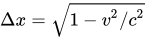
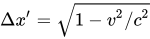
If the length of an object is measured exactly at the locations of its endpoints, then its w:rest length is related to its length in a relatively moving frame by the w:length contraction formula:


- (1)
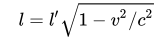
However, it turns out that the visual appearance of that object when photographed from a distance leads to quite different results, because optical aberration and time-of-flight effects have to be considered as well. In particular, light rays arriving simultaneously at the camera weren't emitted simultaneously from all locations at the source.[S 1]
- 1D rods
The visual length of a 1D rod that is both oriented and moving along the x-axis, and which approaches or recedes a camera that is located on the same x-axis, is given by

- (2)
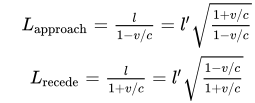
So if the 1D rod approaches it appears to be longer, if it recedes it appears to be shorter, and none of those lengths precisely matches the contraction formula (1) but rather depend on the w:relativistic Doppler factor that also appears in the w:relativistic aberration formula. The only instance when the visual length becomes identical to contraction formula (1) is when the 1D rod is oriented perpendicular to the camera's line of sight and the rod's center is exactly in the camera's line of sight at the time of light emission, because in this case the light emanating simultaneously from both ends of the rod will travel the same distance to the camera.
- 3D objects
It becomes more complicated when 3D objects are considered. First we notice the conformal property of the w:relativistic aberration formula
- (3)
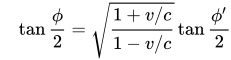
because it only changes the scale of but not the shape of spherical outlines, thus the visual appearance of spheres remains spherical on camera.
Furthermore, light emitted on the backside of arbitrary 3D objects such as spheres, rods and cubes can reach the camera, because the object's motion frees the path of light rays that were hidden otherwise. Consequently, if the object is very far away and subtends a very small angle, it doesn't appear contracted but rather rotated.
The description of visual distortions is connected to the names of Penrose and Terrell in most papers, hence it is called w:Penrose–Terrell effect/rotation or Terrell effect/rotation or Lampa–Penrose–Terrell effect.
Historical papers
Plummer (1910)
w:Henry Crozier Keating Plummer[1] derived the following consequence from relativistic aberration:
- In the first place we may consider the stereographic projection of the celestial sphere on the tangent plane perpendicular to the direction of motion. The form of the law of aberration
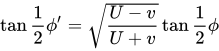
- shows that the effect of aberration is simply to alter the scale of the projection. But the stereographic projection is a conformal representation of the sphere. Hence actual configurations on the sphere are only changed conformally by the effect of aberration, or in other words any small area is altered only in size and not in shape. We know that aberration merely changes the scale of a photograph of a small part of the sky, and the truth of this fact now becomes independent of the velocity (however large) of the observer. Also stars which appear to lie on a circle at any one time will continue to do so permanently.
Mangoldt (1910)
w:Hans Carl Friedrich von Mangoldt[2] discussed the case of a light ray emitted from the origin and then traversing distance in the negative x-direction during time . He showed that a moving marker momentarily co-located at position at time will indicate the Lorentz transformed value



and a momentarily co-located moving clock indicates

where was used by him as Lorentz factor, proving as it should be. At the end of his paper, he alluded to the possibility of using photographic mappings restricted to sufficiently small areas at sufficient distance from the camera, which should directly provide an approximately correct image of relativistic effects such as length contraction and time dilation as indicated by markers and clocks.
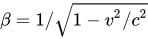

a) Replacing his non-standard notation for the Lorentz factor with modern notation , his position equation can be written


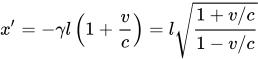
equivalent to equation (2) by identifying Mangoldt's distance with visual length of a rod, whose rest length is defined by coordinate as left endpoint and the origin as right endpoint. So Mangoldt correctly incorporated optical time-of-flight effects in order to transform the optical position of points, though he didn't relate this result to the visual length of moving rods.
b) § Grünbaum (1911) clarified Mangoldt's claim that one can, under certain restrictions, directly demonstrate length contraction and time dilation on photographic images from markers and clocks without considering time-of-flight effects.
Grünbaum (1911)
In a follow-up paper to § Mangoldt (1910), F. Grünbaum[3] focused on the photographic image of distant points. He described a marker (indicating its spatial position) and a co-located clock (indicating its time) that are at relative rest with respect to a photographic apparatus, and another marker/clock pair in relative motion with respect to that apparatus. When both marker/clock pairs meet each other at point P, the apparatus located at point R makes a photo of them. In the rest frame of the apparatus, is the distance from P to R, and T is the time at which the image was created on the photographic plate. On that image, the resting marker indicates its spatial coordinate while the resting clock indicates its time since light took some time to traverse distance . In order to find out which values are indicated on the photographic image of the moving marker/clock pair, he used the Lorentz transformation (with as Lorentz factor):


![{\displaystyle {\begin{matrix}x'_{r}=\beta \left(x_{r}-vt_{r}\right)\Rightarrow \beta \left[x-v\left(T-{\frac {l}{c}}\right)\right]\\t'_{r}=\beta \left(t_{r}-{\frac {v}{c^{2}}}x_{r}\right)\Rightarrow \beta \left[\left(T-{\frac {l}{c}}\right)-{\frac {v}{c^{2}}}x\right]\\\left[\beta ={\frac {1}{\sqrt {1-v^{2}/c^{2}}}},\ x_{r}=x,\ t_{r}=T-{\frac {l}{c}}\right]\end{matrix}}}](../b9443da64dde3a32018c1442d42cc97630ef82c4.svg)
which he summarized in the following table:
| On the image of the apparatus: |
Stationary marker:
Stationary clock: Moving marker: Moving clock: |


![{\displaystyle \beta \left[x-v\left(T-{\frac {l}{c}}\right)\right]}](../db1b4c3b7d9616e39fabb73c01f31986bc41f622.svg)
![{\displaystyle \beta \left[\left(T-{\frac {l}{c}}\right)-{\frac {v}{c^{2}}}x\right]}](../b489c8f302e46b2793d0714af236acd317e71d81.svg)
He then described the symmetrical case when the photographic image of P is made by a moving observer B, discussed the special cases , which together with and easily allows to recover both length contraction and time dilation as well as their symmetry from the data given on the images. Finally he clarified Mangoldt's claim according to whom one can directly demonstrate those effects without considering time-of-flight effects: He showed that this can only be done if one strictly follows Mangoldt's requirement of sufficiently small areas around sufficiently distant points, and only by using approximations which neglect all first-order terms.


a) His formula for the visual position of a single moving marker easily allows us to derive the visual length between two points: We place R to the origin so that point P is at position , thus we can interpret R and P as endpoints of a horizontally aligned and moving rod measured at time , which gives (replacing his non-standard notation for the Lorentz factor with modern notation ):


![{\displaystyle x'_{r}=\gamma \left[x-v\left(T-{\frac {l}{c}}\right)\right]{\underset {x=0 \atop T=0}{=}}\gamma \left[l-{\frac {v}{c}}l\right]=l{\sqrt {\frac {1-v/c}{1+v/c}}}}](../ee401f4a8102c6aa9e9a5701706e2ddb26b271ea.svg)
equivalent to equation (2) by identifying his length with visual length and coordinate as the right endpoint of a rod of rest length whose left endpoint is at the origin. So like Mangoldt, also Grünbaum correctly incorporated optical time-of-flight effects in order to transform the optical position of points, though he didn't relate this result to the visual length of moving rods.
b) In a short review of Grünbaum's paper, w:Max von Laue (1911)[4] described it as using photographic images to demonstrate Lorentz contraction.
Petzoldt (1914)
In an otherwise philosophical analysis of relativity, w:Joseph Petzoldt[5] demonstrated the following consequence:
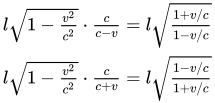
- The image of an object, which is generated on the retina of the eye or on the photographic plate - as a snapshot - is produced by light coming from all the points of the object in question, but it wasn't sent at the same time: all of the light that contributes to the production of the image arrives simultaneously with the light that originated from those points of the object that were closest to the eye or plate; the further the object's point is from the plate or eye, the sooner it must send its contribution of light. The result is that the image of a receding or approaching object having a large speed comparable to that of light, does not correspond to the image of the same object if it were at rest relative to the eye or plate, but rather gives the impression that it originated from a shorter or longer object within that radius of distance. In case the object is receding from the eye or plate, the light contributed from the most distant points would have been sent later, in the case of approach it would have been sent earlier than in the state of rest. A simple calculation that takes into account the Lorentz contraction, results in the fact that the object in question whose physical length is , where is the length for the "co-moving" observer, would have to be assessed on the basis of this photographic momentary image as having the perspectivistic moving length:

- or ,
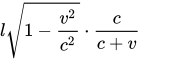
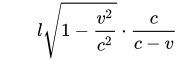
- depending on the whether the object recedes or approaches the eye or plate.
a) Petzoldt explicitly derived the visual length of moving 1D rods, his results being equivalent to equation (2):




Lampa (1924)
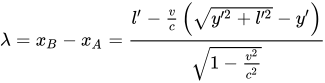
w:de:Anton Lampa[7] devoted an entire paper to the question of the visual length of moving rods. He pointed out, that the relativistic length contraction formula doesn't say anything about the visual appearance of moving rods from the perspective of non-comoving observers. He then introduced endpoints A and B of a stationary rod using coordinates and . So when an observer resting at the origin sees the rod at time , the rod's light must have been sent earlier at time from A and at an even earlier time from B. Applying the Lorentz transformation, he showed that the visual distance between A and B seen by an observer at the origin of a frame in which the rod is moving parallel to the x-axis, is given as follows:




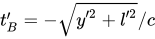

He concluded:
- This distance is a function of at given and . If or , we have and , thus as it must be, because the coordinate systems always coincide at . If we increase beginning with value zero, then decreases and finally becomes negative, while the absolute value of steadily increases; initially decreases, then reaches a minimum and then permanently increases. If , then and and becomes equal to . We see that the distance of the points from which the light rays emanate as measured in system K of the stationary observer, is not at all smaller than the length of the rod measured in the coordinate system attached to it; it even becomes infinitely large if the rod moves relative to the observer with the speed of light. Yet the visual angle under which the stationary observer sees points A and B of the rod, is always finite.


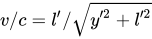


He then derived the relation between the w:visual angle of a co-moving observer and of the stationary observer with:



He finally showed how to recover the Lorentz contracted length from the visual length :
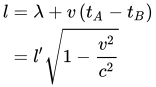
which he rewrote in terms of as angle of the light ray emanating from endpoint B at time , and as angle of the light ray emanating from endpoint A at time :


![{\displaystyle {\begin{aligned}\lambda &=y'(\tan \beta -\tan \alpha )\\\Rightarrow l&=y'\left[(\tan \beta -\tan \alpha )+{\frac {v}{c}}\left({\frac {1}{\cos \beta }}-{\frac {1}{\cos \alpha }}\right)\right]\end{aligned}}}](../f6d3c15cd21c206369a33c11cd5bcfa9960813d0.svg)
a) Lampa's formula for is more general than equation (2), producing the latter in the special case :


b) He was evidently unaware of previous work on visual positions and lengths by §§ Grünbaum (1911) and Petzoldt (1914).
c) In a short review of Lampa's paper, w:Cornelius Lanczos (1925)[8] described it as deriving the relation between the visual angles of a moving rod seen by resting and moving observers, as well as deriving the length of the rod from the data of its appearance.Penrose (1958/59) and Terrell (1959)
§ Petzoldt (1914) and § Lampa (1924) restricted their investigations to the visual appearance of 1D rods, whereas the only early description of the visual appearance of 3D objects was given by § Plummer (1910) in relation to the celestial sphere based on the conformal property of aberration. However, these early investigations were evidently completely forgotten, and it took decades before those questions were taken up again:
Using the conformal property of aberration, w:Roger Penrose (1958/59)[9] described the visual appearance of spheres, and discovered a completely new effect: Due to the motion of the sphere, points that were in the background become visible due to the sphere's motion, leading to the effect that the sphere appears not to be Lorentz contracted but rather rotated. Independently, w:James Terrell (1959)[10] noticed the same rotation effect in relation to 3D rods, leading him to famously declare the "invisibility of the Lorentz contraction". Independently, the special case of the visual length of 1D rods was discussed by Weinstein (1959/60).[11] A large number of follow-up papers by many authors appeared, which demonstrate the visual appearance of 1D and 3D objects in detail, see w:Penrose-Terrell effect.
References
Historical references
- ↑ Plummer, H.C.K. (1910), "On the Theory of Aberration and the Principle of Relativity", Monthly Notices of the Royal Astronomical Society, 40: 252–266, Bibcode:1910MNRAS..70..252P
 See also the transcription On the Theory of Aberration and the Principle of Relativity on English Wikisource
- ↑ Mangoldt, H. v. (1910), "Längen- und Zeitmessung in der Relativitätstheorie.", Physikalische Zeitschrift, 11: 737–744
- ↑ Grünbaum, F. (1911), "Über einige ideelle Versuche zum Relativitätsprinzip", Physikalische Zeitschrift, 12: 500–509
- ↑ Laue, M. v. (1911), "Review of: F. Grünbaum. Über einige ideelle Versuche zum Relativitätsprinzip", Beiblätter zu den Annalen der Physik, 35: 1187
- ↑ Petzoldt, J. (1914), "Die Relativitätstheorie der Physik", Zeitschrift für positivistische Philosophie, 2: 1–56;
- See also the transcription Die Relativitätstheorie der Physik on German Wikisource
- ↑ Einstein, Albert (1917-1954). Über die spezielle und die allgemeine Relativitätstheorie (Collected papers of Albert Einstein Vol 6). Braunschweig: Vieweg. https://einsteinpapers.press.princeton.edu/vol6-doc/448. – See also the English translation Relativity: The Special and General Theory on CPAE Vol 6.
- ↑ Lampa, A. (1924). "Wie erscheint nach der Relativitätstheorie ein bewegter Stab einem ruhenden Beobachter?". Zeitschrift für Physik 27 (1): 138–148. doi:10.1007/BF01328021. https://archive.org/details/zeitschrift-fuer-physik-a-atoms-and-nuclei_1924_27/page/138/mode/2up.
- ↑ Lanczos, C. (1925), "Review of: Anton Lampa. Wie erscheint nach der Relativitätstheorie ein bewegter Stab einem ruhenden Beobachter?", Physikalische Berichte, 6 (4): 251
- ↑ Penrose, R. (January 1959) [July 1958], "The Apparent Shape of a Relativistically Moving Sphere", Mathematical Proceedings of the Cambridge Philosophical Society, 55 (1): 137–139, Bibcode:1959PCPS...55..137P, doi:10.1017/S0305004100033776, S2CID 123023118
- ↑ Terrell, J. (November 1959) [June 1959], "Invisibility of the Lorentz Contraction", Physical Review, 116 (4): 1041–1045, Bibcode:1959PhRv..116.1041T, doi:10.1103/PhysRev.116.1041
- ↑ Weinstein, R. (October 1960) [December 1959], "Observation of length by a single observer", American Journal of Physics, 28 (7): 607–610, doi:10.1119/1.1935916
Further reading
- ↑ A very detailed account of the visual appearance of moving bodies is presented on the website Space Time Travel which is based on the German website Tempolimit Lichtgeschwindigkeit, where the accompanied paper Appearance of relativistically moving objects (in German) gives the formula for the length of 1D rods, followed by descriptions of rotated cubes and spheres.