Example 2
Given:
The displacement equation of equilibrium for an isotropic inhomogeneous linear elastic material can be written as

where

and  and
and  are the Lamé moduli.
Show:
Show that the displacement equation of equilibrium can be expressed as

Solution
The skew part of the tensor  does not affect the stress because it leads to a rigid displacement field. Therefore, the displacement equation of equilibrium may be written as
![{\displaystyle {\boldsymbol {\nabla }}\bullet \left[\mathbf {C} :{\text{symm}}({\boldsymbol {\nabla }}\mathbf {u} )\right]+\mathbf {b} =0}](../3de5eed9ed9f3876b9e9c3b296bb66f9f63d19a2.svg)
where

In index notataion,

and

Therefore,

Now,

Hence,

Taking the divergence,
![{\displaystyle {\begin{aligned}{\boldsymbol {\nabla }}\bullet {\left[\mathbf {C} :{\text{symm}}({\boldsymbol {\nabla }}\mathbf {u} )\right]}&={\boldsymbol {\nabla }}\bullet {\left[\lambda ~({\boldsymbol {\nabla }}\bullet \mathbf {u} )\mathbf {1} +\mu ~({\boldsymbol {\nabla }}\mathbf {u} +{\boldsymbol {\nabla }}\mathbf {u} ^{T})\right]}\\&={\boldsymbol {\nabla }}\bullet {\left[\lambda ~({\boldsymbol {\nabla }}\bullet \mathbf {u} )\mathbf {1} \right]}+{\boldsymbol {\nabla }}\bullet {\left(\mu ~{\boldsymbol {\nabla }}\mathbf {u} \right)}+{\boldsymbol {\nabla }}\bullet {\left(\mu ~{\boldsymbol {\nabla }}\mathbf {u} ^{T}\right)}\end{aligned}}}](../62b81a8b9e67d11dc4eff2e90e69dfa32a15977a.svg)
Recall that
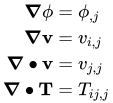
Therefore,
![{\displaystyle {\begin{aligned}{\boldsymbol {\nabla }}\bullet {\left[\lambda ~({\boldsymbol {\nabla }}\bullet \mathbf {u} )\mathbf {1} \right]}&\equiv \left(\lambda ~u_{k,k}\delta _{ij}\right)_{,j}\\&=\lambda _{,i}~u_{k,k}+\lambda ~u_{k,ki}\\&\equiv {\boldsymbol {\nabla }}{\lambda }({\boldsymbol {\nabla }}\bullet \mathbf {u} )+\lambda {\boldsymbol {\nabla }}{({\boldsymbol {\nabla }}\bullet \mathbf {u} )}\end{aligned}}}](../099b986914e1b94a565ec1ff616cd62083d45ae1.svg)
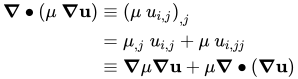
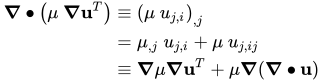
Hence,
![{\displaystyle {\begin{aligned}{\boldsymbol {\nabla }}\bullet {\left[\mathbf {C} :{\text{symm}}({\boldsymbol {\nabla }}\mathbf {u} )\right]}&={\boldsymbol {\nabla }}{\lambda }({\boldsymbol {\nabla }}\bullet \mathbf {u} )+\lambda {\boldsymbol {\nabla }}{({\boldsymbol {\nabla }}\bullet \mathbf {u} )}+{\boldsymbol {\nabla }}{\mu }{\boldsymbol {\nabla }}\mathbf {u} +\mu {\boldsymbol {\nabla }}\bullet {({\boldsymbol {\nabla }}\mathbf {u} )}+{\boldsymbol {\nabla }}{\mu }{\boldsymbol {\nabla }}\mathbf {u} ^{T}+\mu {\boldsymbol {\nabla }}{({\boldsymbol {\nabla }}\bullet \mathbf {u} )}\\&=\mu {\boldsymbol {\nabla }}\bullet {({\boldsymbol {\nabla }}\mathbf {u} )}+(\lambda +\mu ){\boldsymbol {\nabla }}{({\boldsymbol {\nabla }}\bullet \mathbf {u} )}+{\boldsymbol {\nabla }}{\mu }\left({\boldsymbol {\nabla }}\mathbf {u} +{\boldsymbol {\nabla }}\mathbf {u} ^{T}\right)+{\boldsymbol {\nabla }}{\lambda }({\boldsymbol {\nabla }}\bullet \mathbf {u} )\end{aligned}}}](../6b8450c31fb91cf5aaba20670fb84e832dc67669.svg)
Therefore, the displacement equation of equilibrium can be expressed as required, i.e,