Introduction
In real numbers, there is the amount to be able to express convergence in space, for example. With the amount you can define  -neighbourhoods and the sequence convergence is defined via these -neighbourhoods. In addition, Minkowski functionals are defined into circular zero environments
  , depending on topological properties, the set provides certain properties of the Minkowski functionals.
Convergence in real numbers
The real numbers with the amount  is a normaled space and
 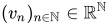 is a sequence in
  and
and  :
:

Convergence in normed spaces
The convergence in normed spaces 
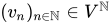 is defined analogously as a sequence in
  and
and  :
:

Epsilon environments
The absolute value or (in more a more general case) the norm can be used in for the definition of the neighbourhoods.

These topology-producing functionals (gauge functionals) are required for the definition of algebra extensions in which a given  has an inverse element. The topologising of the algebra of power series is later performed with measuring functionals (e.g. seminorms,
  -seminorms, ...)
Absorbent sets
The measurements functional are defined via circularly absorbing zero environments for which the associated Minkowski functional produces the associated measuring functionally. The basics provide the following sections.
Introduction measuring functional
When measuring functionals are used, the defining properties of a standard are further generalized in order to be able to use topology-generating functionals in arbitrary topological algebras in an analogous manner. As a result, it will no longer be necessary to describe, for example, stiffness over the open sets from the topology (see also Theorem of continuity für lineare mappings).
Definition: p-homogeneous
Let a vector space over the field  . A functional
  is called -homogeneous, if there is a
  with
with  , which applies:

If  , then
  is homogeneous. is called non-negative if for all
 applies
  .
.
Definition: p-gauge functional
Let a vector space over . A non-negative,
-homogeneous functional  is called -gauge functional on and just gauge functional for .
Example: p-gauge functional
Let and  , then
 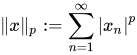 is a
is a  -gauge functional on .
Learning Task: p-gauge functional
The vector space  and the -gauge functional are given. Proof that
 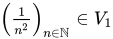 but
but 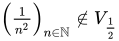 . What is the general definition for and
  with
with  and
and ![{\textstyle p,q\in (0,1]}](../9209a1ead14c19003c475a2d1cc3e81a8314547e.svg) ?
?
Note
The homogeneity has on the one hand a close relationship with the continuity of the scalar multiplication and the ![{\textstyle p\in (0,1]}](../5d5759f236d7ea252b2d4724167f38f65c88f4bb.svg) defines the relationship with a quasi-seminorm[1] that induces the same open sets on the corresponding -seminorm. The triangle inequation for the -homogeneous -seminorm has a quasi-seminorm with a corresponding concavity constant
defines the relationship with a quasi-seminorm[1] that induces the same open sets on the corresponding -seminorm. The triangle inequation for the -homogeneous -seminorm has a quasi-seminorm with a corresponding concavity constant  with:
with:

Definition: System of p-gauge functionals
Let is a vector space over ,  an index set and for all
  let
let  be a -gauge functional on
. Then
be a -gauge functional on
. Then  denotes the set of all -gauge functionals with indices of , i.e.

is called system of -gauge functionals. If is called strain functionalystem.
Definition: equivalence of p-gauge functionalystemen
Let a vector space over and  ,
,  two systems of -gauge functionals on
  . The system of -gauge functionals and the system are named as equivalent if the following two conditions are true:
- (EQ1)

- (EQ2)

Example: p-Gauge functional
With  let
let 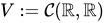 be the set of all continuous function on the domain mapping to the set . The set of the -gauge functional is defined as follows:

and with a specific  the -gauge functional is defined as

Definition: Base of topology for a p-gauge functionalystem
Let  a topological vector space with the system of open sets
  on . Furthermore, is a set of -gauge functionals on . The -gauge functionalystem is called 'basic' for if:
- (BE1)

- (BE2)

Note: Base of topology for a system of p-gauge functionals
- (BE1) means that the balls
 are self-open sets.
- With (BE2), each open set can be represented from the topology as a union of balls. Since any associations of open sets in a topological space after Axiom (T3) must also be open again, the association of balls with , (698-1047-1747220434181.
Definition: Sub-based p-gauge functionalystem
Let a topological vector space with the system of open sets on . Furthermore, is a set of -gauge functionals on . The -gauge functionalystem is called 'sub-based' for , if applicable with  :
:
- (SE1)

- (SE2)

with

Note: Difference in topology - sub-based production
In a topology-producing -gauge functionalystem, the manual handling of finite cuts of open sets in a topology is simplified. (S2) must therefore take into account finite cuts of the neighbourhoods by cutting balls 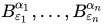 by the condition

with  .
.
Definition: unital positive
Let a unital topological algebra over with the single element of multiplication
  . The -gauge functionalystem is called 'unital positive' exactly when for all the condition (698-1047-1747220434181-341150).
Note: unital positive equivalent measuring functionalystem
One can replace a -gauge functionalystem on a topological algebra with an equivalent unital positive -gauge functionalystem by using the separation property of a house village woman to use minkowki functionals of circular zero environments which do not contain the single element. Then you get
 when
when  and
and  are used as Minkowski-Funktional of the absorbent zero environment
  .
.
Note: p-standard and standard
The term standard is a special case of a standard with which is defined below.
Definition: Standard
Let a topological vector space above the field . A functional 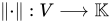 is called standard on if
  meets the following conditions:
- (N1)

- (N2)

(N3) 
- (N4)

Definition:
Let a topological vector space above the field . A functional is called semistandard on , if meets the following conditions:
- (H1)
- (H2)
- (H3)
Note:standard semi - standard
If (N2) does not apply in the definition of the standard, a is obtained semi-standard. (N2) ensures the house village property in the topological vector space. It is possible to separate the points with the standard, i.e. to measure whether two vectors  differ, i.e.
  or
or 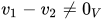 .
.
Multiplicative convex - submultiplicity of seminorm
A seminorm is submultiplicative with a stiffness constant  , if applicable for all :

 is called the stiffness constant of the multiplication.
The seminorm can be replaced by an equivalent seminorm
is called the stiffness constant of the multiplication.
The seminorm can be replaced by an equivalent seminorm  for which
  is (see MLC-Regularität.
Lemma: Stability constant and submultiplicity
Let a local-convexe topological algebra with the basic-generating seminorm system
  and a submultiplicative seminorm with stiffness constant and
given with:
(698-863-174722043418-341-11)
then there is an equivalent seminorm
and a submultiplicative seminorm with stiffness constant and
given with:
(698-863-174722043418-341-11)
then there is an equivalent seminorm  with
with

Proof: Stability constant and submultiplicity
If  submultiplicity is obtained directly with

Proof: Definition of seminorm
If  is applicable, this is defined for all
  :
:

and the submultiplicity is obtained via:

Proof: equivalence of seminorms
The equivalence of the seminorms is obtained directly from the definition with , for:

Note: Submultiplicity
If a topological algebra is a normed space, it is generally only possible to say that the submultiplicivity of the seminorm is met with a certain stiffness constant of the multiplication, since the balls around the zero vector generate a neighborhood system of the zero vector. The Lemma shows that without restriction a seminorm with stiffness constant can also be replaced by an equivalent submultiplicative seminorm. The procedure can be carried out analogously for local spaces.
Definition: p-Norm
Let a vector space above the field and . A functional means standard on , if meets the following conditions:
- (PN1)
- (PN2)
- (PN3)

- (PN4)
Note
For  , a standard can also be made to a standard by setting the standard
  as follows:

Example
Let with
with  and the sets of the -sumable series (698-1047-1747220434181-341-341-213) in the real numbers.

 is a standard on the -vector space
  .
.
Definition: p-normality
Let means -normally or locally limited with the concavity constant if a -standard
 ,
,
exists which produces the topology on (formal  ).
).
Definition: p-seminorm
Let a topological vector space above the field and . A functional is called -seminorm on with (698-1047220434181-341-230) as a concavity constant, if (698-1047-1747220434181-3419) meets the following conditions:
(PH1)
(PH2)
(PH3)
Note: p-seminorm
If (PN2) is not valid in the definition of the standard, (698-1047-1747220434181-341-341-237)-seminorm with (698-1047-1747220434181-341-341-238) is considered a concavity constant. Analogously to the standard semi, a single -seminorm cannot separate the points in the topological vector space (house village property T2).
Multiplikativ pseudokonvex - Submultiplicivity of p-seminorm
A seminorm is submultiplicative with a stiffness constant , if applicable for all :
are called the stiffness constant of the multiplication.
The seminorm can be replaced by an equivalent seminorm , for which is replaced.
Definition: pseudokonvexer vector space
Let means pseudoconvex if the topology is produced by a system  of seminorms which has the following properties.
![{\displaystyle \left\|\cdot \right\|_{\alpha }:V\longrightarrow \mathbb {K} {\mbox{ ist }}p_{\alpha }{\mbox{-homogen mit }}\alpha \in {\mathcal {A}}{\mbox{ und }}p_{\alpha }\in (0,1]}](../d31ee48744547c9adf902e41560e55208a420253.svg) ,
,
Formally listed 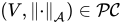 .
.
Note: topology-producing p-standard
A standard is topology-producing for topology  if the following condition applies:

The balls are further used for the characterization of the stiffness.
Definition: Epsilon balls of p-gauge functionals
Let a vector space and a (698-1047220434181-341-259)-gauge functional to (698-1047220434181-341-260), then the -261)-ball is defined by (69847

Definition: Quasinorm
Let a topological vector space above the field . A functional
is called quasinorm on , if
meets the following conditions:
- (QN1)
- (QN2)
- (QN3)
- (QN4)

Definition: semi-norm
A function
on a vector space above the field means quasi-shalf standard with constant stiffness of the addition  if meets the following conditions:
- (QH1)
- (QH2)
- (QH3)
Note: Quasinorm - semi-norm
Analogue to standard semis and norms or -norms and -seminorms a quasi-semi-norm (698-1047-1747220434181-34181-341-284) with a continuity constant (698-1047-1747220434181-34285) of the addition, if no longer applies (Q.
Note: Stability constant
The stiffness constant is related to the Konkavitätskonstante einer (698-1047-1747220434181-341-286)-Norm bzw. (698-1047-1747220434181-341-287)-seminorm. This shows the Korrespondenzlemma für (698-1047-1747220434181-341-288)-seminorms
Convergence over nets
Let(698-10471747220434181-341-289) has a topologischer space,  and (698-1047220434181-341-291) has a net in
  with an index set (698-10471747220434181-341-293). Convergence over nets is defined as follows:

Definition: Algebre classes
The distinction according to algebras classes is essential for the investigation of permanently singular elements, since the invertability in an algebra extension depends on the class  .
.
Notation 1: Algebras classes
Let a class of topological algebras and a field, then subclasses of topological algebras are denoted by the following symbols:
 Class of unital algebras in ;
 Class of commutative algebras in , commutative refers to the multiplication in the algebras.
 Class of topological algebras over in ;
Notation 2: Algebras classes
- Class of all topological algebras;
 Class of all Banach algebras (full, normed);
 class of local convex algebras; i.e. topology generated by a system of seminorms;
 Class of multiplicative local convex algebras;
Notation 3: Algebras classes
 Class of the standardizable algebras or locally limited algebras;
 Class of pseudoconvex algebras; & i.e. topology produced by a system of -seminorms;
 Class of the multiplicative pseudoconvexen algebras.
Note: Pseudokonvexe rooms
For pseudoconvexe algebras, the system can also be used from
the appropriate semi-standards. With the Korrespondenzsatz für (698-1047-1747220434181-341-314)-seminorms
the relationship of -seminorms and quasi-seminorms. Other
not all -seminorms have the same
Concavity constant (see definition gauge functional)
 , i.e.

Task 1: Norm
Draw the ball in  with (698-1047220434181-341-322) and
![{\displaystyle {\begin{array}{rrcl}\left\|\cdot \right\|_{p}:&\mathbb {R} ^{2}&\rightarrow &\mathbb {R} _{o}^{+}\\&x&\mapsto &\left\|\left({\begin{array}{c}x_{1}\\x_{2}\end{array}}\right)\right\|_{p}:={\sqrt[{p}]{|x_{1}|^{p}+|x_{2}|^{p}}}\end{array}}}](../a247076c7b67d5b083441bb141d5add673311ef8.svg)
drawing the edge of the balls  with respect to the standard
  with
with
-
 and
and 
 and
and
Task 2: p-standard
Draw the ball in with  and
and

drawing the edge of the balls with respect to the standard with
 (698-1047-1747220434181-341-341-339) and
  (698-1047-1747220434181-341-341-342) and
See also
- nets
- norms
- Korrespondenzlemma für (698-1047-1747220434181-341-344)-seminorms
- Theorem of continuity für lineare mappings
- sequence of continuity
- MLC-Regularität
- MPC-Regularität
- LC-Regularität
- PC-Regularität
Page Information
Translation and Version Control
This page was translated based on the following Wikiversity source page and uses the concept of Translation and Version Control for a transparent language fork in a Wikiversity:
- ↑ Kalton, N. (1986). "Plurisubharmonic functions on quasi-Banach spaces". Studia Mathematica (Institute of Mathematics, Polish Academy of Sciences) 84 (3): 297–324. doi:10.4064/sm-84-3-297-324. ISSN 0039-3223. https://kaltonmemorial.missouri.edu/assets/docs/sm1986b.pdf.