Simple, Step, and Continuous Functions
Exercise 1. Simple Functions are Approximately Step
Let 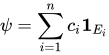 be a simple function on the bounded interval [a,b]. Also let
  .
.
Prove that there exists a step function s and measurable set F such that
- s and
 are equal on F, and F is nearly all of [a,b].
More formally, for all  , we have
  .
.
And ![{\displaystyle \lambda ([a,b]\smallsetminus F)<\varepsilon }](../dd62e48877abaf3e0c0eef17391ef08a3422d0de.svg) .
.
Hint: Approximate each of  .
.
Exercise 2. Step Functions are Approximately Continuous
Let s be any step function on a closed, bounded interval, ![{\displaystyle s:[a,b]\to {\mathbb {R}}}](../9c99d69d50782426ad7d83d40b98610f4a0e10f7.svg) and
and 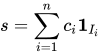 . Also let .
Prove that there is a continuous function ![{\displaystyle f:[a,b]\to {\mathbb {R}}}](../47e7106b6b404ed334ba8c22568d01c0f8d6176a.svg) and measurable set
and measurable set ![{\displaystyle E\subseteq [a,b]}](../07a3f179daff7072656193774ff8a7ecc6607548.svg) , such that
, such that
![{\displaystyle {\text{ for all }}x\in E:f(x)=s(x),\quad {\text{ and }}\lambda ([a,b]\smallsetminus E)<\varepsilon }](../196e47bb27e26f41454d0e5aabaa7f1c79bce066.svg)
Hint: There is a finite number of discontinuities of s.
Put a small enough neighborhood around each discontinuity. Outside of these neighborhoods, make f and s equal.
Inside of these neighborhoods, interpolate a linear function from one end to the other.
Approximations of Measurable Functions
Here we study two kinds of approximation results. One defines a notion in which two functions are "basically the same" (at least for the purposes of integration). This is the idea of functions being equal "almost everywhere". For functions equal almost everywhere, one may replace one function by the other and the value of the integral is unchanged.
The other kind of approximation result is that every measurable function is (1) approximately continuous, and (2) approximately step. This means that measurable functions can be replaced by continuous or step functions, and although this changes the value of the integral, it does so "not too much".
Definition: almost everywhere, a.e.
Let  be two measurable functions. We say that they are equal almost everywhere if the set of points at which they are not equal is a null set. That is to say,

We also abbreviate the statement that f equals g almost everywhere by writing 
Exercise 3. Almost Equal to 0
Show that the constant function 0, and the Dirichlet function  are equal almost everywhere.
A.e. Preserves Measurability
Suppose are two functions, and f is measurable, and suppose We will prove that therefore g is measurable.
Let  and consider the sets



Exercise 4. A.e. Preserves Measurability
Justify why the following sets are measurable, in this order:
1. F
2. H
3. 
4. 
5. G
Simple Functions Are Approximately Step
In this section we will show that, if ![{\displaystyle \psi :[a,b]\to {\mathbb {R}}}](../73312109142c4c0a41824bc55d803e5a28b3b2b0.svg) is a simple function then there is a step function and a set such that
is a simple function then there is a step function and a set such that  on E and
 ![{\displaystyle \lambda ([a,b]\smallsetminus E)<\varepsilon }](../1bdda2e9327b7c5280ff2d78f50eb7ae3c3dccf1.svg) .
.
So let be a simple function and let .
As we proved in a previous lesson, each  is approximately an open set. That is to say, there is an open set
  such that
  .
.
Measurable Functions Are Approximately Continuous and Step
We will now show that for any measurable function and , there exists a continuous function ![{\displaystyle g:[a,b]\to {\mathbb {R}}}](../e68f7ea7aa040aaf50d68f0373fb81ffa8062a59.svg) such that
such that
 on a set
and . When  is "very small" then E is almost the whole interval [a,b], and g is very close to f.
We will also prove that there exists a step function such that
 on a set
and .
First we prove that there is an M such that  except on a set of measure less than
  .
.
To do so, consider the sequence of sets
![{\displaystyle E_{n}=\{x\in [a,b]:|f(x)|\leq n\}}](../eeb1466042d7d5f8444c1b3ef1562b7c03cc61e8.svg)
Exercise 5. Measurable Approximately Bounded
First show that  is measurable for each
  .
.
Next show that ![{\displaystyle [a,b]=\bigcup _{n=1}^{\infty }E_{n}}](../b29644a39a8a9e16c500295d501939514822b3d6.svg) .
.
Then use the continuity of measure to show that there is some M for which 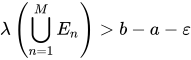 . Define
  .
.
Infer that this is the desired M.
Next we will show that there is a simple function  such that
  except on F.
To do so, set  such that
  and define the sets
![{\displaystyle {\begin{aligned}E_{n,i}&=\left\{x\in [a,b]:{\frac {M(i-1)}{n}}\leq |f(x)|<{\frac {Mi}{n}}\right\}\\&=(|f|)^{-1}([M(i-1)/n,Mi/n)),\quad {\text{ for }}1\leq i\leq n\end{aligned}}}](../766ed3bfc01d1ec3579e55fcfb499fba24de8a38.svg)
and then define the function
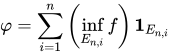
Exercise 6. Simple Approximation Confirmation
Show that is simple and, except on F, .
Finally, use all of the above (with the help of results proved in earlier exercises) to prove the desired result.