Motivation and emotion/Lectures/Introduction
Lecture 01: Introduction
This is the first lecture for the motivation and emotion unit of study.

Overview
This lecture:
- Overviews the unit, highlighting:
- key points from the unit outline
- assessment:
- major project:
- topic development (10%)
- book chapter (50%)
- exam (40%)
- major project:
- Introduces the psychological study of motivation and emotion and key conceptual frameworks
Outline
- Unit overview
Introduction to motivation and emotion
- Motivational science
- Key questions
- Motivation theoretical frameworks
- Introduction to emotion
Key observations
- People are motivated by different things
(individual differences e.g., “One man's meat is another man's poison.”) - A person is motivated by multiple things at once
(motivation is multiple) - A person is motivated by different things at different times
(motivation is dynamic) - Two people may perform the same behaviour for different reasons
Motivational science
The psychology of motivation differs from lay perspectives which are often focused, for example, on how to get more motivation to do something desirable or inspirational. Academic study of motivation covers this topic, but also so much more, including paradoxical and unconscious motivations, and it does so scientifically.
Psychological science is an evolving body of knowledge and methods that prioritise theory‑driven hypotheses tested via rigorous empirical methods rather than anecdotal or opinion‑based sources (e.g. inspirational quotes, influencers, news articles).
Common wisdom and lay notions about motivation are often narrow, and also wrong or lacking in nuance.
|
Understanding motivational theory and research can be a powerful lever to unlock not only one's own motivation but also how to work effectively with others. Thus, the study of motivation is very applied.
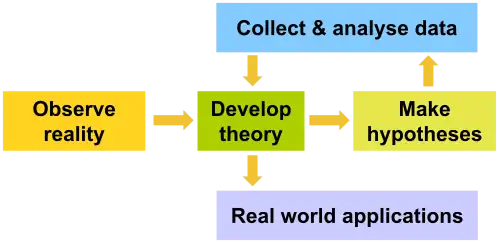
Empirical approaches to exploring motivational processes (see Figure 2) define and operationalise the psychological construct(s) and then formulates clear, falsifiable hypotheses grounded in established theories (e.g. self‑determination theory). Data are collected and analysed through peer‑reviewed research designs (e.g., longitudinal, experimental, meta‑analytic). And each study responds to, or builds on, previous studies, so that a cohesive body of knowledge develops. This is what is meant by being grounded in science, or evidence-based.
Norcross, J. C., Mrykalo, M. S., & Blagys, M. D. (2002). Auld Lang Syne: Success predictors, change processes, and self‑reported outcomes of New Year’s resolvers and nonresolvers. Journal of Clinical Psychology, 58(4), 397–405. https://doi.org/10.1002/jclp.1151 [pdf]
Key questions
The key questions underlying psychological study of motivation and emotion are:
Why do we do
what we do?
Why do we feel
The practical, applied problems are:
How can we change
what we do?
How can we change
Core problems to be solved by motivational science include "What causes behaviour?" and, more specifically:
- Why does behaviour start?
- Why is behaviour sustained over time?
- Why is behaviour directed towards some goals yet away from others?
- Why does behaviour change its direction?
- Why does behaviour stop?
Etymology

The terms "motivation" and "emotion" have their roots in the Latin verb "movere" which means "to move" (see Figure 3). More specifically:
- "motivation" is derived from "motivus" which refers to the action of moving or being moved. This evolved to "motivare" which means "to set in motion" or "to stimulate". In the context of psychology and behaviour, "motivation" refers to the processes that initiate, direct, and sustain goal-directed behavior. It is the driving force that pushes individuals to take action and achieve their objectives.
- "emotion" comes from "emotus" which means "moved" or "agitated." Emotions are complex psychological states characterised by feelings, physiological responses, and behavioral expressions. Emotions are often triggered by internal or external events and can significantly influence behavior and decision-making.
Therefore, both motivation and emotion are linked to the idea of movement or being moved, but represent different aspects of human experiences and behaviour. Motivation is the driving force behind goal-oriented actions, while emotion is the affective states and responses to stimuli that often influence behavior and decision-making.
What is motivation?
- Common understanding
The everyday, layperson understanding of "motivation" is that it involves using will-power and self-discipline to focus and channel one's attention and efforts towards achieving challenging short- or long-term goals such as working out or studying.
For example, how does this video make you feel? Why? The ultimate motivational clip - Rise and shine! (YouTube) (3:24 mins):
How do you motivate yourself?
- Psychological understanding
In contrast, psychological science considers ALL behaviour to be motivated, including:
- mundane behaviour (e.g., drinking and eating)
- less "desirable" behaviours (e.g., avoidance, procrastination, nose-picking etc.)
- "non-behaviour" (i.e., choosing not to do something is also a motivated behaviour)
- approach-based goal-directed behaviours (e.g., training for a marathon)
Motivation is complex:
- Multiple people engaged in the SAME behaviour (e.g., a workout) may have DIFFERENT motivations (e.g., fitness, emotion regulation, social engagement).
- We each have MULTIPLE motivations in any moment, but only our DOMINANT motivation gets acted upon.
Motivation can be defined as all internal process that give behaviour energy, direction, and persistence (Reeve, 2018):
- Energy (Strength): Behaviour strength, intensity, resilience
- Direction (Purpose): Behaviour aimed to achieve particular purposes or outcome
- Persistence (Endurance): Behaviour sustained over time and place
What is your definition of motivation?
What is emotion?
Emotions:
- are dynamic e.g., help us adapt to our environment
- provide feedback about our behaviour
- motivate changes in energy, direction, and persistence of behaviour
Emotions involve subjective feelings, psychophysiological arousal, purposeful/motivated response, and expressive reactions to significant life events such as opportunity, threat, and loss (Reeve, 2018).
Emotional intelligence involves tuning into, self-regulating, and making effective use of emotion in one's self and others.
What is your definition of emotion?
What is the relationship between motivation and emotion?
How do motivation and emotion relate to each other? How do they work together?
Consider:
- Emotion provides feedback about motivation processes (e.g., positive emotion if motivational pursuit is going well and negative emotion if it is going badly)
- Emotions trigger motivational response (e.g., fear → fight, freeze, flight, fawn)
Although we often study and discuss motivation and emotion as separate constructs, they are intrinsically intertwined.
To start with, we'll study motivation and emotion separately, but along the way, and increasingly towards the end, we'll return to their relationship.
Take-home messages
- This unit seeks to understand and apply psychological theory and research about motivation and emotion.
- Motivation refers to the processes that give behaviour its energy, direction, and persistence.
- Emotions help us to adapt by functioning as motivators, providing feedback about our behaviour, and helping us to communicate our needs to others.
Readings
- Unit outline
- Motivation (Wikipedia)
Slides
- Unit overview (Google Slides)
- Introduction to motivation and emotion (Google Slides)
See also
- Motivation and emotion (Introduction to Psychology - 1st year lecture)
- Lecture
- Historical development and assessment skills (Next lecture)
- Tutorial
Recording
- Lecture 01 (2025)