These questions are inspired by MyOpenMath/Solutions/Gauss law (TF)/Proof

This is NOT generally true. By the definition of solid angle, the projection of  along the
  does obey a conservation law. The surface area element is
  , and the projection of this surface along the radial can be used to define the solid angle of a flux cone:

Since 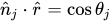 , we have:
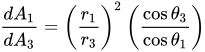
From the figure,  . But there is no hint as to the angle between the unit normal
  and the radial unit vector , except that since the
  exits the surface at both points, we know that:

While for some orientations of the surface areas at 1 and 3, the statement,  , could be true, the statement is not generally true.

This is generally true. Since the electric field falls as  and points in the direction, each term is directly proportional a solid angle. Moreover, since the flux cone exits at both points, the angle between the outward unit normal and the electric field is less than 90°. It must be emphasized that this is true because there is only one point charge is present.

This is generally NOT true. If the charge is positive, the electric field points from left to right, as do both surface areas  and
and  . Hence, both terms are positive (provided the charge is not zero.)

This is generally true.

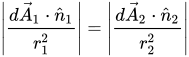 is generally true. The notation
 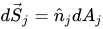 (for
(for  ) is a bit confusing, and selected to compensate for the presence of different notations in the literature. An easy way to remember that
  is to recognize that no other vector definition of a directed surface area is available. As an aside, the absolute value symbols ensure that we don't care whether the electric flux is entering or exiting the Gaussian surface. In other words, the absolute value symbols ensure that all six entities are equal:
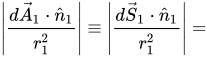
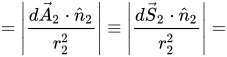
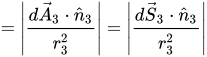

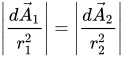 is NOT generally true. However, it is true in the special case that the Gaussian surface's unit normal is parallel to the displacement vector at both locations.
An interesting question
To illustrate the value of such "true-false" questions as a way to scaffold a mathematical proof, it would be interesting for advanced students to attempt to answer the following question:
- Is it generally true that if and only if
 ?
?