In classical (small strain) rate-independent plasticity we start off with an
additive decomposition of the strain tensor
Assuming linear elasticity, we have the following elastic stress-strain law
Let us assume that the theory applies during plastic deformation of
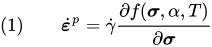
the material. Hence, the material obeys an associated flow rule
where is the plastic flow rate, is the yield function,
is the temperature, and is an internal variable.
Answer the following questions. Show your derivations in a clear and step-by-step manner.
Part 1
Let be the equivalent plastic strain, defined as
Express the time derivative of in terms of and
. This is the evolution law for .
Part 2
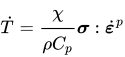
For an adiabatic process, the rate of change of temperature can
be written as
where is the Taylor-Quinney coefficient, is the density,
and is the specific heat. Express in terms of
and . This is the
evolution law for .
Part 3
Write down the rate form of the elastic stress-strain law. Assume
that deformations are small so that objectivity of the rates is not a
concern.
Part 4
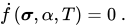
The consistency condition during plastic flow requires that
Write down an expression for the time derivative of
using the chain rule.
Part 5
Use the consistency condition and the expressions you have derived
in the previous parts to derive an expression for in
terms of , ,
, , and .
Part 6
The continuum elastic-plastic tangent modulus is defined by
the following relation
Derive an expression for the elastic plastic tangent modulus using the
results you have derived in the previous parts.
Part 7
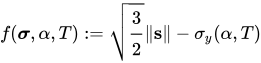
The theory of plasticity also states that the material
satisfies the von Mises yield condition
where is the deviatoric part of the stress .
Derive an expression for in terms of the
normal to the yield surface
Part 8
The yield stress is given by the Johnson-Cook model
where is the initial yield stress, are constants,
is a reference temperature, and is the melt temperature.
Derive expressions for , and
for the von Mises yield condition with the
Johnson-Cook flow stress model.
Part 9
Assume that the elastic response of the material is linear, i.e.,
Derive the expression for the elastic-plastic tangent modulus for a
von Mises yield condition with Johnson-Cook flow stress for a linear
elastic material using the expressions that you have derived in the
previous parts.
Part 10
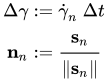
Discretize the equations for (equation 1),
(from part 1), and (from part 2)
using Forward Euler. Use the following notation in your discretized
equations:
where is the time step, is the value
of at , is the value of at
.
Part 11
The Kuhn-Tucker loading-unloading conditions are
Write down a discrete form of the Kuhn-Tucker conditions.
Part 12
In the radial return algorithm, we define a trial elastic state as
where are the stress and strain at and
are the values at . Show
that, if the elastic response of the material is linear,
equation (2) can be written as
Hint: Start by showing that
Part 13
Starting from equation (3) show that
where is the deviatoric part of and is the
deviatoric part of .
Part 14
Show that
Hint: The stress is given by
Express this equation in terms of and .
Then use the discretized equation for (part 10) and
the relation for for isotropic elasticity. Finally compute
the deviatoric stress terms after showing that
Part 15
The discretized form of the Kuhn-Tucker conditions in conjunction
with the consistency condition gives us
Use this condition and the relations you have derived in the
previous sections to arrive at a nonlinear equation in
that can be solved using Newton iterations.
Part 16
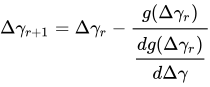
Let the nonlinear equation be . Recall that
the Newton method requires that we iterate using the formula
where is the Newton iteration number. Derive an expression for
the derivative of that is required in the above formula.
(You can use Computational Inelasticity by J.C. Simo and T.J.R. Hughes for pointers.)
Problem 2: Billet Upset Forging
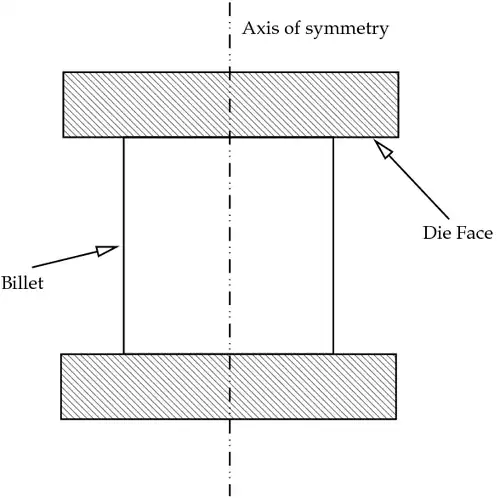
Consider the isothermal upset forging of the cylindrical billet shown
in Figure 2.
Figure 2. Upset forging of a cylindrical billet.
Assume that the dies are rigid. Also assume that sticking friction is
in effect between the billet and the die faces when they are in contact.
The billet has an initial radius of 10 mm and its initial height is 30 mm.
The shear modulus of the material is 384.6 MPa, the bulk modulus of the
material is 833.3 MPa, the initial yield stress is 1 MPa and the linear
hardening modulus is 3 MPa.
Model a quarter of the cylinder using symmetry boundary conditions.
Apply a compressive force of 1 kN to the die.
Plot the final shape of the billet. Compare your results with those shown in Simo and Hughes (Fig. 9.8, p. 325).
Plot a curve of the die force (kN) versus the die stroke (mm). Compare your results with those shown in Simo and Hughes. Do you observe any volumetric locking?
(Use an implicit software to solve these problems.)
Problem 3: Taylor Impact Tests
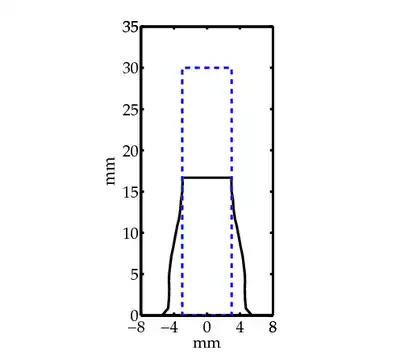
Consider the impact of a cylindrical Taylor impact specimen on
a rigid target. The undeformed and deformed profiles of the
specimen are shown in in Figure 3.
Figure 3. Taylor impact test of a cylindrical rod.
The initial length of the specimen is 30 mm. The initial diameter is
6 mm. The initial velocity is 188 m/s. The initial temperature is 718 K.
The material of the specimen is OFHC copper. The properties of the bar are
(in SI units):
Density
8930.0
Thermal conductivity
386.0
Specific heat
414.0
Shear modulus
46.0e9
Bulk modulus
129.0e9
Coeff. Thermal Expansion
1.76e-5
The plastic deformation of the specimen is described by the Johnson-Cook
model and plasticity. The Johnson-Cook model parameters are (in SI
units):
A
90.0e6
B
292.0e6
C
0.025
n
0.31
m
1.09
1.0
294.0
1356.0
Use LS-DYNA to simulate the Taylor impact test. Assume that there is no friction between the anvil and the specimen. Plot the final deformed shape of the specimen and compare that with the experimentally determined shape given in the table below. What differences do you observe and why?
Point
x (mm)
y (mm)
1
0.000000
0.000000
2
5.436409
0.000000
3
4.711554
0.852540
4
4.611804
2.040725
5
4.581879
3.228910
6
4.615129
4.141866
7
4.585204
4.980980
8
4.448878
6.175878
9
4.312552
7.223092
10
4.073150
8.344149
11
3.870324
9.465205
12
3.597672
10.868203
13
3.388196
11.707317
14
3.218620
12.902215
15
3.152120
13.949429
16
2.982544
15.070486
17
2.952618
16.674871
18
0.000000
16.674871
19
0.000000
0.000000
You can generate a mesh in ANSYS and tranfer it to LS-DYNA if you want.
Show whether energy is conserved during your simulation.
![{\displaystyle {\boldsymbol {\varepsilon }}={\frac {1}{2}}\left[{\boldsymbol {\nabla }}\mathbf {u} +({\boldsymbol {\nabla }}\mathbf {u} )^{T}\right]\qquad {\text{or}}\qquad \varepsilon _{ij}={\frac {1}{2}}(u_{i,j}+u_{j,i})~.}](../b5a1a57334406446db9e517e10040b7d8fc3168c.svg)














![{\displaystyle \sigma _{y}(\alpha ,T)=\left[\sigma _{0}+B\alpha ^{n}\right]\left[1-\left({\cfrac {T-T_{0}}{T_{m}-T_{0}}}\right)\right]}](../20acd46f1b209919acb430425ac1ab381b8e9462.svg)











![{\displaystyle {\text{(3)}}\qquad {\boldsymbol {\sigma }}_{n+1}^{\text{trial}}=\left[\lambda ~{\text{tr}}({\boldsymbol {\varepsilon }}_{n+1})~{\boldsymbol {\mathit {1}}}+2\mu ~{\boldsymbol {\varepsilon }}_{n+1}\right]-\left[\lambda ~{\text{tr}}({\boldsymbol {\varepsilon }}_{n}^{p})~{\boldsymbol {\mathit {1}}}+2\mu ~{\boldsymbol {\varepsilon }}_{n}^{p}\right]~.}](../4be071d6c80033a50d2bcc9cb2201382a4de34dc.svg)