Topological space
A topological space is the fundamental subject of the subdiscipline topology of mathematics. By introducing a topological structure on a set, it is possible to establish.
- intuitive positional relations like "proximity" and
- "convergence against" from the real numbers
 or from the
  , respectively.
to many and very general structures (such as the topology of function spaces).
Definition: topology
A topology is a set system  consisting of subsets (open sets) of a basic set
  for which the following axioms are satisfied.
- (T1)

- (T2)
 for all
  .
.
- (T3) For any index set
 and
and  for all
  holds:
  .
.
A set together with a topology on is called topological space  .
.
By defining all open sets in by the topology  , all closed sets are also defined as complements of an open set
  .
.

Definition - open kernel of a set
Let  be in the topological space , then the open core
  is defined as the "largest" open set contained in
  :
:
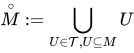
Since in the definition is represented as the union of open sets ,  open by axiom (T3).
Definition - connection of a set
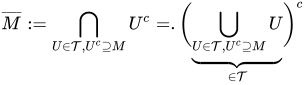
Let be in the topological space , then the closure  is defined as the "smallest" closed set containing :
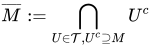
Since in the definition is represented as the intersection of closed sets  with , is again open as the completion of any union of open sets, since it holds again according to (T3):
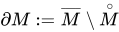
Definition - Boundary of a set
Let be a set in the topological space , then the edge of a set from the closure of the set without the open core of . The boundary is therefore defined as follows:
 .
.
The sets  are by definition open and mutually the two sets form the complements of each other. Thus these two sets are both open and closed at the same time. Therefore, the two sets have no boundary points.
Definition - Neighbourhood
Let  and
and  be a set in a topological space , then the
  is called Neighbourhood of
  if there exists an open set
  with:
with:

The set of all Neighbourhood of with respect to the topology is denoted by  .
.  denotes the set of all open neighbourhoods of .
Definition - Neighbourhood basis
Let and  a set system in a topological space , then the \mathcal{B} is called the neighbourhood basis of if the following properties hold:
- (B1)

- (B2) for each environment
 a neighborhood
  with
with  .
.
Example
The set of open  neighbourhood
  in
in  with the Euclidean topology
  generated by the amount
  is an neighbourhood basis of
  .
.
The neighbourhood basis term helps to prove convergence statements for the neighbourhood basis only, and thus to obtain the statements for arbitrary neighbourhoods as well. In calculus one uses -neighbourhoods in definitions without explicitly addressing the topological aspect of the neighbourhood basis, that proofs in general arbitrary neighbourhoods and not only for the neighbourhood basis. Due to the fact that an arbitrary neighbourhood contains a set of the neighbourhood basis, the most of the convergence proofs can limit themselves to the neighbourhood basis.
Definition - base of topology
Let and  be a set system in a topological space , then the
  is called the basis of if holds:
- (BT1)

- (BT2) for every open set there is an open set
 with .
Example
The set of all open intervals  is a basis of the topology in the topological with the Euclidean topology generated by the amount .
Convergence in topological spaces
In calculus, the convergence of sequences is a central definition to define notions based on it, such as continuity, difference, and integrals. Sequences  with
with  as index set are unsuitable to define convergence in general topological spaces, because the index set is not powerful enough concerning the neighbourhood basis. This is only possible if the topological space has a countable neighbourhood basis. Therefore one goes over either to nets or Filters
Example: topology on texts
Usually, one assumes that topologies are defined on mathematical spaces (e.g., number spaces, function spaces, (topological) groups, vector spaces, ...). However, the generality of the definition makes it also possible to define a topology on texts. This example was added because purely descriptively, e.g., texts in the German language
- can have a similar statement and
- use different words.
This similarity of semantics, or syntax, is explored in more detail as an exercise in "Topology on Texts".
Describe similarity of words by metrics
From spoken words, represent the number of letters and the set of occurring letters as a table. How can you derive a distance of words from the tabulated list. make a suggestion for this. What are the properties of your proposed distance function. Is it a metric on the space of words?
Task - distance between words
- Consider the words "bucket", "buket", "buckett". How can you express the differences of the words by a metric
- Phonetic similarity words "bucket" and "pucket" have a phonetic similarity, but from the sequence of letters the spellings differ greatly. How can you notate similarity of spoken words (Speech Recognition) by a phonetic notation and in this notation of phonemes express a similarity of words as well.
Classification of topological spaces
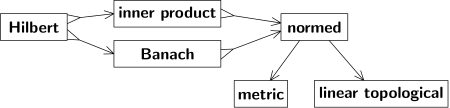
Meaning of Properties topology
- (T1)
 empty set and the basic set are open sets.
- (T2)
 for all
  : the average of finitely many open sets is an open set.
- (T3) The union of any many open sets is again an open set.
Semantics: metric
A metric  associates with
  two elements
  from a base space the distance between
  and
and  .
.
Definition: Metric
Let be an arbitrary set. A mapping  is called a metric on if for any elements , and
  of the following axioms are satisfied:
- (M1) separation:
 ,
,
- (M2) symmetry:
 ,
,
- (M3) triangle inequality:
 .
.
Illustration: metric triangle inequality
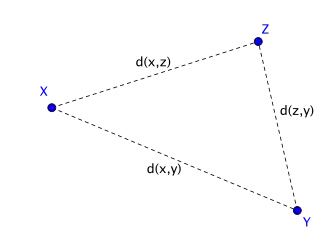
According to the triangle inequality, the distance between two points X,Y is at most as large as sum of the distances from X to Z and from Z to Y, that is, a detour via the point Z
Non-negativity
Non-negativity follows from the three properties of the metric, i.e. for all holds.  . The non-negativity follows from the other properties with:
 .
.

Open sets in metric spaces
- In a metric space
 , one defines a set
  to be open (i.e.
  ) if for every
  there is a
  that the
  -sphere
  lies entirely in (i.e. i.e.
  )
)
- Show that with this defined
 , the pair
  is a topological space (i.e., (T1), (T2), (T3) satisfied).
Norm on vector spaces
A norm is a mapping  from a vector space
  over the body
  of the real or the complex numbers into the set of nonnegative real numbers
  . Here the norm assigns to each vector
  its length
  .
.
Definition: Norm
Let be a vector space and 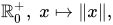 a mapping.
If satisfies the following axioms axioms N1,N2, N3, then is called a norm on .
a mapping.
If satisfies the following axioms axioms N1,N2, N3, then is called a norm on .
- (N1) Definiteness:
 for all ,
- (N2) absolute homogeneity:
 for all and
  .
.
- (N3) Triangle inequality:
 for all
  .
.
The property (N1) is actually an equivalence and it holds in any normed space. If  is the zero vector in and
  is the zero in the field , if is a vector space).
- (N1)' definiteness:
 for all ,
- Since one uses a minimality principle for definitions for the defining property, one would not use a stronger formulation (N1)' in the definition for (N1), since the equivalence from the defining properties of the norm follow the properties of the vector space already for any normed space.

Normed space / Metric space
A normed space  is also a metric space.
- A norm assigns to a vector
 its vector length
  .
.
- The norm can be used to define a metric via
 that specifies the distance between and .
Learning Task: generate metric from given norm
Let be a normed space with norm 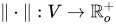 .
Show that the defined mapping
.
Show that the defined mapping  with satisfies the properties of a metric.
Notation: norm
- In the axiom (N2) , denotes the amount of the scalar. "
 " sign: Outer linkage in vector space or multiplication
  .
.
- indicates the length of the vector .
- In (N3) for all . '"
 "-sign denotes two distinct links (i.e., addition in
  and
and  , respectively.
Illustration: norm triangle inequality
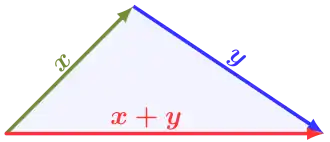 mini
mini
Def: convergence in normalized space
Let be a normalized space and 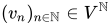 a sequence in and
  :
:

Def: convergence in metric space
Let be a metric space and 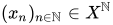 a sequence in and :

Def: Cauchy sequences in metric spaces
Let be a metric space and a sequence in .  is called a Cauchy sequence in
  :
:

Equivalence: norms
Let two norms  and
and  be given on the vector space . The two norms are equivalent if holds:
 .
.
Show that a sequence converges in exactly if it also converges with respect to .
Absolute value in complex numbers
Let  be a complex number with
  . Show that
  is a norm on the
  vector space
  !
!
Historical Notes: Norm
This axiomatic definition of norm was established by Stefan Banach in his 1922 dissertation. The norm symbol in use today was first used by Erhard Schmidt in 1908 as the distance  between vectors and .
See also
Page Information
You can display this page as Wiki2Reveal slides
Wiki2Reveal
The Wiki2Reveal slides were created for the Functional analysis' and the Link for the Wiki2Reveal Slides was created with the link generator.