Construct major edits of in Draft:Physics/A/String vibration or a subpage (e.g., /a, /b, /c.)
“Among vibrating bodies there are none that occupy a more prominent position than Stretched Strings. From the earliest times they have been employed for musical purposes ... . To the mathematician they must always possess a peculiar interest as a battle-field on which were fought out the controversies of D’Alembert, Euler, Bernoulli, and Lagrange relating to the nature of the solutions of partial differential equations. To the student of Acoustics they are doubly important." --"Lord Rayleigh:[32, Vol. I, Chap. VI].[1]
This discussion was motivated by the fact that the flow of energy associated with Poynting vector does not seem physical. This is not the only case of a conservation law seems to leave unanswered questions about the details. Here we consider the conservation of energy in a stretched string. In this case, there is a unique answer to the question, "where is the potential energy". What is odd is how difficult that question is to answer. Rowland published what seems to be acceptable but approximate solutions for some special cases.
DEBUG
This discussion focuses on making a subset of those approximate solutions more accessible to novice lovers of physics.
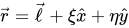
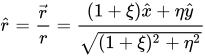
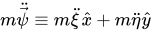
Figure 1. A mass is attached to a spring of length . The mass has been displaced from its equilibrium point by direction and by direction. Both and are assumed small for a wave in the linear regime. The vector represents the distance between consecutive lumped masses when the wave amplitude is zero. It is assumed that because the string is under tension, and is the length of the relaxed spring of spring constant . In expressing Newton's second law, the acceleration is written as using the convention that a dot denotes differentiation with respect to time.
XXX
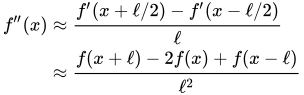
First derivative revisited
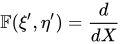
Most readers have probably seen a definition of the derivative that can be found at:
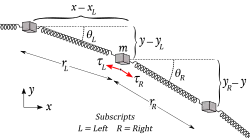
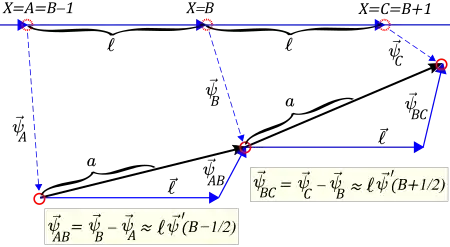
Figure 2: Free-body force diagram for lumped mass model for vibrating string. We label the three masses shown with the consecutive integers
Here we adopt the convention that unit of length. We label masses with the variable that represents each mass by an integer. To obtain a wave equation we focus on the three consecutive integers, . When the string is at equilibrium (i.e., zero wave amplitude), we can also use non-integral values of to form a coordinate system that labels points in space between the masses, as shown in the top of Figure 2.
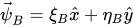
For non-zero wave amplitude, each mass can move away from its equilibrium point by in the x direction and in the y-direction (Rowland, et al, use the symbol to describe motion in the other transverse direction.)
Defining to be the vector associated with this displacement, we have,
We denote
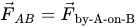
The convention used by OpenStax Physics[2] is that refers to the force on object A by object B. To keep the notation in Figure 2 compact, we define the displacement vector from A to B as:
<math></math>
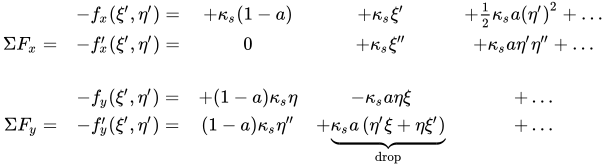
Wave equation
Leave as exercise for the readers to verify the Table (with both compact and PDE forms). And also to realte X to x.
Equation for kappas and a
Define => =>
UNDER CONSTRUCTION: Allowing ℓ≠1
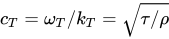
The dimensional analysis conventions introduced in OpenStax University Physics permit us to show that () and () are equivalent to results obtained in reference <sub><big><big>
DEBUG3
From from reference RowlandEJP:
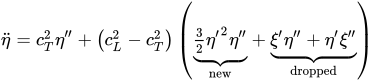
Symbolic computation probably renders this exercise unnecessary, but one way to "guess" the wave equation when is to use dimensional analysis, though if you want certainty it might be better to repeat all the steps with the extra term included. Using






























![{\displaystyle {\begin{array}{rcl}{\vec {f}}_{AB}&=-\kappa _{s}\left[{\vec {\psi }}_{X-1/2}^{\,\prime }-a{\hat {\psi }}_{X-1/2}^{\prime }\right]&={\vec {f}}{\bigl (}{\vec {\psi }}_{X-1/2}^{\,\prime }{\bigr )}\\{\vec {f}}_{CB}&=+\kappa _{s}\left[{\vec {\psi }}_{X+1/2}^{\,\prime }-a{\hat {\psi }}_{X+1/2}^{\prime }\right]&={\vec {f}}{\bigl (}{\vec {\psi }}_{X+1/2}^{\,\prime }{\bigr )}\\\end{array}}}](../../aeadd6e64eeed2e180f3c8c60e127dc438723fb7.svg)