Lead Article: Tables of Physics Formulae
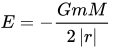
This article is a summary of the laws, principles, defining quantities, and useful formulae in the analysis of Gravitation.
Gravitational Field Definitions
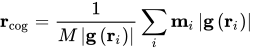
A common misconseption occurs between centre of mass and centre of gravity. They are defined in simalar ways but are not exactly the same quantity. Centre of mass is the mathematical descrition of placing all the mass in the region considered to one position, centre of gravity is a real physical quantity, the point of a body where the gravitational force acts. They are only equal if and only if the external gravitational field is uniform.
Contrary to the strong analogy between (classical) gravitation and electrostatics, there are no "centre of charge" or "centre of electrostatic attraction" analogues.
| Quantity Name
|
(Common) Symbol/s
|
Defining Equation
|
SI Units
|
Dimension
|
| Centre of Gravity |

(Symbols can vary
enourmously)
|
ith moment of mass 
Centre of gravity for a descrete masses
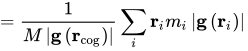
Centre of a gravity for a continuum of mass



|
m
|
[L]
|
| Standard Gravitation
Parameter of a Mass
|

|

|
N m2 kg-1
|
[L]3 [T]-2
|
| Gravitational Field, Field
Strength, Potential Gradient,
Acceleration
|

|

|
N kg-1 = m s-2
|
[L][T]-2
|
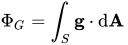
| Gravitational Flux
|

|
|
m3 s-2
|
[L]3[T]-2
|
| Absolute Gravitational Potential
|

|

|
J kg-1
|
[L]2[T]-2
|
| Gravitational Potential Differance
|

|

|
J kg-1
|
[L]2[T]-2
|
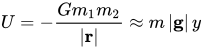
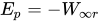
| Gravitational Potential Energy
|

|
|
J
|
[M][L]2[T]-2
|
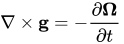
| Gravitational Torsion Field
|

|

|
Hz = s-1
|
[T]-1
|
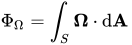
| Gravitational Torsion Flux
|

|
|
N m s kg-1 = m2 s-1
|
[M]2 [T]-1
|
| Gravitomagnetic Field
|

|
|
Hz = s-1
|
[T]-1
|
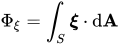
| Gravitomagnetic Flux
|

|
|
N m s kg-1 = m2 s-1
|
[M]2 [T]-1
|
| Gravitomagnetic Vector Potential [1]
|

|

|
m s-1
|
[M] [T]-1
|
Gravitational Potential Gradient and Field

|
Laws of Gravitation
Modern Laws
Gravitomagnetism (GEM) Equations:
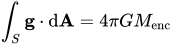
In an relativley flat spacetime due to weak gravitational fields (by General Relativity), the following gravitational analogues of Maxwell's equations can be found, to describe an analogous Gravitomagnetic Field. They are well established by the theory, but have yet to be verified by experiment [2].
| Einstein Tensor Field (ETF) Equations
|
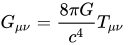
where Gμυ is the Einstien tensor:

|
| GEM Equations
|


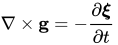
![{\displaystyle \nabla \times {\boldsymbol {\xi }}={\frac {1}{c^{2}}}\left[-4\pi G\mathbf {j} _{\mathrm {m} }+{\frac {\partial \mathbf {g} }{\partial t}}\right]\,\!}](../53d69aeb56f3d6146fe3509ab8e70a6aa6556834.svg)
|
| Gravitomagnetic Lorentz Force
|


|
Classical Laws
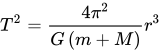
It can be found that Kepler's Laws, though originally discovered from planetary observations (also due to Tycho Brahe), are true for any central forces.
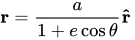
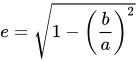
For Kepler's 1st law, the equation is nothing physically fundamental; simply the polar equation of an ellipse where the pole (origin of polar coordinate system) is positioned at a focus of the ellipse, centred on the central star.
e = elliptic eccentricity
a = elliptic semi-major axes = planet aphelion
b = elliptic semi-minor axes = planet perihelion
Gravitational Fields
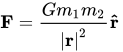
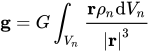
The general formula for calculating classical gravitational fields, due to any mass distribution, is found by using Newtons Law, definition of g, and application of calculus:
|
For uniform mass distributions the table below summarizes common cases.
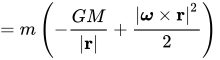
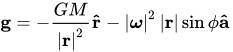
For a massive rotating body (i.e. a planet/star etc), the equation is only true for much less massive bodies (i.e. objects at the surface) in physical contact with the rotating body. Since this is a classical equation, it is only approximatley true at any rate.
| Superposition Principle for
the Gravitational Field
|
|
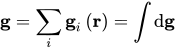
|
| Gravitational Acceleration
|
|

|
| Gravitational Field for
a Rotating (spinning about axis) body
|
 = azimuth angle relative to rotation axis = azimuth angle relative to rotation axis
 = unit vector perpendicular to rotation = unit vector perpendicular to rotation
axis, radial from it
|
|
| Uniform Gravitational Field, Parabolic Motion
|
 = Initail Position = Initail Position
 = Initail Velocity = Initail Velocity
 = Time of Flight = Time of Flight
|
Use Constant Acc. Equations to obtain
![{\displaystyle \mathbf {g} ={\frac {2}{t^{2}}}\left[\left(\mathbf {r} -\mathbf {r} _{0}\right)-\mathbf {v} _{0}t\right]\,\!}](../710aaa87a780376202716af8c930a08bda429caf.svg)
|
| Point Mass
|
|

|
| At a point in a local
array of Point Masses
|
|

|
| Line of Mass
|
 = Mass = Mass
 = Length of mass distribution = Length of mass distribution
|

|
| Spherical Shell
|
 = Mass = Mass
 = Radius = Radius
|
Outside/at Surface 
Inside 

|
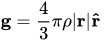
| Spherical Mass Distribution
|
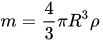 = Mass = Mass
= Radius
|
Outside/at Surface
Inside
|
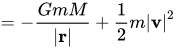
| Gravitational Potential Energy of a
Physical Pendulum in a Uniform Field
|
 = seperation between pivot and centre of mass = seperation between pivot and centre of mass
= length from pivot to centre of gravity
 = mass of pendulum = mass of pendulum
 = mass moment of pendulum = mass moment of pendulum
|

|
| Gravitational Torque on a physical
Pendulum in a Uniform Field
|
|

|
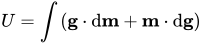
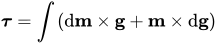
For non-uniform fields and mass-moments, applying differentials of the scalar and vector products then integrating gives the general gravitational torque and potential energy as:
|
Gravitational Potentials
See also
References
- ↑ Gravitation and Inertia, I. Ciufolini and J.A. Wheeler, Princeton Physics Series, 1995, ISBN 0-691-03323-4
- ↑ Gravitation and Inertia, I. Ciufolini and J.A. Wheeler, Princeton Physics Series, 1995, ISBN 0-691-03323-4