Rouché's theorem is a statement about the location of the zeros of holomorphic functions, often used to estimate the number of zeros.
Statement
Let  be open, and let
  be a cycle in
  , which is null-homologous in and winds around every point in its interior exactly once, i.e.,
 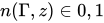 for each
  . Let
. Let  be holomorphic functions such that

holds. Then  and
and  have the same number of zeros (counted with multiplicity) in
  .
.
Proof
For each ![{\displaystyle \lambda \in [0,1]}](./010c0ee88963a09590dd07393d288edd83786b91.svg) , consider the function
, consider the function  . Since
 ,
,
 has no zeros on
  . Since is holomorphic on
  , it follows from the Zero and Pole counting integral that the number of zeros of in is
 .
.
This means it depends continuously on  . A continuous
  -valued function on
 ![{\displaystyle [0,1]}](./738f7d23bb2d9642bab520020873cccbef49768d.svg) is constant, so
is constant, so  and
and  have the same number of zeros in .
Application
An application of Rouché's theorem is a proof of the Fundamental Theorem of Algebra:
Let ![{\displaystyle p(z)=\sum _{k=0}^{n}a_{k}z^{k}\in \mathbb {C} [z]}](./8322ee8e7bfedfca7355f1c66c687056d5c91894.svg) be a polynomial with
be a polynomial with  and
and  . The idea of the proof is to compare
  with
with  (the number of zeros of
  is known). It holds that

for  and a sufficiently large
  . Hence, and have the same number of zeros, namely
  , in
, in  .
.
See also
Page Information
You can display this page as Wiki2Reveal slides
Wiki2Reveal
The Wiki2Reveal slides were created for the Complex Analysis ' and the Link for the Wiki2Reveal Slides was created with the link generator.
Translation and Version Control
This page was translated based on the following Wikiversity source page and uses the concept of Translation and Version Control for a transparent language fork in a Wikiversity:
https://de.wikiversity.org/wiki/Satz_von_Rouché