Introduction
The theorem of continuity for linear mappings provides equivalent conditions for stiffness, with topology-producing functionals norms, seminorms, gauge functionals.
- Normed spaces - TCN The theorem of continuity for normed spaces is a special case of the more general case for topological vector spaces equivalent conditions are formulated for the stiffness of linear mappings over norms.
- Topological vector spaces - TCT This theorem generalizes the continuity of linear mapping for topological vector spaces and gauge functionals.
Linear mappings - finite dimensional vector spaces
A linear mapping  of a finite dimensional vector space
  over the field
  into a vector space
  over the field is always continuous.
Linear mappings - not continuous
Linear mapping of an infinite-dimensional -vector space into a vector space are also not continuous (see Examples).
Continuity for linear mapping - normed spaces
Let  and
and  normed spaces above the field and
 a linear mapping, the following statements are equivalent:
- (1) T is steady at every point

- (2) T is steady in the zero vector

- (3) There is a
 with
with 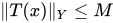 for all with
- (4) There is a with
 for all ,
Proof
The proof of equivalence is performed by a cycle of implications in the following way (1)  (2) (3) (4) (1)
Corrollary of TCN for bilinear mappings
The theorem of continuity can be transfered to bilinear mappings and normed spaces:
Let  ,
,  and normed spaces above the field and
 a bilinear mapping, the following statements are equivalent:
- (1) T is steady at every point

- (2) T is constantly in the zero vector

- (3) There is a with
 for all
  with
with 
- (4) There is a with
 for all ,
The product space  is naturally converted into a -vector space through the following operations
  :
:

With  the product space also becomes a normed space.
Application of Corrolary
It is helpful for the Topologization lemma for algebras to prove the stiffness to a point. scalar multiplication and the multiplication on the algebra are in this context bilineare mappings. For example,  and
and  with
with 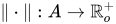 are the submultiplicative standard on the algebra
  .
.
Task - Proof Corollary
Prove the above corollary using the ideas from the theorem of continuity for linear mappings on normed spaces. Notes:
 .
.
- Use the linearity in each component to estimate
 .
.
Task - equivalence of norms - product space
In the above corollar, a standard is defined on . Show that  is a äquivalente Norm on .
Operator standard
The condition (4) from the stiffness set for linear mappings leads to the introduction of the operator space. This makes the vector space of the steady linear functions  a subset of all linear mappings
  itself a normedn space. (the index
  in stands for "continuous".
Alternative statement
Alternatively to (3), the statement can also be formulated as follows:
- There is a with

This is equivalent to
- 698-1047-1747202468649-341-68
Definition: Operatornorm
Be  and
and  normed vector spaces above the field and
  the set of linear mapping of (698-1047-174720246 is
  linearer Operator. Then the operator standard

concerning Vektornormen  and
and  by
by

defined.
The operator standard  provides a smallest upper barrier for the stretching of vectors from the one-piece ball in .
Linear mappings with finite definition range
For finite-dimensional vector spaces, this distinction is not necessary because each finite-dimensional linear mapping is continuous.
Task 1
Prove the set that linear mappings with a finite definition range are steady.
Evidence
Let and
and  have a base of nominated vectors for (i.e.
  for all
 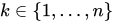 .
.
- Use the statement (3) from the grade for linear mappings.
- Select
 from the completed single ball
  .
.
- Set as Linearkombination of the base vectors.
- Estimate the standard
 .
.
Note: Stability and Standard Limitation
For continuous linear mapping of a normaledn space according to , the image 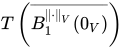 of the completed single ball is limited to the standard (698-1047-174720246.
Stability set for linear mapping on topological vector spaces
Bee  and
and  topological vector spaces with the systems of topologieerzeugenden gauge functionals above the field and
- a linear mapping, the following statements are equivalent:
- (1) T is steady at every point
- (2) T is steady in the zero vector
- (3)

- (4)
 ,
,
Proof SLAT
Also the Stetigkeitssatz für Lineare mapping auf topologischen vector spaces (SLAT) becomes as
Ringschluss of (1) (2) (3) (4) (1).
Korrollar SLAT for bilinear mappings
The assessment of the stiffness rate applies analogously to bilineare mappings and normed spaces:
Bee  ,
,  and normed spaces above the field and
- a bilinear mapping, the following statements are equivalent:
- (1) T is steady at every point
- (2) T is steady in the zero vector
(3)  for all with
- (4)
 for all ,
measure functional and partial order
The index quantities  of the nets are selected as a function of the index quantity of the measured functionals.
  is a suitable choice (see gauge functionale und partielle Ordnung.
See also
Page Information
Translation and Version Control
This page was translated based on the following Wikiversity source page and uses the concept of Translation and Version Control for a transparent language fork in a Wikiversity: