Report 6
Problem 1
Problem Statement
ODE: 
Part 1: show that cos7x and sin7x are linearly independent using the Wronskian and Gramian.
Part 2: Find 2 equations for the two unknowns M, N, and solve for M, N.
Part 3: Find the overall solution y(x) that corresponds to the initial conditions: 
Plot the solution over 3 periods
Solution
Part 1
Wronskian: Function is linearly independent if 




g(x) and f(x) are linearly independent
Gramian: Function is linearly independent if 







g(x) and f(x) are linearly independent
Part 2
The particular solution for a 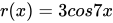 will be:

Differentiate to get:


Plug the derivatives into the equation:


Separate the sin and cos terms to get 2 equations in order to solve for M and N


dividing each equation by cos7x and sin7x respectively:




So the particular solution is:

Part 3
The overall solution can be found by:

The roots given in the problem statement 
Lead to the homogeneous solution of:

Combining the homogeneous and particular solution gives us:

Solving for the constants by using the initial conditions




The overall solution is:

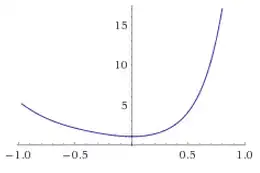
Plot
Plot
over 3 periods:
Honor Pledge
On our honor, we solved this problem on our own, without aid from online solutions or solutions from previous semesters.
Problem 2
Problem Statement
Complete the solution to problem on p.8-6.
Find the overall solution 
that corresponds to the initial condition
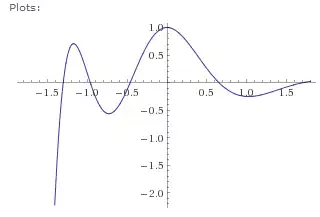
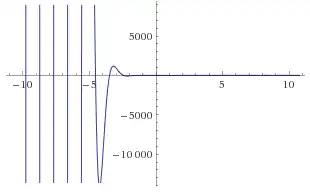
Plot solution over 3 periods.
Solution
Given:





Solve for M and N:



Using initial conditions given find A and B
After applying initial conditions, we get


Honor Pledge
On our honor, we solved this problem on our own, without aid from online solutions or solutions from previous semesters.
Problem 3
Problem Statement
Is the given function even or odd or neither even nor odd? Find its Fourier Series.
Solution

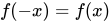 so
so  is an even function.
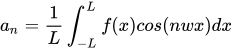
The Fourier series is ![{\displaystyle f(x)=a_{0}+\sum _{n=1}^{\infty }[a_{n}cos(nwx)+b_{n}sin(nwx)]}](../../../572aa93560e3630683588a21c7ec56e16ddf8c5b.svg) .
.

For 
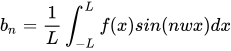
For
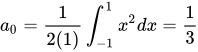
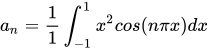
The above integral requires two iterations of integration by parts. Which gives
![{\displaystyle a_{n}={\frac {1}{n\pi }}[sin(n\pi )-sin(-n\pi )]+{\frac {2}{n^{2}\pi ^{2}}}[cos(n\pi )+cos(-n\pi )]-{\frac {2}{n^{3}\pi ^{3}}}[sin(n\pi )-sin(-n\pi )]}](../../../d258d6131ac7db6db3bb6f452fefd88e4665da2a.svg)
Similarly, integration by parts needs to be used twice to solve the following integral.

![{\displaystyle b_{n}={\frac {-1}{n\pi }}[cos(n\pi )-cos(-n\pi )]+{\frac {2}{n^{2}\pi ^{2}}}[sin(n\pi )+sin(-n\pi )]+{\frac {2}{n^{3}\pi ^{3}}}[cos(n\pi )-cos(-n\pi )]}](../../../d1701f6016a8083df714cbc0dd71c9713fd9bcc6.svg)
So the Fourier series for is
![{\displaystyle {\frac {1}{3}}+\sum _{n=1}^{\infty }cos(nwx)[{\frac {1}{n\pi }}[sin(n\pi )-sin(-n\pi )]+{\frac {2}{n^{2}\pi ^{2}}}[cos(n\pi )+cos(-n\pi )]-{\frac {2}{n^{3}\pi ^{3}}}[sin(n\pi )-sin(-n\pi )]]}](../../../4d1b3c785ae7c556a2ef2c7898b84e5b699ca899.svg)
![{\displaystyle +sin(nwx)[-{\frac {1}{n\pi }}[cos(n\pi )-cos(-n\pi )]+{\frac {2}{n^{2}\pi ^{2}}}[sin(n\pi )+sin(-n\pi )]+{\frac {2}{n^{3}\pi ^{3}}}[cos(n\pi )-cos(-n\pi )]]}](../../../1d9a819ff8a5c1b538d2e0c1f188752c8061c7d1.svg)
Honor Pledge
On our honor, we solved this problem on our own, without aid from online solutions or solutions from previous semesters.
Problem 4
Problem Statement
1) Develop the Fourier series of . Plotand develop the truncated Fourier series
 .
.
![{\displaystyle f_{n}({\bar {x}}):={\bar {a}}_{0}+\sum _{k=1}^{n}[{\bar {a}}_{k}\cos k\omega {\bar {x}}+{\bar {b}}_{k}\sin k\omega {\bar {x}}]}](../../../b4148a2e3b7a30083ad8bd117fa313bd2b8f2204.svg)
for n = 0,1,2,4,8. Observe the values of at the points of discontinuities, and the Gibbs phenomenon. Transform the variable so to obtain the
Fourier series expansion of . Level 1: n=0,1.
2)Do the same as above, but using to obtain the Fourier series expansion of
 ; compare to the result obtained above. Level 1: n=0,1.
Solution
Part 1
To begin, the function was determined to be even. Even functions reduce to a cosine Fourier series.
Because , has a period of 4, the length is 2.
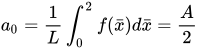
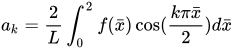

![{\displaystyle f_{k}({\bar {x}})=a_{0}+\sum _{k=1}^{n}[a_{n}\cos {\frac {n\pi {\bar {x}}}{2}}]}](../../../6cc46d3cbd89239f72ac5880a5d2d543eb352c72.svg)
![{\displaystyle f_{k}={\frac {A}{2}}+\sum _{k=1}^{n}[{{\frac {2A}{k\pi }}\sin({\frac {k\pi }{2}})}\cos {\frac {k\pi {\bar {x}}}{2}}]}](../../../1e8c93229a59b63538e7e80387133e57164cd1b3.svg)
For n=0,

For n=1,



Plot (A=1)
.JPG)
Part 2
To begin, the function was determined to be odd. Even functions reduce to a sine Fourier series.
Because , has a period of 4, the length is 2.


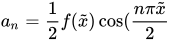 from 0 to 4


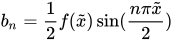 from 0 to 4

![{\displaystyle f_{k}({\tilde {x}})={\frac {A}{2}}+\sum _{k=1}^{n}[{\frac {A}{k\pi }}(1-\cos(\pi k))(\sin({\frac {k\pi {\tilde {x}}}{2}}))]}](../../../933cdaee1e78aa31c54808efafc3dc19c3b120dc.svg)
For n=0,

For n=1,


Plot (A=1)
.JPG)
Honor Pledge
On our honor, we solved this problem on our own, without aid from online solutions or solutions from previous semesters.
Problem 5
Problem Statement
Find the separated ODE's for the Heat Equation:
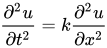 (1)
(1)
 heat capacity
Solution
Separation of Variables:
Assume: 
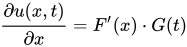 (2)
(2)
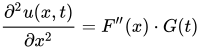 (3)
(3)
 (4)
(4)
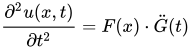 (5)
(5)
Plug (2) and (3) into Heat Equation (1):
 (6)
(6)
Rearrange (6) to combine like terms:


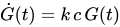




Solution:
Separated ODE's for Heat Equation:
Honor Pledge
On our honor, we solved this problem on our own, without aid from online solutions or solutions from previous semesters.
Problem 6
Problem Statement
Verify (4)-(5) p.19-9
(4)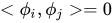 for
for 
(5) for
for 
Solution
Verification of (4)
Using the integral scalar product calculation,

Substituting in sin values,
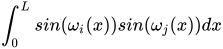
Using  and
and 
You can substitute z into the integral instead of x.

Integrating,
![{\displaystyle {\frac {1}{2}}[{\frac {sin(i-j)z}{i-j}}-{\frac {sin(i+j)z}{i+j}}]}](../../../2ce36a3c8f876d2f7be13eb64e2a9a2867294867.svg) from
from  to
to 
Since , the equation with its sin values turns into 0-0=0
Verification of (5)
You can use the same equation from the verification of (4) from this point:
from to
Putting those values in and substituting L back in the equation, it turns into 
Honor Pledge
On our honor, we solved this problem on our own, without aid from online solutions or solutions from previous semesters.
Problem 7
Problem Statement

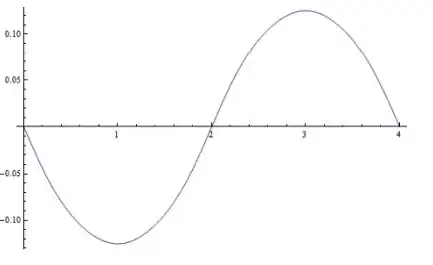
Plot the truncated series for n=5.


Solution
![{\displaystyle a_{j}={\frac {2[((-1)^{j})-1]}{\pi ^{3}j^{3}}}}](../../../e26da390654d425ff6ffa2e7c79e2834e53977a0.svg)

C=3 and L=2
Plot 

Plot 

Plot 

Plot 
Honor Pledge
On our honor, we solved this problem on our own, without aid from online solutions or solutions from previous semesters.