Report 7
Intermediate Engineering Analysis
Section 7566
Team 11
Due date: April 25, 2012.
R7.1
Solved by Andrea Vargas
Problem Statement
Verify (4)-(5) pg 19-9:
(4)  for
for 
(5) 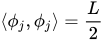 for
for 
Solution
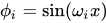
From the lecture notes on p.19-9 we know that:
(2) 
(3) 
Then, we have

Since the period of  is
is  and we know that
  , we can assume that
  for simplicity.
We can compute the result of the previous integral using Wolfram ALpha (Mathematica software). The following is the input given to the software:
int from 0 to pi sin(ax)sin(bx)
where a is  and b is
  . The software generates the following answer:

Substituting for and :

We also know that  where c is any integer. We can cancel any terms with
  or
or  as they are equal to zero.
Then, we can verify:
(4) for
Similarly we can verify (5).
We have

Here, we will keep the integration boundaries as  to be consistent with the problem statement.
We can compute the result of the previous integral using Wolfram ALpha (Mathematica software). The following is the input given to the software:
int 0 to L (sin(ax))^2
where a is . The software generates the following answer:
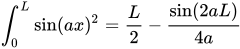
Substituting for :
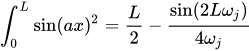
We know from the previous explanation that .So,we can apply the same assumption as before that where c is any integer. This allows us to cancel any terms with  as they are equal to zero.
Then, we can verify:
(5) for
R7.2
Solved by Francisco Arrieta
Problem Statement
Plot the truncated series 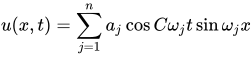 with
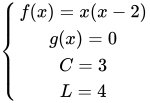
with  and for:
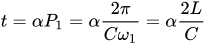

Solution
Using:
Then:
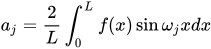
![{\displaystyle =2\left[{\frac {(-1)^{j}-1}{\pi ^{3}j^{3}}}\right]\!}](../../4b9edee1735a65c4e8e77e0fe0d8c56c42df298c.svg)
 for all even values of j
Plugging back to the truncated series:
![{\displaystyle u(x,t)=\sum _{j=1}^{n}2\left[{\frac {(-1)^{j}-1}{\pi ^{3}j^{3}}}\right]\cos[C{\frac {j\pi }{L}}\alpha {\frac {2L}{C}}]\sin[{\frac {j\pi }{L}}x]\!}](../../bc3e5da7427b39a2b47f74c890be6daa36b4584c.svg)
![{\displaystyle =\sum _{j=1}^{n}2\left[{\frac {(-1)^{j}-1}{\pi ^{3}j^{3}}}\right]\cos(\alpha j2\pi )\sin({\frac {j\pi }{2}}x)\!}](../../f4d178327c761aef07b1e905e1b7cc8c4a17f83d.svg)
For :
![{\displaystyle u(x,t)=[{\frac {-4}{\pi ^{3}}}\cos(2\pi \alpha )\sin({\frac {\pi x}{2}})]+[{\frac {-4}{27\pi ^{3}}}\cos(6\pi \alpha )\sin({\frac {3\pi x}{2}})]+[{\frac {-4}{125\pi ^{3}}}\cos(10\pi \alpha )\sin({\frac {5\pi x}{2}})]\!}](../../ecbb2bafe8d86dfbd5fb43ce8281b85f2833499a.svg)
When  :
:
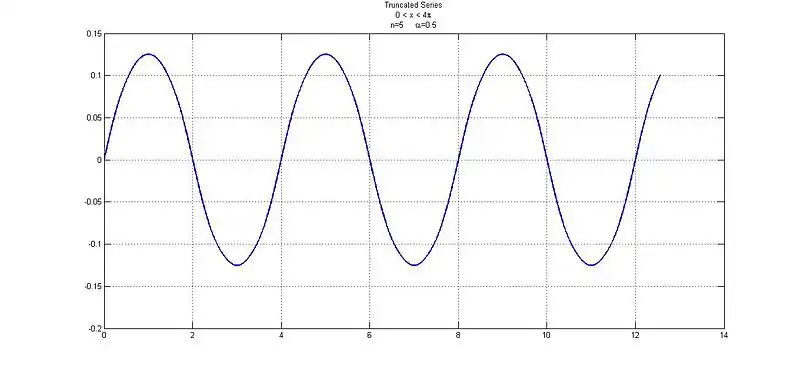
When  :
:
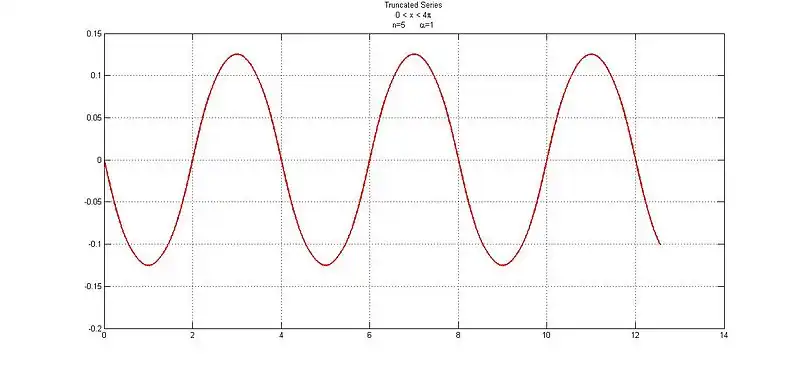
When  :
:
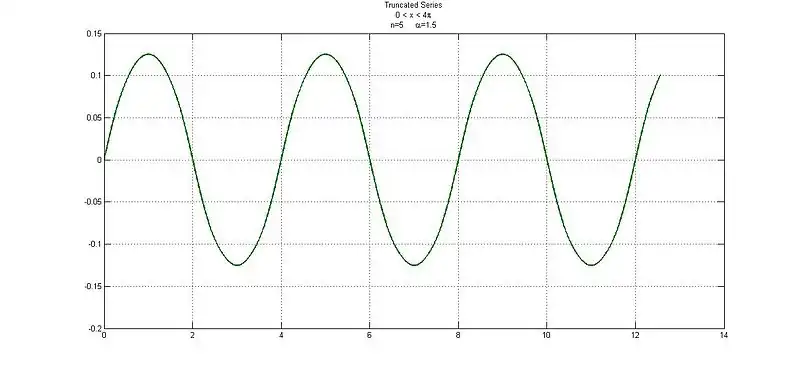
When  :
:
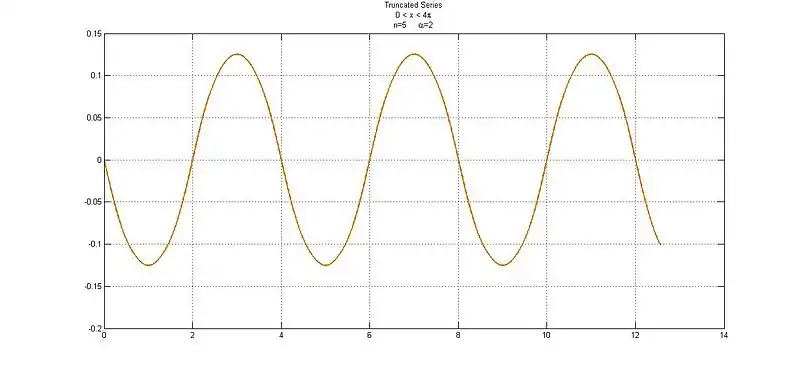
--Egm4313.s12.team11.arrieta (talk) 06:20, 22 April 2012 (UTC)
R7.3
Problem Statement
Find (a) the scalar product, (b) the magnitude of  and
and  ,(c) the angle between and for:
1) 
2) 
Part 1
solved by Kyle Gooding
Scalar Product

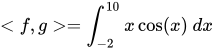
Using integration by parts;
![{\displaystyle <f,g>=[x\sin(x)+\cos(x)]_{-2}^{10}}](../../06ebb57cd5e38e25a1c85810efce7780355558e0.svg)

Magnitude

![{\displaystyle =\int _{-2}^{10}[\cos(x)]^{2}\ dx\!}](../../6b9fed1f7272d0c3ded1fd8e5370e7c8722806eb.svg)
![{\displaystyle =[.5(x+\sin(x)\cos(x)|_{-2}^{10}]^{1/2}}](../../28efb2c181e6b7c741e4acd76bdd1ad27d91076f.svg)

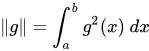
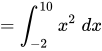
![{\displaystyle =[x^{3}/3]_{-2}^{10}}](../../37d38251d182847ee8da52d55a500779afb2a40d.svg)

Angle Between Functions

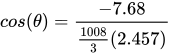

The two functions are nearly orthogonal.
Part 2
solved by Luca Imponenti
Scalar Product
![{\displaystyle <f,g>=\int _{-1}^{1}[{\frac {1}{2}}(3x^{2}-1)][{\frac {1}{2}}(5x^{3}-3x)]\ dx\!}](../../dfc6e327a734ba8f03bbf1230e50e5e98223f28f.svg)
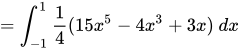

![{\displaystyle ={\frac {1}{4}}[({\frac {15}{6}}1^{6}-1^{4}+{\frac {3}{2}}1^{2})-({\frac {15}{6}}(-1)^{6}-(-1)^{4}+{\frac {3}{2}}(-1)^{2})]\!}](../../53cff8357d3b5f93f2fbaae853728c278b35d84e.svg)
Since all exponents are even, everything in brackets cancels out

Magnitude
![{\displaystyle =\int _{-1}^{1}[{\frac {1}{2}}(3x^{2}-1)]^{2}\ dx\!}](../../96ccb23d62629ff7917a2a6e03e2a6750c6a1cb2.svg)

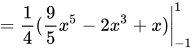
![{\displaystyle ={\frac {1}{4}}[({\frac {9}{5}}1^{5}-2(1)^{3}+1)-({\frac {9}{5}}(-1)^{5}-2(-1)^{3}+(-1))]\!}](../../6a67a46b3168d49f86e6b9d5193940336b666e72.svg)
![{\displaystyle ={\frac {1}{4}}[{\frac {4}{5}}-(-{\frac {4}{5}})]\!}](../../c25eee2b658f4822793325fe55dbe628ec494f4e.svg)

![{\displaystyle =\int _{-1}^{1}[{\frac {1}{2}}(5x^{3}-3x)]^{2}\ dx\!}](../../b7dab4c84a1b03ac40fba4b50302dfb4d1a45262.svg)

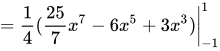
![{\displaystyle ={\frac {1}{4}}[({\frac {25}{7}}1^{7}-6(1)^{5}+3(1)^{3})-({\frac {25}{7}}(-1)^{7}-6(-1)^{5}+3(-1)^{3})]\!}](../../a4531b4d40107736928a68a1c13e726c81505e0f.svg)
![{\displaystyle ={\frac {1}{4}}[{\frac {4}{7}}-(-{\frac {4}{7}})]\!}](../../3dc29b7811deeaa641b8e5ecbb01cb934edd33a2.svg)

Angle Between Functions
Since the two functions are orthogonal

R7.4
Solved by Gonzalo Perez
K 2011 pg.482 pb. 6
Problem Statement
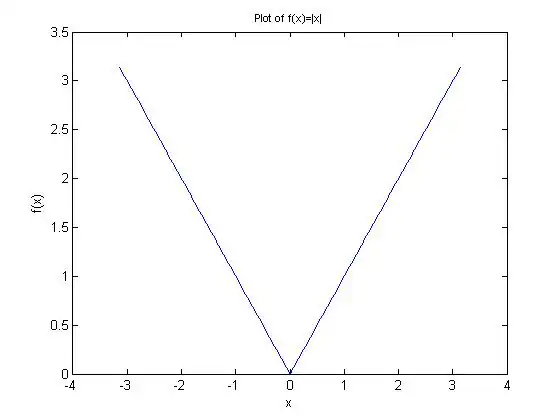
Sketch or graph  which for
  is given as follows:

Solution
The MATLAB code shown below was used to developed the graph of :

K 2011 pg.482 pb. 9
Problem Statement
Sketch or graph which for is given as follows:
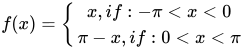
Solution
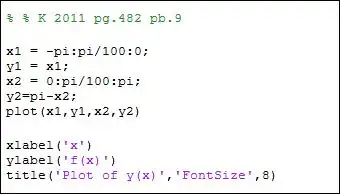
The MATLAB code shown below was used to developed the graph of the piecewise function :

Solved by Jonathan Sheider
K 2011 p.482 pb. 12
Problem Statement
Find the Fourier series of the given function which is assumed to have a period of . Show the details of your work.
Sketch or graph the partial sums up to that including  and
and 
Given:

Solution
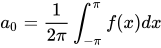
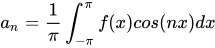
The Fourier series of a function with a period of  is defined:

Where:

This particular function given in the problem can be also defined in a piecewise manner over this interval, namely:
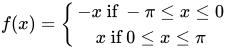
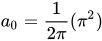
Calculating the first term  :
:

![{\displaystyle a_{0}={\frac {1}{2\pi }}\left(\left[{\frac {-x^{2}}{2}}\right]_{-\pi }^{0}+\left[{\frac {x^{2}}{2}}\right]_{0}^{\pi }\right)\!}](../../4e17df4be9800f3431026f88698aeddb9583aec3.svg)


Calculating the coefficient  :
:


Using integration by parts with the following substitutions:
 and therefore
 and therefore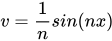
This yields for the integral:
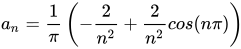
![{\displaystyle a_{n}={\frac {1}{\pi }}\left(-\left[{\frac {1}{n}}xsin(nx)-\int {\frac {1}{n}}sin(nx)dx\right]_{-\pi }^{0}+\left[{\frac {1}{n}}xsin(nx)-\int {\frac {1}{n}}sin(nx)dx\right]_{0}^{\pi }\right)\!}](../../59f207735cd3f6a76889368cf0bcffbae9093c82.svg)
![{\displaystyle a_{n}={\frac {1}{\pi }}\left(-\left[{\frac {1}{n}}xsin(nx)+{\frac {1}{n^{2}}}cos(nx)\right]_{-\pi }^{0}+\left[{\frac {1}{n}}xsin(nx)+{\frac {1}{n^{2}}}cos(nx)\right]_{0}^{\pi }\right)\!}](../../e2b633c9c87057353bf6ee823049d2b4c115a542.svg)
![{\displaystyle a_{n}={\frac {1}{\pi }}\left(-\left[{\frac {1}{n^{2}}}-\left({\frac {1}{n}}(-\pi )sin(-n\pi )+{\frac {1}{n^{2}}}cos(-n\pi )\right)\right]+\left[{\frac {1}{n}}\pi sin(n\pi )+{\frac {1}{n^{2}}}cos(n\pi )-{\frac {1}{n^{2}}}\right]\right)\!}](../../32d9959d8d3079033c212a612dfe6e0701340f3d.svg)
Note that for all n = 1,2,3... :  as
as  therefore these terms are evaluated as zero, which yields:
![{\displaystyle a_{n}={\frac {1}{\pi }}\left(-\left[{\frac {1}{n^{2}}}-\left(0+{\frac {1}{n^{2}}}cos(-n\pi )\right)\right]+\left[0+{\frac {1}{n^{2}}}cos(n\pi )-{\frac {1}{n^{2}}}\right]\right)\!}](../../8d8a40694482606047531daefc07e8dc0137c4ad.svg)

Note that  therefore:


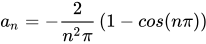
To evaluate the term 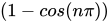 :
:
Note that 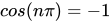 for odd n values as
And that  for even n values as
  .
.
Therefore, it can be concluded that for odd n values:

And for even n values:

Therefore, for the coefficient , all even terms will equal zero while all odd terms will have a multiplier of 2, this yields (for all odd n values):

Calculating the coefficient  :
:


Using integration by parts with the following substitutions:
and therefore
 and therefore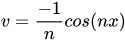
This yields for the integral:
![{\displaystyle b_{n}={\frac {1}{\pi }}\left(-\left[{\frac {-1}{n}}xcos(nx)-\int {\frac {-1}{n}}cos(nx)dx\right]_{-\pi }^{0}+\left[{\frac {-1}{n}}xcos(nx)-\int {\frac {-1}{n}}cos(nx)dx\right]_{0}^{\pi }\right)\!}](../../975903e802e5abdabbcb2ba1c3195f0fdacd3607.svg)
![{\displaystyle b_{n}={\frac {1}{\pi }}\left(-\left[{\frac {-1}{n}}xcos(nx)+{\frac {1}{n^{2}}}sin(nx)\right]_{-\pi }^{0}+\left[{\frac {-1}{n}}xcos(nx)+{\frac {1}{n^{2}}}sin(nx)\right]_{0}^{\pi }\right)\!}](../../68fecd9942e380ab24ceae33d529c500cec18c82.svg)
![{\displaystyle b_{n}={\frac {1}{\pi }}\left(-\left[0-\left({\frac {-1}{n}}(-\pi )cos(-n\pi )+{\frac {1}{n^{2}}}sin(-n\pi )\right)\right]+\left[{\frac {-1}{n}}\pi cos(n\pi )+{\frac {1}{n^{2}}}sin(n\pi )-0\right]\right)\!}](../../95ab7b425606a7908018f24b660d5e5cd7f3caa9.svg)
Note that for all n = 1,2,3... : as therefore these terms are evaluated as zero, which yields:
![{\displaystyle b_{n}={\frac {1}{\pi }}\left(-\left[0-\left({\frac {-1}{n}}(-\pi )cos(-n\pi )+0\right)\right]+\left[{\frac {-1}{n}}\pi cos(n\pi )+0\right]\right)\!}](../../9e42a5d3165b5afa0d7c91bd861e6184a01a373b.svg)
![{\displaystyle b_{n}={\frac {1}{\pi }}\left(\left[{\frac {1}{n}}(\pi )cos(-n\pi )\right]+\left[{\frac {-1}{n}}\pi cos(n\pi )\right]\right)\!}](../../347593712464e1543f4132ae4cb28e07450c530d.svg)
Note that therefore:



Therefore there will be no  terms in the Fourier representation.
In conclusion, the Fourier series representation for the given function is as follows:
terms in the Fourier representation.
In conclusion, the Fourier series representation for the given function is as follows:


A graph of the function, and the Fourier series for  is shown below:
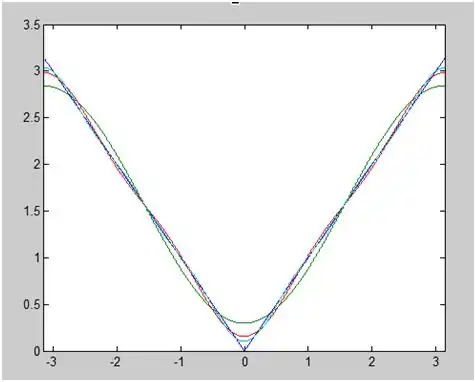
--Egm4313.s12.team11.sheider (talk) 06:00, 22 April 2012 (UTC)
K 2011 p.482 pb. 13
Problem Statement
Find the Fourier series of the given function which is assumed to have a period of . Show the details of your work.
Sketch or graph the partial sums up to that including and
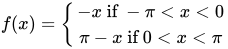
Given:
Solution
The Fourier series of a function with a period of is defined:
Where:
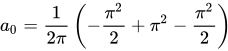
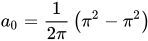
Calculating the first term :

![{\displaystyle a_{0}={\frac {1}{2\pi }}\left(\left[{\frac {x^{2}}{2}}\right]_{-\pi }^{0}+\left[\pi x-{\frac {x^{2}}{2}}\right]_{0}^{\pi }\right)\!}](../../af09909b1e049b7124b5d70c419623a1149ee34f.svg)


Calculating the coefficient :

Using integration by parts with the following substitutions for the integral 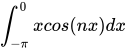 :
:
and therefore
and therefore
Using integration by parts with the following substitutions for the integral 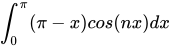 :
:
 and therefore
and therefore
This yields for the overall expression:
![{\displaystyle a_{n}={\frac {1}{\pi }}\left(\left[{\frac {1}{n}}xsin(nx)-\int {\frac {1}{n}}sin(nx)dx\right]_{-\pi }^{0}+\left[{\frac {1}{n}}(\pi -x)sin(nx)-\int -{\frac {1}{n}}sin(nx)dx\right]_{0}^{\pi }\right)\!}](../../6e6b3207229bdc26ff5d126f3958fa7bcb0a47ce.svg)
![{\displaystyle a_{n}={\frac {1}{\pi }}\left(\left[{\frac {1}{n}}xsin(nx)+{\frac {1}{n^{2}}}cos(nx)\right]_{-\pi }^{0}+\left[{\frac {1}{n}}(\pi -x)sin(nx)-{\frac {1}{n^{2}}}cos(nx)\right]_{0}^{\pi }\right)\!}](../../790cd72d4dced9490edb09171b99475fcde079c5.svg)
![{\displaystyle a_{n}={\frac {1}{\pi }}\left(\left[{\frac {1}{n^{2}}}-\left({\frac {1}{n}}(-\pi )sin(-n\pi )+{\frac {1}{n^{2}}}cos(-n\pi )\right)\right]+\left[-{\frac {1}{n^{2}}}cos(n\pi )+{\frac {1}{n^{2}}}\right]\right)\!}](../../5184b16af9520d7856eeb6a65c90aa3c1950b99b.svg)
Note that for all n = 1,2,3... : as therefore these terms are evaluated as zero, which yields:
![{\displaystyle a_{n}={\frac {1}{\pi }}\left(\left[{\frac {1}{n^{2}}}-0-{\frac {1}{n^{2}}}cos(-n\pi )\right]+\left[-{\frac {1}{n^{2}}}cos(n\pi )+{\frac {1}{n^{2}}}\right]\right)\!}](../../345a49f8d9cfaa705639ff511d9e4376e59ae97e.svg)

Note that therefore:

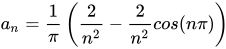

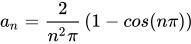
To evaluate the term :
Note that for odd n values as
And that for even n values as .
Therefore, it can be concluded that for odd n values:
And for even n values:

Therefore, for the coefficient , all even terms will equal zero while all odd terms will have a multiplier of 2, this yields (for all odd n values):
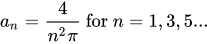
Calculating the coefficient :

Using integration by parts with the following substitutions for the integral 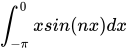 :
:
and therefore
and therefore
Using integration by parts with the following substitutions for the integral 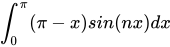 :
:
and therefore
and therefore
This yields for the overall expression:
![{\displaystyle b_{n}={\frac {1}{\pi }}\left(\left[{\frac {-1}{n}}xcos(nx)-\int {\frac {-1}{n}}cos(nx)dx\right]_{-\pi }^{0}+\left[{\frac {-1}{n}}(\pi -x)cos(nx)-\int -{\frac {-1}{n}}cos(nx)dx\right]_{0}^{\pi }\right)\!}](../../00a82d3af7cc8e00ce618d200c082ce312b8f3cd.svg)
![{\displaystyle b_{n}={\frac {1}{\pi }}\left(\left[{\frac {-1}{n}}xcos(nx)+{\frac {1}{n^{2}}}sin(nx)\right]_{-\pi }^{0}+\left[{\frac {-1}{n}}(\pi -x)cos(nx)-{\frac {1}{n^{2}}}sin(nx)\right]_{0}^{\pi }\right)\!}](../../9beafbe721d90b04eb33c2221973042d165ed8b4.svg)
![{\displaystyle b_{n}={\frac {1}{\pi }}\left(\left[0-\left({\frac {-1}{n}}(-\pi )cos(-n\pi )+{\frac {1}{n^{2}}}sin(-n\pi )\right)\right]+\left[-{\frac {1}{n^{2}}}sin(n\pi )-\left({\frac {-1}{n}}\pi \right)\right]\right)\!}](../../9d1dee6e11e995af845e98577345badbea5d4243.svg)

Note that for all n = 1,2,3... : as therefore these terms are evaluated as zero, which yields:


Note that therefore:
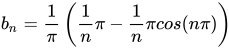

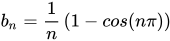
To evaluate the term :
Note that for odd n values as
And that for even n values as .
Therefore, it can be concluded that for odd n values:
And for even n values:
Therefore, for the coefficient , all even terms will equal zero while all odd terms will have a multiplier of 2, this yields (for all odd n values):

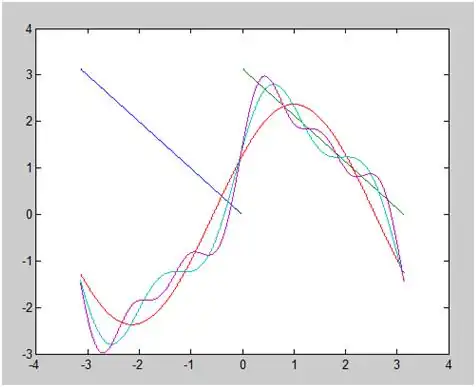
In conclusion, the Fourier series representation for the given function is as follows:


A graph of the function, and the Fourier series for is shown below:
--Egm4313.s12.team11.sheider (talk) 06:00, 22 April 2012 (UTC)
R7.5
Solved by Daniel Suh
Problem Statement
Consider the following,


with  , and
, and 
1. Find the integration with the given data.
2. Confirm the results with Matlab's trapz command for the trapezoidal rule.
Solution
Part 1
Trigonometric Identities
Angle Sum and Difference Identities


Rearrange


Substitute and Combine



Utilize Trig Identities







Part 2
>> X = 0:2*pi/100:2*pi;
>> Y = sin(2*X).*sin(3*X);
>> Z = trapz(X,Y)
Z =
2.9490e-017