Part 3
Solved by Luca Imponenti
Find  , for
, for  such that:

for  in
in ![{\displaystyle [0.9,3]\!}](../../../bb2c515c8c74080e5a7916ac7bd889dc9164916e.svg) with the initial conditions found.
with the initial conditions found.
Plot for for in .
Homogeneous Solution
The homogeneous case is shown below:

This equation has the following roots:

Which gives yields the homogeneous solution

General Solution, n=4
Using the taylor series approximation from earlier with  we have

We know the particular solution,  , ve will have this form:

taking the derivatives of this solution

and

Plugging the above equations into the original ODE yields the following matrix equation:

The unknown vector  can be easily solved by forward substitution,the following values were calculated in matlab:

So the particular solution  is
is

We can now find the general solution for n=4,  .
.



Solving using the initial conditions yields;

General Solution, n=7
Using the taylor series approximation from earlier with  we have

In a similar fashion we construct a matrix equation for n=7:
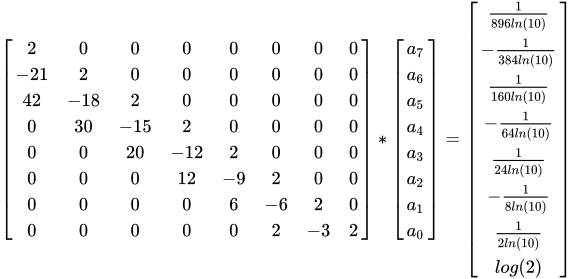
Solving:

So the particular solution  is
is

We can now find the general solution for n=7,  .
.



Solving using our initial conditions yields



General Solution, n=11
Using the taylor series approximation from earlier with  we have


Finally, we write out the matrix equation for n=11:
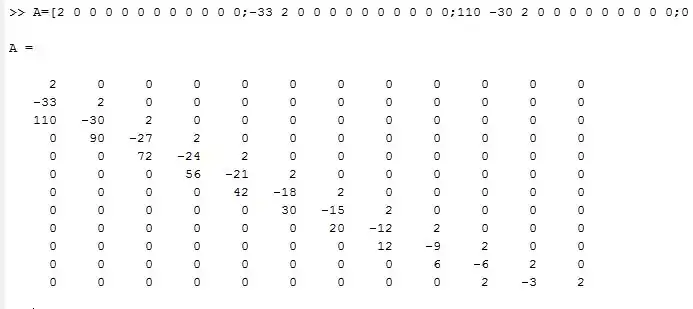
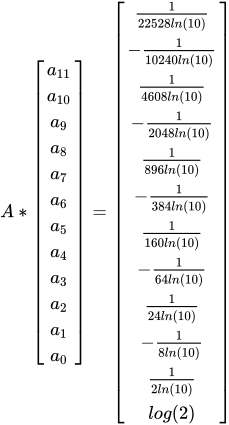
Solving the system in matlab:


So the particular solution  is
is


We can now find the general solution for n=11,  .
.



Solving using our initial conditions yields



Plot
 shown in red
 shown in blue
 shown in green

Part 4
Solved by Luca Imponenti
Use the matlab command ode45 to integrate numerically  with
with 
and the initial conditions from Part 3 to obtain the numerical solution for y(x).
Plot y(x) in the same figure as above.
Matlab Solution
The numerical solution calculated using the matlab ode45 command is shown below:
 ans =
   0.2788
   0.2854
   0.2923
   0.2997
   0.3074
   0.3229
   0.3401
   0.3592
   0.3804
   0.4040
   0.4302
   0.4595
   0.4921
   0.5285
   0.5691
   0.6145
   0.6651
   0.7218
   0.7850
   0.8557
   0.9346
   1.0228
   1.1213
   1.2313
   1.3542
   1.4914
   1.6445
   1.8155
   2.0063
   2.2193
   2.4569
   2.7219
   3.0175
   3.3471
   3.7146
   4.1243
   4.5809
   5.0898
   5.6568
   6.2885
   6.9921
   7.3442
   7.7142
   8.1032
   8.5119
Plot
Plotting the aboved vector of y-values,along with the results from earlier yields the following graph:
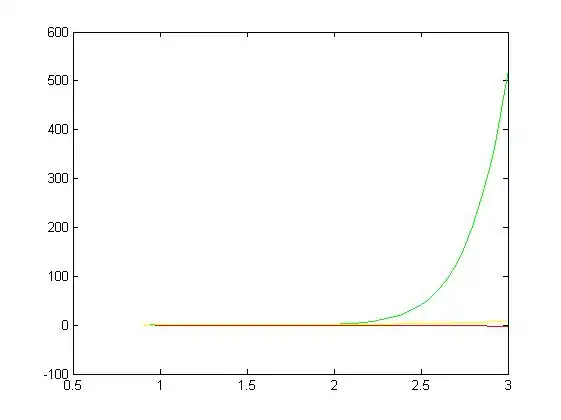
where the answer calculated in matlab is shown in yellow.
Egm4313.s12.team11.imponenti (talk) 08:04, 14 March 2012 (UTC)