Report 5
R5.1
Question
Find  for the following series:
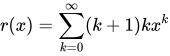
1. 
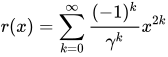
2. 

Use (2)-(3)p.7-31 to find for the Taylor series of
3.  at
at 
4.  at
at
5. at 
Solution
1. 
Using L'Hospital's rule and (2)p.7-31, and setting 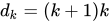 :
:
![{\displaystyle R_{c}=\left[\lim _{k\to \infty }\left|{\frac {(k+2)(k+1)}{(k+1)k}}\right|\right]^{-1}=\left[\lim _{k\to \infty }\left|{\frac {k+2}{k}}\right|\right]^{-1}=\left[\lim _{k\to \infty }\left|{\frac {1}{1}}\right|\right]^{-1}=1}](../../d89ec676f3cf615faaeb0997172dcb95b74783ba.svg)
2.
Using (3)p.7-31 and setting  :
:
![{\displaystyle R_{c}=\lim _{k\to \infty }\left[{\sqrt[{k}]{\left|{\frac {(-1)^{k}}{\gamma ^{k}}}\right|}}\right]^{-1}=\lim _{k\to \infty }{\frac {{\sqrt[{k}]{|\gamma ^{k}}}|}{\sqrt[{k}]{|(-1)^{k}|}}}=\lim _{k\to \infty }{\frac {\sqrt {|\gamma |}}{\sqrt {|-1|}}}={\sqrt {|\gamma |}}}](../../cf4cb5edaa63bfb91ef61971c7b7d8f627d672ad.svg)
3. Taylor series about :

Using (2)p.7-31 and setting  :
:
![{\displaystyle R_{c}=\left[\lim _{k\to \infty }\left|{\frac {\frac {(-1)^{k+1}}{(2(k+1)+1)!}}{\frac {(-1)^{k}}{(2k+1)!}}}\right|\right]^{-1}=\left[\lim _{k\to \infty }\left|{\frac {-1}{(2k+3)(2k+2)}}\right|\right]^{-1}=\infty }](../../b721fc0efcd52911cf42fc70932fb7c8ddeaf4d9.svg)
4. Taylor series about :

Using L'Hospital's rule and (2)p.7-31, and setting 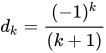 :
:
![{\displaystyle R_{c}=\left[\lim _{k\to \infty }\left|{\frac {\frac {(-1)^{k+1}}{(k+2)}}{\frac {(-1)^{k}}{(k+1)}}}\right|\right]^{-1}=\left[\lim _{k\to \infty }\left|{\frac {(-1)(k+1)}{(k+2)}}\right|\right]^{-1}=\left[\lim _{k\to \infty }\left|{\frac {-1}{1}}\right|\right]^{-1}=1}](../../7cd4a14cdb511abf7e3c8034eb8ea2b23678a9e9.svg)
5. Taylor series about :

Using L'Hospital's rule and (2)p.7-31, and setting 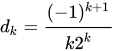 :
:
![{\displaystyle R_{c}=\left[\lim _{k\to \infty }\left|{\frac {\frac {(-1)^{k+2}}{(k+1)2^{k+1}}}{\frac {(-1)^{k+1}}{k2^{k}}}}\right|\right]^{-1}=\left[\lim _{k\to \infty }\left|{\frac {-1k}{2(k+1)}}\right|\right]^{-1}=\left[\lim _{k\to \infty }\left|{\frac {-1}{2}}\right|\right]^{-1}=2}](../../e6e30324a52fa7ec79718228b79c6a2b784f05b6.svg)
Author
This problem is solved and uploaded by Radina Dikova
R5.2
Question
Determine whether the following pairs of functions are linearly independent:


First use the Wronskian method, then use the Gramian method.
Solution
The Wronskian is defined as: 
If 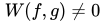 , then the functions f and g are linearly independent.
The Gramian is defined as: 
Where 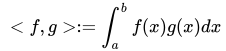
If  , then the functions f and g are linearly independent.
1. Using Wronskian.

Therefore, f and g are linearly independent.
2. Using Wronskian.

Therefore, f and g are linearly independent.
1. Using Gramian with an interval of [-1,1]




Therefore, f and g are linearly independent.
2. Using Gramian with an interval of [-1,1]




Therefore, f and g are linearly independent.
Author
This problem was solved and uploaded by David Herrick.
R5.3
Question
Verify that  and
and  in (1)-(2) p.7-34 are linearly independent using the Gramian
Solution
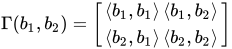
The given Grammian:
|
|
In reference to to (3) on p.8-9
|

|
Calculating the dot products yields:
|

|
|
|

|
|
|

|
|
|

|
Plugging the dot products into the Grammian yields:
|

|
Therefore, b1 and b2 are linearly independent.
Author
Solved and uploaded by Derik Bell
R5.4
Question
Show that:
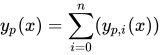
is the particular solution to:

Discuss the choice of particular solutions in the table on p8-3. In other words, for r(x) = kcos(wx), why would you need to have both cos(wx) and sin(wx) in the particular solution?
Solution
For a single excitation that satisfies
 ,
,

for example:



and so on until...
 where by linearity:
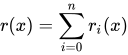
Since  is the solution to a single iteration of r(x) and
  , then by linearity, the solution to r(x) is:
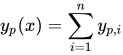
Part 2:
kcos(wx) is a periodic function. As shown by (3) on p8-2, any periodic function can be broken down into a fourier trigonometric series:
![{\displaystyle r(x)=a_{0}+\sum _{n=1}^{\infty }[a_{n}cos(nwx)+b_{n}sin(nwx)]}](../../858d13ad529622b5ebcfb7acfaed39dd0e53bec5.svg)
r(x) can be further broken down as the sum of:

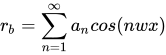
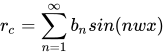
Where 
Since r(x) is expressed in terms of cos(x) and sin(x) the particular solution, which is also a sum of the individual particular solutions for each iteration of  ,
,  , and
, and  , needs to be in terms of sin(x) and cos(x) as well. That applies to all periodic functions as shown on p8-2, which sin(x) is as well. Therefore that justifies why the particular solutions for kcos(wx), ksin(wx),
  , and
, and  must all include both cos(x) and sin(x).
Author
This problem was solved and uploaded by John North.
R5.5
Question
- 1. Show that cos(7x) and sin(7x) are linearly independent using the Wronskian and the Gramian (integrate over 1 period)
- 2. Find 2 equations for the two unknowns M,N and solve for M,N
- 3. Find the overall solution y(x) that corresponds to the initial condition y(0)=1, y'(0)=0. Plot the solution over 3 periods.
Solution
(1)
First, using Wronskian:
- For 2 functions, f and g, the Wrosnkian is defined as

- Where f and g are linearly independent if

- For

- Then,

Therefore, f and g are linearly independent
Second, using Gramian:
- Consider two functions, f and g, where the scalar product is defined as
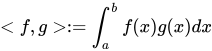
- And the Gramian defined as

- Then f and g are linearly indepdent if

- For f=cos(7x) and g=sin(7x) and integrating over one period (
 )
)
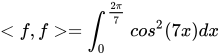
- Letting
 and changing limits of integration by plugging in old limits into "u" equation
![{\displaystyle \displaystyle <f,f>={\frac {1}{7}}\int _{0}^{2\pi }cos^{2}(u)du={\frac {1}{7}}[{\frac {u}{2}}+{\frac {1}{4}}sin2u\mathbf {\mid } _{0}^{2\pi }]={\frac {\pi }{7}}}](../../263cce7ecd18acb9ddad438083778f296463e589.svg)
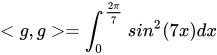
- Letting and changing the limits of integration by plugging in old limits into "u" equations
![{\displaystyle \displaystyle <g,g>={\frac {1}{7}}\int _{0}^{2\pi }sin^{2}(u)du={\frac {1}{7}}[{\frac {u}{2}}-{\frac {1}{4}}sin2u\mid _{0}^{2\pi }]={\frac {\pi }{7}}}](../../97164633c3a9ffc4faef325b4d92790d7a003655.svg)

- From Kreyszig p.479, it is apparent that sin and cos are orthogonal to each other, so the above integration will equal zero

- Plugging in the results of each integral into the Gramian

Therefore, f and g are linearly independent
(2)
- Given

- And particular solutions of the form

- Plug particular solutions back into original ODE and collect like terms


- Equating coefficients
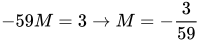
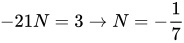
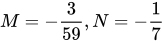
(3)
The overall solution  consists of the particular solution and homogeneous soloution
- Homogeneous solotuion

 so we have distinct real roots
![{\displaystyle \displaystyle \lambda _{1,2}={\frac {1}{2}}[-a\pm {\sqrt {a^{2}-4b}}]={\frac {1}{2}}[3\pm 7]=5,-2}](../../32fd38fa7576045718896b24a05d4d968d62122a.svg)

- Using initial conditions
 and
and 


- Solving the two equations for the two unknowns yields
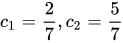

- Particular solution
 where
where 

- Giving us an overall solution of

- Plotting the solution over three periods
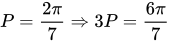
Matlabcode
EDU>> x=0:0.001:(6*pi)/7;
EDU>> y=(2/7).*exp(5.*x)+(5/7).*exp(-2.*x)-(3/59).*cos(7.*x)-(1/7).*sin(7.*x);
EDU>> plot(x,y)
Author
Solved and uploaded by Joshua House
R5.6
Question
Find the solution to the following initial condition problem, and plot it over 3 periods.




Solution
First, we take the first and second derivative of the particular solution:
![{\displaystyle \displaystyle y'_{p}(x)=e^{-2x}(-3Msin(3x)-2Mcos(3x)+3Ncos(3x)-2Nsin(3x))=e^{-2x}[(-3M-2N)sin(3x)+(-2M+3N)cos(3x)]}](../../57e59630b7409a345dd5ea03e26e6d0f9b73fb4c.svg)

![{\displaystyle \displaystyle =2e^{-2x}[(12M-5N)sin(3x)+(13M-12N)cos(3x)]}](../../d81b8e488e32c288d1f54bd36e45d78239afe306.svg)
Now, we plug the particular solution derivatives into the initial equation:
![{\displaystyle \displaystyle 2e^{-2x}[(12M-5N)sin(3x)+(13M-12N)cos(3x)]+4[e^{-2x}[(-3M-2Nsin(3x)+(-2M+3N)cos(3x)]]}](../../95d75df2a5f12657a53a39da5862f3186f89477b.svg)
![{\displaystyle \displaystyle +13[e^{-2x}[Mcos(3x)+Nsin(3x)]]=2e^{-2x}cos(3x)}](../../7f6418320a09c5c1ee69e9763e80550a195079ef.svg)
![{\displaystyle \displaystyle e^{-2x}[(24M-10N)sin(3x)+(26M-24N)cos(3x)+(-12M-8N)sin(3x)+(-8M+12N)cos(3x)+13Mcos(3x)+13Nsin(3x)]}](../../1cea19074022c2229385c5047fb58f026dcbb239.svg)


Now, we equate the coefficients of sin(3x) and cos(3x) to determine the unknown coefficients M and N:


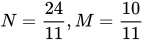
Therefore, the particular solution is:
![{\displaystyle \displaystyle y_{p}(x)=e^{-2x}[{\frac {10}{11}}cos(3x)+{\frac {24}{11}}sin(3x)]}](../../3bb9afdf7616bf58cccd80df8b554b97d149bbb1.svg)
Now, we focus on the homogeneous part of the solution. It is given to us as:
![{\displaystyle \displaystyle y_{h}(x)=e^{-2x}[Acos(3x)+Bsin(3x)]}](../../33b76122f69f374297e69cd0733255c40882d7b3.svg)
As you can see, this is identical to the particular solution, except that M is now A and N is now B. Therefore, the first derivative of the homogenous solution will be in the same form as the first derivative of the particular solution:
![{\displaystyle \displaystyle y'_{h}(x)=e^{-2x}(-3Asin(3x)-2Acos(3x)+3Bcos(3x)-2Bsin(3x))=e^{-2x}[(-3A-2B)sin(3x)+(-2A+3B)cos(3x)]}](../../e97310806a2ca538f50780255d53f3439bf777a1.svg)
Remembering the two initial conditions, y(0) = 1 and y'(0) = 0, we apply these to the homogenous equations:
![{\displaystyle \displaystyle y_{h}(0)=e^{-2x}[Acos(3x)+Bsin(3x)]=1}](../../ffc00dbfda6b2c926f9884abe6d7001a1e53b9db.svg)
![{\displaystyle \displaystyle y'_{h}(x)=e^{-2x}[(-3A-2B)sin(3x)+(-2A+3B)cos(3x)]=0}](../../619688406e79bb47ca01d1ea36d30112ad8d50c8.svg)
This yields two equations that we can use to solve for the coefficients A and B:


Therefore, the homoegenous solution is:
![{\displaystyle \displaystyle y_{h}(x)=e^{-2x}[cos(3x)+{\frac {3}{2}}sin(3x)]}](../../dff17ff2c1c6abd9c59f0c16cd6a120ee0aeb919.svg)
We find the final solution, y(x), by adding the homogenous and particular solutions as seen below:
![{\displaystyle \displaystyle y(x)=y_{h}(x)+y_{p}(x)=e^{-2x}[cos(3x)+{\frac {3}{2}}sin(3x)]+e^{-2x}[{\frac {10}{11}}cos(3x)+{\frac {24}{11}}sin(3x)]}](../../0ecacb10a8174f4c79a42670677353930f528306.svg)
![{\displaystyle \displaystyle y(x)=e^{-2x}[{\frac {21}{11}}cos(3x)+{\frac {81}{22}}sin(3x)]}](../../254db9075f5b197df5ac99cca8b1d36b5819af19.svg)
Matlab Code:
x= 0:0.001:(2*pi/3);
y = exp(-2.*x)*(21/11).*cos(3.*x) + exp(-2.*x)*(81/22).*sin(3.*x);
plot(x,y)
Author
This problem was solved and uploaded by Will Knapper
R 5.7
Question

The oblique basis vectors are:


1. Find the components  using the Gram matrix as in (1)p.8-11.
2. Verify the results by using (1)-(2)p.7c-34 in (2)p8-11, and rely on the non-zero determinant of the matrix of components of  relative to the basis
  , as discussed on p.7c-34.
Solution
1. Using Gram matrix as in (1) p.8-10:
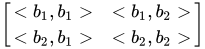
 =
= 
From (3)p.8-9 we know that  . Solving the various components we get:
 =
= 
In order to solve for we need to calculate the inverse of .
This gives is the Gram matrix as used in (1)p.8-11:

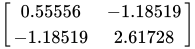 =
=
Thus:

2. Plugging in into  we get:



Separating into components:
 and
and 
Solving the two linearly independent equations we get:


Author
This problem was solved and uploaded by Radina Dikova
R 5.8
Question
Find the integral (see R5.9)
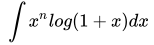
using integration by parts and then with the help of General binomial theorem.
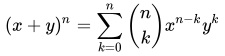

Solution
The indefinite integral of  is
is

For n = 0, we get 
For n = 1, we get 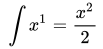
And the indefinite integral of  is
is

Integration by parts
- For n = 0
![{\displaystyle \ \int x^{0}log(1+x)dx=log(1+x)[x+1]-x\ }](../../6f3609807f317cef95c4cdcd1d0d90d3896fdb7a.svg)
- For n = 1
![{\displaystyle \ \int x^{1}log(1+x)dx={\frac {1}{2}}*[(x-log(1+x))+x^{2}log(1+x)-{\frac {x^{2}}{2}}]\ }](../../5e372b7cb59ec182b8614199a2e07058daa0bf49.svg)
Author
Solved and uploaded by
Mike Wallace
R 5.9
Question
Consider the L2-ODE-CC(5)p.7b-7 with log(1+x) as excitation:


and the initial conditions

Part One
Project the excitation r(x) on the polynomial basis
![{\displaystyle \ [b_{j}(x)=x^{j},j=0,1,...,n]\ }](../../0dc72c6a0e4fd696b1058039ce8110ad77653a7a.svg)
i.e., find  such that
r(x) ≈ 
for x in ![{\displaystyle \ [-{\frac {3}{4}},3],\ }](../../bb66d40d4df2c944438f22654e25df8b28a2adeb.svg) and for n = 3, 6, 9
and for n = 3, 6, 9
Plot  to show uniform approximation and convergence
Part Two
In a separate series of plots, compare the approximation of the function log(1+x) by 2 methods:
A. Projection on polynomial basis (1) p.8-17
B. Taylor series expansion about x = 0
Observe and discuss the pros and cons of each method
Find  such that:

with the same initial conditions (2) p.7c-28
Plot for n = 3, 6, 9, for x in ![{\displaystyle \ [-{\frac {3}{4}},3].\ }](../../688918f3fdad89b20488740db39ba67f3bdfc4a6.svg)
In a series of separate plots, compare the results obtained with the projected excitation on polynomial basis to those with truncated Taylor series of the excitation. Plot also the numerical solution as a baseline for comparison.
Solution
Using

For n = 0










Subtracting Y from Y' in order to find the coefficients



For n = 0 the final solution will be

For n = 1

We need to find the homogeneous Y




Solving for the initial conditions



This gives coefficients of:

For n = 1 the final solution will be;

Author
This problem was solved and uploaded by
Mike Wallace
Contribution Summary
Problem 2 was solved and Problem 5 was proofread by David Herrick
Problem 5 was solved and uploaded by Joshua House
Problems 1 and 7 were solved and uploaded by Radina Dikova
Problem 3 was solved and uploaded by Derik Bell
Problem 4 was solved and uploaded by John North
Problem 8 and 9 were solved and uploaded by
Mike Wallace
Problem 6 was solved and uploaded by William Knapper