Showed card game. Introduced Studyguide. Did first quiz on motion. Don't sweat these calculations if you can't do them. You have other ways to succeed in this class.
T 29 August 2017 (UTC)
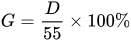
Attendance policy: Allowed to miss 15 days without penalty. Nominally, you must attend 60 days to get 100%.
and D is the days that you attend, OR 55 if you attend more than 55 days.
Polarizing filters. Maybe do another wikiquiz.
T 5 September 2017 Syllabus
Test prep: Questions 1-14 of second quiz Special:Permalink/1415990 has been discussed. (quiz called "velocity and acceleration"
{{cot|[[Physics and Astronomy Labs/Uniform acceleration tapping basketball with spitwads#How_Things_Work_Lake_Campus_Fall_17|Hidden transclusion <sup>--click to visit</sup> ]] .. click bar to see or hide}}

{{#lst:Physics and Astronomy Labs/Uniform acceleration tapping basketball with spitwads}}
{{cob}}
Go to Studyguide: 7/16 from 1409885 to b_waves_PC. Also: NOT ON THIS TEST: What happens to the wavelength on a wave on a stretched string if the wave passes from lightweight (low density) region of the rope to a heavy (high density) rope? Question 14 on studyguide.
1 Newtwon wrote in code. Much of his personal writings were never really understood as late as 1937.
2 3 4
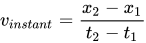
5 An apple speeds up as it falls. At every instant in time it seems to have a certain speed. How do you mathematically describe this "instantaneous" velocity?
when the two times are nearly the same. See also File:Tangent as Secant Limit.svg
6 7 8 9 10 11 12 13 14 15 16
Wed oct 4 newton's cannon
File:Bisection_method.svg and wikipedia:Bisection method and Newton's cannon
" 4 October 2017 At 6250 we missed the center of the cannon by approximately on ball diameter. At 6200 it seemed to go higher. The for this second one was 3min32sec=212sec
Measure distance "as crow flies" for v = 1000 and 4000 m/s.
Predict distance for v=2000. Make a sketch showing how a graph and similar triangles would permit you to find a formula. You can also get the formula by something called Regression_analysis
Measure and calculate Big/Small and also percent error. The latter is (Measured−True)/True. You can report Big/Small as off by a factor of .... For small errors (less than about 10% or so, they essentially give the same information).
Fit your three points to a parabola. It's best not to use Excel curve fit. There is an Excel extension, but it is more convenient to search the internet for "regression" fitting.
Now use your parabola to predict the distance for v=3000. Measure and compare as before.
We collected this data (USING A REDUCED IMAGE ON THE SCREEN):
initial
speed  DISTANCE
m/s     CM
1000	7.2
4000	36.9
2000	12.4
3000	19.9
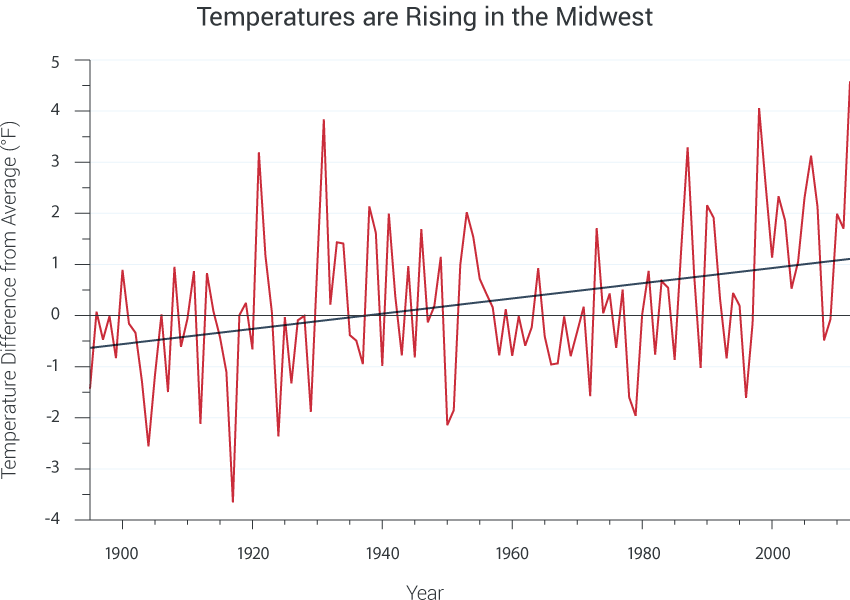
nationalgeographi.com (google) Average temperatures have climbed 1.4 degrees Fahrenheit (0.8 degree Celsius) around the world since 1880.
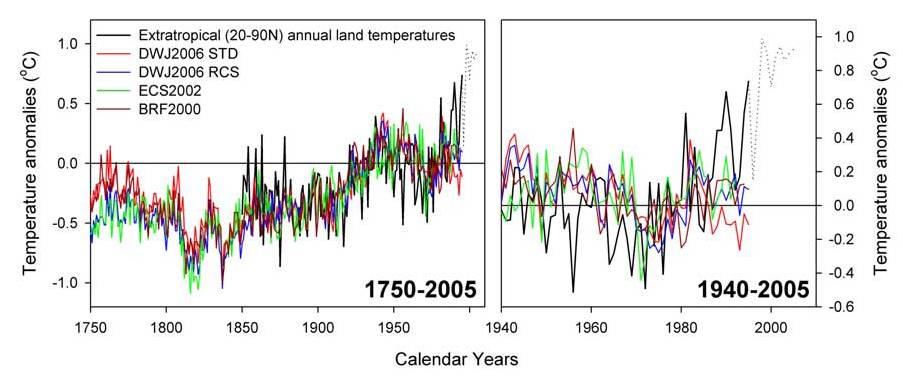
Summary of findings - Muller (berkeleyearth.org) The analysis shows that the rise in average world land temperature globe is approximately 1.5 degrees C in the past 250 years, and about 0.9 degrees in the past 50 years.
Goal: Find the so-called "parabolic" curve File:Kepler_orbits.svg. Or more precisely, be able to predict periods for near-parabolic ellipses by extraplating. Let y=1/t, where t is the time to crash, and do a fit for y=y(v), where v is the initial speed. Data


_Experiment_to_illustrate_inertia.jpg)