Overview
The w:Four-current is the four-dimensional analogue of the w:electric current density

where c is the w:speed of light,  the four-velocity, ρ is the w:charge density,
  the rest charge density , and j the conventional w:current density. Alternatively, it can be defined in terms of the inhomogeneous Maxwell equations as the negative product of the D'Alembert operator and the electromagnetic potential
  , or the four-divergence of the electromagnetic tensor
  :
:
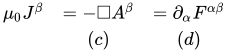
and the generally covariant form
![{\displaystyle (e)\ J^{\mu }=\partial _{\nu }{\mathcal {D}}^{\mu \nu },\ \left[{\mathcal {D}}^{\mu \nu }\,=\,{\frac {1}{\mu _{0}}}\,g^{\mu \alpha }\,F_{\alpha \beta }\,g^{\beta \nu }\,{\sqrt {-g}}\right]}](../b2964d2a492b2dbee537e042cea0b603655649e6.svg)
The Lorentz transformation of the four-potential components was given by #Poincaré (1905/6) and #Marcolongo (1906). It was explicitly formulated in modern form by #Minkowski (1907/15) and reformulated in different notations by #Born (1909), #Bateman (1909/10), #Ignatowski (1910), #Sommerfeld (1910), #Lewis (1910), Wilson/Lewis (1912), #Von Laue (1911), #Silberstein (1911). The generally covariant form was first given by #Kottler (1912) and #Einstein (1913).
Historical notation
Poincaré (1905/6)
w:Henri Poincaré (June 1905[R 1]; July 1905, published 1906[R 2]) showed that the four quantities related to charge density  are connected by a Lorentz transformation:
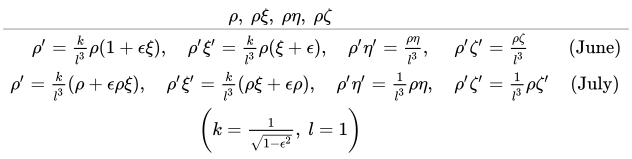
and in his July paper he further stated the continuity equation and the invariance of Jacobian D:[R 3]

Even though Poincaré didn't directly use four-vector notation in those cases, his quantities are the components of four-current (a).
Marcolongo (1906)
Following Poincaré, w:Roberto Marcolongo defined the general Lorentz transformation  of the components of the four independent variables
  and its continuity equation:[R 4]
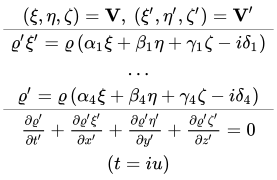
equivalent to the components of four-current (a), and pointed out its relation to the components  of the four-potential

equivalent to the components of Maxwell's equations (b).
Minkowski (1907/15)
w:Hermann Minkowski from the outset employed vector and matrix representation of four-vectors and six-vectors (i.e. antisymmetric second rank tensors) and their product. In a lecture held in November 1907, published 1915, Minkowski defined the four-current in vacuum with  as charge density and
  as velocity:[R 5]

equivalent to (a), and the electric four-current in matter with  as current and
  as charge density:[R 6]

In another lecture from December 1907, Minkowski defined the “space-time vector current” and its Lorentz transformation[R 7]
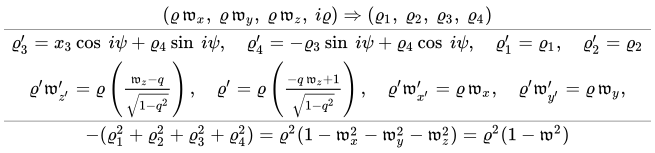
equivalent to (a). In moving media and dielectrics, Minkowski more generally used the current density vector “electric current”  which becomes
  in isotropic media:[R 8]

Born (1909)
Following Minkowski, w:Max Born (1909) defined the “space-time vector of first kind” (four-vector) and its continuity equation[R 9]
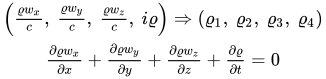
equivalent to (a), and pointed out its relation to Maxwell's equations as the product of the D'Alembert operator with the electromagnetic potential  :
:

equivalent to (c). He also expressed the four-current in terms of rest charge density and four-velocity
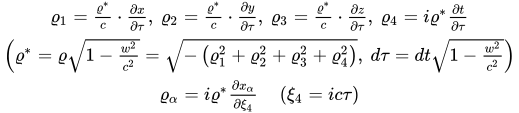
equivalent to (b).
Bateman (1909/10)
A discussion of four-current in terms of integral forms (even though in the broader context of w:spherical wave transformations), was given by w:Harry Bateman in a paper read 1909 and published 1910, who defined the Lorentz transformations of its components  [R 10]
![{\displaystyle \rho w_{x}=\beta (\rho 'w'-v\rho '),\ \rho w_{y}=\rho 'w'_{y},\ \rho w_{z}=\rho 'w'_{z},\ -\rho =\beta (v\rho 'w'_{x}-\rho '),\ \left[\beta ={\frac {1}{\sqrt {1-v^{2}}}}\right]}](../e96ee13b6b778066353fad73467159a5650ed727.svg)
forming the following invariant relations together with the differential four-position and four-potential:[R 11]
![{\displaystyle {\begin{matrix}{\frac {1}{\lambda ^{2}}}\left[\rho w_{x}dx+\rho w_{y}dy+\rho w_{z}dz-\rho dt\right]\\{\frac {\rho ^{2}}{\lambda ^{2}}}\left(1-w^{2}\right)dx\ dy\ dz\ dt\\\rho \left[A_{x}w_{x}+A_{y}w_{y}+A_{z}w_{z}-\Phi \right]dx\ dy\ dz\ dt\end{matrix}}}](../5b705177419a41f15dc3f638896188709a6c4e27.svg)
with  in relativity.
Ignatowski (1910)
w:Wladimir Ignatowski (1910) defined the “vector of first kind” using charge density and three-velocity :[R 12]
![{\displaystyle {\begin{matrix}\left(\varrho {\mathfrak {v}},\ \varrho \right)\\\hline \left[\varrho {\sqrt {1-n{\mathfrak {v}}^{2}}}=\varrho '{\sqrt {1-n{\mathfrak {v}}^{\prime 2}}}=\varrho _{0}\right]\end{matrix}}}](../42ae8fb604f7b920bff1830597edae1d9bf4e48f.svg)
equivalent to four-current (a).
Sommerfeld (1910)
In influential papers on 4D vector calculus in relativity, w:Arnold Sommerfeld defined the four-current P, which he called four-density (Viererdichte):[R 13]
![{\displaystyle {\begin{matrix}P_{x}=\varrho {\frac {{\mathfrak {v}}_{x}}{c}},\ P_{y}=\varrho {\frac {{\mathfrak {v}}_{y}}{c}},\ P_{z}=\varrho {\frac {{\mathfrak {v}}_{z}}{c}},\ P_{l}=i\varrho \\\hline \beta ^{2}={\frac {1}{c^{2}}}\left({\mathfrak {v}}_{x}^{2}+{\mathfrak {v}}_{y}^{2}+{\mathfrak {v}}_{z}^{2}\right)\quad \Rightarrow \quad \left|P\right|=i\varrho {\sqrt {1-\beta ^{2}}}\\{}[l=ict]\end{matrix}}}](../2cc52f7aca71fafcbcee37a7bf6206ea0bfb1085.svg)
equivalent to (a). In the second paper he pointed out its relation to four-potential  and the electromagnetic tensor (six-vector) f together with the continuity condition:[R 14]
![{\displaystyle {\begin{matrix}{\begin{aligned}P&={\mathfrak {Div}}\mathrm {Rot} \ \Phi ={\mathfrak {Div}}\ f\\-P&=\square \Phi ,\ (\mathrm {Div} \ \Phi =0)\\\mathrm {Div} \ P&=0\end{aligned}}\\\left[{\begin{aligned}\mathrm {Rot} &={\text{exterior product}}\\\mathrm {Div} &={\text{divergence four-vector}}\\{\mathfrak {Div}}&={\text{divergence six-vector}}\\\square &={\text{D'Alembert operator}}\end{aligned}}\right]\end{matrix}}}](../1a87f1399835d10e2b3df93ae391d24fcc34400d.svg)
equivalent to Maxwell's equations (c). The scalar product with the four-potential[R 15]

he called “electro-kinetic potential” whereas the vector product with the electromagnetic tensor[R 16]

he called the electrodynamic force (four-force density).
Lewis (1910), Wilson/Lewis (1912)
w:Gilbert Newton Lewis (1910) devised an alternative 4D vector calculus based on w:Dyadics which, however, never gained widespread support. The four-current is a “1-vector”:[R 17]
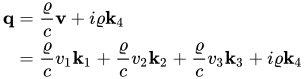
equivalent to (a) and its relation to the four-potential  and electromagnetic tensor
  :
:
![{\displaystyle {\begin{matrix}{\begin{aligned}\lozenge \lozenge \times \mathbf {m} &=\mathbf {q} \\\lozenge \mathbf {M} &=\mathbf {q} \\\lozenge ^{2}\mathbf {m} &=-\mathbf {q} \end{aligned}}\\{\begin{aligned}\left({\frac {\partial H_{12}}{\partial x_{2}}}+{\frac {\partial H_{13}}{\partial x_{3}}}+{\frac {\partial E_{14}}{\partial x_{4}}}\right)\mathbf {k} _{1}&={\frac {\varrho }{c}}v_{1}\mathbf {k} _{1}\\\left({\frac {\partial H_{21}}{\partial x_{1}}}+{\frac {\partial H_{23}}{\partial x_{3}}}+{\frac {\partial E_{24}}{\partial x_{4}}}\right)\mathbf {k} _{2}&={\frac {\varrho }{c}}v_{2}\mathbf {k} _{2}\\\left({\frac {\partial H_{31}}{\partial x_{1}}}+{\frac {\partial H_{32}}{\partial x_{2}}}+{\frac {\partial E_{34}}{\partial x_{4}}}\right)\mathbf {k} _{3}&={\frac {\varrho }{c}}v_{3}\mathbf {k} _{3}\\\left({\frac {\partial H_{41}}{\partial x_{1}}}+{\frac {\partial H_{42}}{\partial x_{2}}}+{\frac {\partial E_{43}}{\partial x_{4}}}\right)\mathbf {k} _{4}&={\frac {\varrho }{c}}i\mathbf {k} _{4}\end{aligned}}\\\left[{\begin{matrix}\lozenge =\mathbf {k} _{1}{\frac {\partial }{\partial x_{1}}}+\mathbf {k} _{2}{\frac {\partial }{\partial x_{2}}}+\mathbf {k} _{3}{\frac {\partial }{\partial x_{3}}}+\mathbf {k} _{4}{\frac {\partial }{\partial x_{4}}}\\\lozenge ^{2}={\frac {\partial ^{2}}{\partial x_{1}}}+{\frac {\partial ^{2}}{\partial x_{2}}}+{\frac {\partial ^{2}}{\partial x_{3}}}+{\frac {\partial ^{2}}{\partial x_{4}}}\end{matrix}}\right]\end{matrix}}}](../f9239b8e6070cf8c1c2d86e720f6dcaabcc76e19.svg)
equivalent to (c,d).
In 1912, Lewis and w:Edwin Bidwell Wilson used only real coordinates, writing the above expressions as[R 18]
![{\displaystyle {\begin{matrix}{\begin{aligned}\lozenge \cdot \mathbf {M} &=4\pi \mathbf {q} \\\lozenge ^{2}\mathbf {m} &=-4\pi \mathbf {q} \end{aligned}}\\\left[{\begin{matrix}\lozenge =\mathbf {k} _{1}{\frac {\partial }{\partial x_{1}}}+\mathbf {k} _{2}{\frac {\partial }{\partial x_{2}}}+\mathbf {k} _{3}{\frac {\partial }{\partial x_{3}}}-\mathbf {k} _{4}{\frac {\partial }{\partial x_{4}}}\\\lozenge ^{2}={\frac {\partial ^{2}}{\partial x_{1}}}+{\frac {\partial ^{2}}{\partial x_{2}}}+{\frac {\partial ^{2}}{\partial x_{3}}}-{\frac {\partial ^{2}}{\partial x_{4}}}\end{matrix}}\right]\end{matrix}}}](../291b0d3d6dd39457915009aaea1f6012415acab6.svg)
equivalent to (c,d).
Von Laue (1911)
In the first textbook on relativity in 1911, w:Max von Laue elaborated on Sommerfeld's methods and explicitly used the term “four-current” (Viererstrom) of density in relation to four-potential and electromagnetic tensor  :[R 19]
![{\displaystyle {\begin{matrix}P\Rightarrow \left(P_{x}={\frac {\varrho {\mathfrak {q}}_{x}}{c}},\ P_{y}={\frac {\varrho {\mathfrak {q}}_{y}}{c}},\ P_{z}={\frac {\varrho {\mathfrak {q}}_{z}}{c}},\ P_{l}=i\varrho \right)\\\hline {\begin{aligned}P&=\varDelta iv\ ({\mathfrak {M}})\\-P&=\square \Phi \ (Div\ \Phi =0)\\Div\ (P)&=0\end{aligned}}\\\left[{\begin{aligned}{\mathfrak {Rot}}&={\text{exterior product}}\\Div&={\text{divergence four-vector}}\\\varDelta iv&={\text{divergence six-vector}}\\\square &={\text{D'Alembert operator}}\end{aligned}}\right]\end{matrix}}}](../12bb0bd7aa4c4e679078a93384fa2109484264dc.svg)
equivalent to (a,c,d). He went on to define four-force density F as vector-product with , four-convection K and four-conduction  using four-velocity Y:[R 20]
![{\displaystyle {\begin{matrix}F=[P{\mathfrak {M}}],\ (PF)=(P[P{\mathfrak {M}}])=0\\K=-(YP)Y\\\Lambda =P+(YP)Y\end{matrix}}}](../29b4d360a57ac29ffef655a8954bf841f6e1abef.svg) ,
,
Silberstein (1911)
w:Ludwik Silberstein devised an alternative 4D calculus based on w:Biquaternions which, however, never gained widespread support. He defined the “current-quaternion” (i.e. four-current) C and its relation to the “electromagnetic bivector” (i.e. field tensor)  and “potential-quaternion” (i.e. four-potential) [R 21]
![{\displaystyle {\begin{matrix}{\begin{aligned}\mathrm {C} &=\rho \left(\iota +{\frac {1}{c}}\mathbf {p} \right)\\&=\iota \rho {\frac {dq}{dl}}\\\mathrm {C} &=\mathrm {D} \mathbf {F} =-\Box \Phi \\\mathrm {S} \mathrm {D} _{c}\mathrm {C} &=0\end{aligned}}\\\left[\mathrm {D} ={\frac {\partial }{\partial l}}-\nabla ,\ \mathrm {D} \mathrm {D} _{c}=\Box ={\frac {\partial ^{2}}{\partial x^{2}}}+{\frac {\partial ^{2}}{\partial y^{2}}}+{\frac {\partial ^{2}}{\partial z^{2}}}+{\frac {\partial ^{2}}{\partial l^{2}}}\right]\end{matrix}}}](../dec4048f09cfb19e952288dcd30e2b86b8f70f16.svg)
Kottler (1912)
w:Friedrich Kottler defined the four-current  and its relation to four-velocity
  , four-potential , four-force
  , electromagnetic field-tensor
  , stress-energy tensor
  :[R 22]
![{\displaystyle {\begin{matrix}P^{(1)}=\rho {\frac {{\mathfrak {v}}_{x}}{c}}=i\rho _{0}V^{(1)},\ P^{(2)}=\rho {\frac {{\mathfrak {v}}_{y}}{c}}=i\rho _{0}V^{(2)},\ P^{(3)}=\rho {\frac {{\mathfrak {v}}_{z}}{c}}=i\rho _{0}V^{(3)},\ P^{(4)}=i\rho =i\rho _{0}V^{(4)}\\\hline \sum _{h=1}^{4}{\frac {\partial F_{gh}}{\partial x^{(h)}}}=\mathbf {P} ^{(g)},\ \Box \Phi _{\alpha }=-\mathbf {P} ^{(\alpha )}\\F_{\alpha }(y)=\sum _{\beta }{\frac {F_{\alpha \beta }(y)\mathbf {P} ^{(\beta )}(y)}{\sqrt {1-{\mathfrak {w}}^{2}/c^{2}}}}\\\left[{\underset {\beta }{\sum }}F_{\alpha \beta }(y)\mathbf {P} ^{(\beta )}(y)={\underset {\beta }{\sum }}F_{\alpha \beta }(y){\underset {\gamma }{\sum }}{\frac {\partial }{\partial y^{(\gamma )}}}F_{\beta \gamma }(y)={\underset {\beta }{\sum }}{\frac {\partial }{\partial y^{(\beta )}}}S_{\alpha \beta },\ \rho _{0}=\rho {\sqrt {1-{\mathfrak {v}}^{2}/c^{2}}}\right]\end{matrix}}}](../8102a66a4b1ca33589669fd5c0940f5df20a280c.svg)
equivalent to (a,b,c,d) and subsequently was the first to give the generally covariant formulation of Maxwell's equations using metric tensor  [R 23]
![{\displaystyle {\begin{matrix}\sum c^{(1\alpha )}\sum _{\beta ,\gamma }c^{(\beta \gamma )}\Phi _{\alpha /\beta \gamma }=-\mathbf {P} ^{(\alpha )}\ {\text{etc}}.\\\left[\sum _{\beta ,\gamma }c^{(\beta \gamma )}\Phi _{\beta /\gamma }=0\right]\end{matrix}}}](../512a89f450c3f89ee5795d491e6fc0e5931dbfe4.svg)
equivalent to (e).
Einstein (1913)
Independently of Kottler (1912), w:Albert Einstein defined the general covariant four-current in the context of his Entwurf theory (a precursor of general relativity):[R 24]
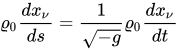
equivalent to (a), and the generally covariant formulation of Maxwell's equations
![{\displaystyle {\begin{matrix}\sum _{\nu }{\frac {\partial }{\partial x_{\nu }}}\left({\sqrt {-g}}\cdot \varphi _{\mu \nu }\right)=\varrho _{0}{\frac {dx_{\mu }}{dt}}\\\hline {\begin{aligned}{\frac {\partial {\mathfrak {H}}_{x}}{\partial y}}-{\frac {\partial {\mathfrak {H}}_{y}}{\partial z}}-{\frac {\partial {\mathfrak {E}}_{x}}{\partial t}}&=u_{x}\\\dots \\\dots \\{\frac {\partial {\mathfrak {E}}_{x}}{\partial x}}+{\frac {\partial {\mathfrak {E}}_{y}}{\partial z}}+{\frac {\partial {\mathfrak {E}}_{x}}{\partial z}}&=\varrho \end{aligned}}\\\left[\varrho _{0}{\frac {dx_{\mu }}{dt}}=u_{\mu }\right]\end{matrix}}}](../70ead9d63958d0146c7f80dfd787f363557e2109.svg)
equivalent to (e) in the case of  being the Minkowski tensor.
Historical sources
- ↑ Poincaré (1905a), p. 1505
- ↑ Poincaré (1905b), p. 133–134
- ↑ Poincaré (1905b), p. 134
- ↑ Marcolongo (1906), p. 348-349
- ↑ Minkowski (1907/15), p. 929
- ↑ Minkowski (1907/15), p. 933
- ↑ Minkowski (1907/8), p. 57, 60, 67
- ↑ Minkowski (1907/8), p. 71
- ↑ Born (1909), p. 573-574, 576-577
- ↑ Bateman (1910), p. 241
- ↑ Bateman (1910), p. 252
- ↑ Ignatowsky (1910), p. 24-25
- ↑ Sommerfeld (1910a), p. 751
- ↑ Sommerfeld (1910b), p. 651
- ↑ Sommerfeld (1910a), p. 764
- ↑ Sommerfeld (1910a), p. 770
- ↑ Lewis (1910), p. 176ff
- ↑ Wilson & Lewis (1910), p. 488ff
- ↑ Laue (1911), p. 77f, 100f
- ↑ Laue (1911), p. 80, 102, 119
- ↑ Silberstein (1911), p. 796, 801f
- ↑ Kottler (1912), p. 1661, 1686ff
- ↑ Kottler (1912), p. 1688-1689
- ↑ Einstein & Grossmann (1913), p. 241
 See also the transcription The Transformation of the Electrodynamical Equations on English Wikisource
- Born, M. (1909), "Die träge Masse und das Relativitätsprinzip", Annalen der Physik, 333 (3): 571–584
- Einstein, A. & Grossmann, M. (1913), "Entwurf einer verallgemeinerten Relativitätstheorie und eine Theorie der Gravitation", Zeitschrift für Mathematik und Physik, 62: 225–261
{{citation}}: CS1 maint: multiple names: authors list (link)
- Herglotz, G. (1904), "Über die Berechnung retardierter Potentiale", Gött. Nachr. (6): 549–556
- Ignatowsky, W. v. (1910), "Das Relativitätsprinzip", Archiv der Mathematik und Physik 17: 1-24, 18: 17-40
- See also the transcription Das Relativitätsprinzip on German Wikisource
- See also the transcription On the spacetime lines of a Minkowski world on English Wikisource
- Laue, M. v. (1911), Das Relativitätsprinzip, Braunschweig: Vieweg
- Lewis, G. N. (1910), "On Four-Dimensional Vector Analysis, and Its Application in Electrical Theory", Proceedings of the American Academy of Arts and Sciences, 43 (7): 165–181
- Lewis, G. N. & Wilson, E. B. (1912), "The Space-time Manifold of Relativity. The Non-Euclidean Geometry of Mechanics and Electromagnetics", Proceedings of the American Academy of Arts and Sciences, 48: 387–507
{{citation}}: CS1 maint: multiple names: authors list (link)
- Marcolongo, R. (1906), "Sugli integrali delle equazioni dell'elettrodinamica" (PDF), Atti della Reale Accademia dei Lincei Rendiconti, 15: 344–349
- Minkowski, H. (1915) [1907], "Das Relativitätsprinzip", Annalen der Physik, 352 (15): 927–938
- See also the transcription Das Relativitätsprinzip on German Wikisource
- See also the transcription Die Grundgleichungen für die elektromagnetischen Vorgänge in bewegten Körpern on German Wikisource
- See also the transcription The Fundamental Equations for Electromagnetic Processes in Moving Bodies on English Wikisource
- Poincaré, H. (1905), "Sur la dynamique de l'électron", Comptes Rendus, 140: 1504–1508
- See also the transcription Sur la dynamique de l’électron on French Wikisource
- See also the transcription On the Dynamics of the Electron on English Wikisource
- Poincaré, H. (1906) [1905], "Sur la dynamique de l'électron", Rendiconti del Circolo Matematico di Palermo, 21: 129–176
- See also the transcription Sur la dynamique de l’électron on French Wikisource
- See also the transcription On the Dynamics of the Electron on English Wikisource
- Silberstein, L. (1912) [1911], "Quaternionic form of relativity", The London, Edinburgh, and Dublin Philosophical Magazine and Journal of Science, 23 (137): 790–809, doi:10.1080/14786440508637276
- Sommerfeld, A. (1910a), "Zur Relativitätstheorie I: Vierdimensionale Vektoralgebra", Annalen der Physik, 337 (9): 749–776
- See also the transcription On the Theory of Relativity I: Four-dimensional Vector Algebra on English Wikisource
- See also the transcription On the Theory of Relativity II: Four-dimensional Vector Analysis on English Wikisource